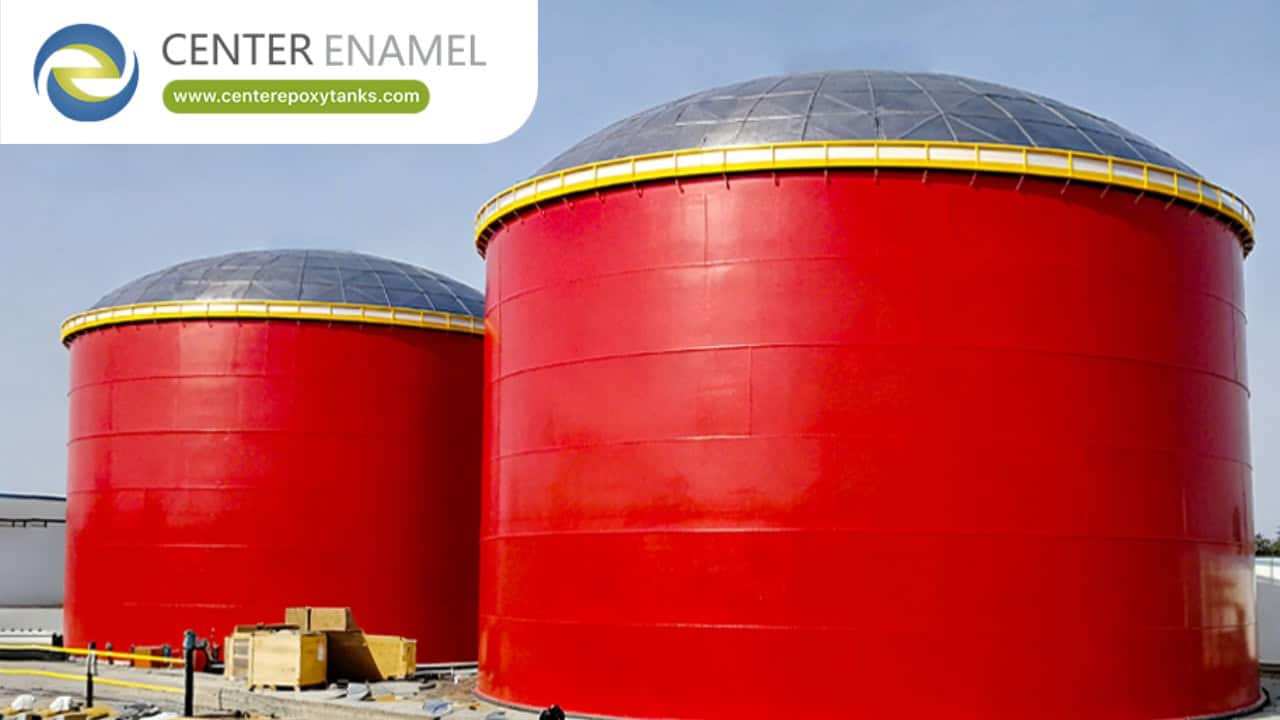
Welded Stainless Steel Fuel Oil Storage Tanks: Engineering & Design Guide
For industrial fuel oil management—whether for power generation, marine bunkering, or commercial heating—the containment vessel is the most critical asset. Center Enamel provides global solutions for welded stainless steel fuel storage, engineered to prevent contamination, withstand chemical stress, and exceed international safety requirements.
1. Why Stainless Steel for Fuel Storage?
While carbon steel is common, welded stainless steel tanks provide significant long-term performance advantages for fuel oil containment:
Purity Retention: Stainless steel does not rust. This prevents the formation of iron oxide flakes that can clog fuel filters, damage injection pumps, and compromise the combustion process in generators or boilers.
Superior Corrosion Resistance: Stainless steel alloys (SS304/316L) naturally resist the chemical components of refined fuels and biodiesel blends, extending the tank’s service life significantly.
Lower Life-Cycle Maintenance: Unlike carbon steel, which requires heavy-duty internal epoxy coatings that eventually degrade, stainless steel maintains its passive protective layer indefinitely.
2. Global Standards & Manufacturing Compliance
Fuel oil containment is a highly regulated field. Center Enamel engineers every tank to comply with the project’s local and international safety standards, ensuring full insurance and environmental compliance.
API 650: The gold standard for welded steel tanks for oil storage, ensuring structural integrity under various load conditions.
UL 142: Standards for steel aboveground storage tanks for flammable and combustible liquids, critical for site safety and environmental protection.
Material Certification: Every tank is fabricated using certified 304 or 316L stainless steel, accompanied by full Mill Test Certificates (MTCs) to guarantee the metallurgical composition.
3. The Center Enamel Advantage
Center Enamel is not just a manufacturer; we are a partner in your infrastructure project. Our manufacturing process integrates:
Precision Welding: We utilize advanced TIG/MIG/Plasma welding techniques with dedicated stainless steel filler materials to ensure the weld zone is as corrosion-resistant as the base metal.
Post-Weld Treatment: Every welded joint undergoes passivation and pickling to restore the chromium-oxide protective layer, ensuring no weak points in the stainless structure.
Non-Destructive Testing (NDT): We employ rigorous radiographic (X-ray) and ultrasonic testing on all critical seams to guarantee a 100% leak-proof structure before shipping.
4. Technical Comparison: Fuel Storage Materials
Feature | Welded Stainless Steel | Welded Carbon Steel | Bolted/GFS Tanks |
Corrosion Resistance | Excellent | Moderate (needs coating) | Low (for fuel) |
Maintenance | Minimal | High (re-coating required) | Not recommended for fuel |
Fuel Purity | High (no rust risk) | Moderate (risk of scaling) | N/A |
Fabrication | High precision/Custom | Standard | Modular |
5. Frequently Asked Questions (FAQ)
Q: Can your stainless steel fuel tanks store bio-diesel or high-sulfur oils?
A: Yes. Stainless steel, particularly 316L grade, is highly resistant to the acidic components found in certain biofuels and blends, making it a safer and more durable choice than carbon steel for modern fuel mixtures.
Q: What is the lead time for custom welded fuel tanks?
A: Lead time depends on capacity, wall thickness, and international certification requirements. As an experienced exporter, Center Enamel optimizes production workflows to ensure timely delivery for global industrial projects.
Q: Do your tanks come with leak detection systems?
A: We can integrate double-wall tank designs, interstitial monitoring, and high-precision level sensors to ensure your facility meets strict environmental containment regulations (such as SPCC rules).
Q: Does Center Enamel assist with international logistics?
A: Absolutely. We have extensive experience in export packaging for ocean freight, ensuring that tanks arrive at your site in perfect condition. We also provide full assembly and installation manuals, with optional on-site supervisor deployment.
Q: How do I request a technical proposal for a fuel storage project?
A: Please submit your site requirements, including the type of fuel, required capacity (m³ or gallons), local seismic conditions, and any specific safety certifications (UL, API, etc.) required by your project stakeholders. Our engineering team will provide a tailored technical solution.


