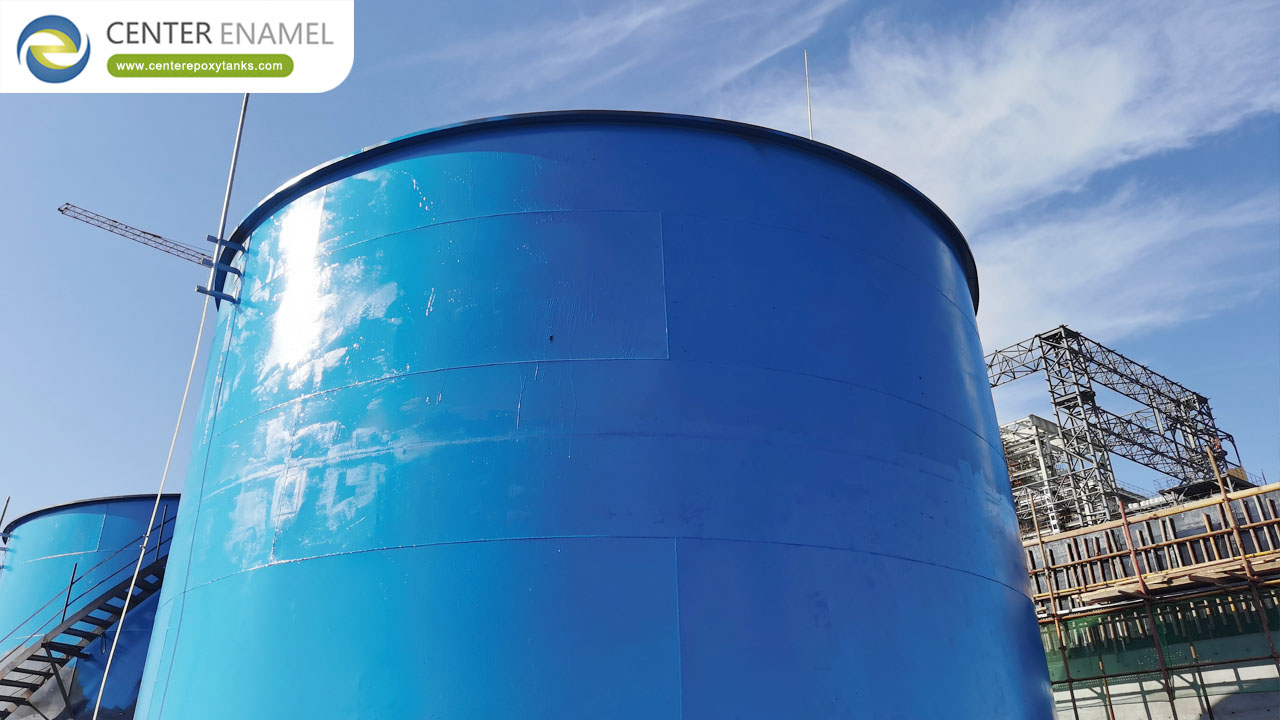
A Professional China Welded Carbon Steel Fuel Storage Tanks Manufacturer | Center Enamel
In the global oil, gas, and petrochemical sectors, the safe containment of volatile hydrocarbons—ranging from crude oil and diesel to aviation turbine fuel and gasoline—requires absolute structural integrity. Selecting the right containment vessel is a critical engineering decision that dictates terminal safety, environmental compliance, and long-term operational continuity.
When projects demand monolithic strength, high-pressure tolerance, and absolute leak prevention under severe industrial conditions, monolithic welded steel tanks represent the gold standard. As a premier industrial storage expert with over three decades of global manufacturing experience, Shijiazhuang Zhengzhong Technology Co., Ltd. (Center Enamel) stands out as a leading welded carbon steel fuel storage tanks manufacturer in China, delivering precision-engineered solutions tailored to rigorous international specifications.
Engineering Excellence in Welded Carbon Steel Construction
Center Enamel combines decades of fabrication mastery with advanced automation to engineer fuel storage tanks that excel in demanding environments. Unlike modular tanks, welded carbon steel structures provide a seamless, continuous shell capable of withstanding shifting internal loads, high specific gravities, and dynamic environmental forces.
Strict Compliance with Global Standards: Every fuel tank is engineered, fabricated, and tested in strict accordance with major international codes, including API 650 (Welded Tanks for Oil Storage), API 620, AWWA D100, and fire safety guidelines such as NFPA 30.
Advanced Certified Welding Protocols: Center Enamel employs automated and semi-automated welding processes—including Submerged Arc Welding (SAW) and Gas Metal Arc Welding (GMAW)—executed by ASME- and AWS-certified welding professionals. This guarantees deep, consistent penetration and eliminates point failures.
Rigorous Non-Destructive Testing (NDT): To ensure zero defects, welded seams undergo exhaustive quality checks, including ultrasonic testing (UT), radiographic testing (RT), magnetic particle inspection (MPI), and vacuum box testing.
Technical Performance Matrix: Industrial Fuel Storage Solutions
Technical Parameter | Center Enamel Monolithic Welded Carbon Steel Tanks | Modular Bolted Steel Tanks | Cast-in-Place Concrete Containment Reservoirs |
Structural Pressure & Vacuum Tolerance | High tolerance for internal vapor pressures and vacuum relief conditions | Moderate pressure limits governed by panel flange and gasket design | Limited to low-pressure or atmospheric operational windows |
Monolithic Seam Integrity | 100% full-penetration welded seams designed for high-risk hydrocarbons | Bolted mechanical seams requiring specialized elastomer gaskets | Monolithic concrete prone to micro-cracking and chemical seepage over time |
Corrosion & Lining Compatibility | Customizable multi-layer industrial coating systems compliant with ISO 12944 | Factory-applied epoxy or glass-fused-to-steel coatings | Requires specialized interior chemical membranes to prevent fuel contamination |
Primary Industrial Applications | Crude oil, diesel reserves, gasoline, jet fuel (Jet A/A-1), and biofuels | Potable water, municipal wastewater, agricultural water | Large-volume water reservoirs and wastewater basins |
Advanced Coating Systems for Hydrocarbon Preservation
Fuel purity and corrosion defense are inseparable. Hydrocarbons can interact with unprotected steel, causing rust flaking, particulate contamination, and microbiologically influenced corrosion (MIC). Center Enamel applies scientifically calibrated protective lining systems:
Surface Preparation: Steel plates undergo abrasive blasting to a near-white metal finish (Sa 2.5) to ensure optimal mechanical anchor profiles.
Specialized Internal Linings: Multi-component epoxy and phenolic resin systems are applied in climate-controlled environments to resist aromatic hydrocarbons, ethanol blends, and sulfur compounds without shedding particulates.
External Marine-Grade Coatings: Designed to withstand C5-M coastal and severe industrial atmospheres, protecting the tank exterior against weathering and atmospheric oxidation.
Frequently Asked Questions (FAQ)
Q: What international standards do Center Enamel welded carbon steel fuel tanks comply with?
A: Center Enamel's welded fuel tanks are engineered and manufactured in strict compliance with global petroleum standards, including API 650, API 620, AWWA D100, and fire protection codes such as NFPA 30 and NFPA 407.
Q: Why choose a welded carbon steel tank over a bolted tank for fuel storage?
A: Welded carbon steel tanks offer a monolithic, seamless structure ideally suited for high-capacity, high-pressure, or volatile hydrocarbon containment (such as crude oil, diesel, and aviation fuel) where maximum structural rigidity and zero-leakage risk are paramount.
Q: How does Center Enamel ensure the quality of field or shop welds?
A: All welding is performed by certified professionals using advanced automated techniques (SAW/GMAW). Furthermore, strict Non-Destructive Testing (NDT) protocols—including radiographic, ultrasonic, and vacuum box testing—are implemented to verify 100% seam integrity.
Q: Can these welded fuel tanks be customized for specific footprint and capacity requirements?
A: Yes. Center Enamel provides fully bespoke engineering designs utilizing Finite Element Analysis (FEA) to optimize the diameter-to-height ratio, nozzle configurations, internal ladders, platforms, and roof types (such as fixed cone roofs or internal floating roofs) to meet exact client site constraints.


