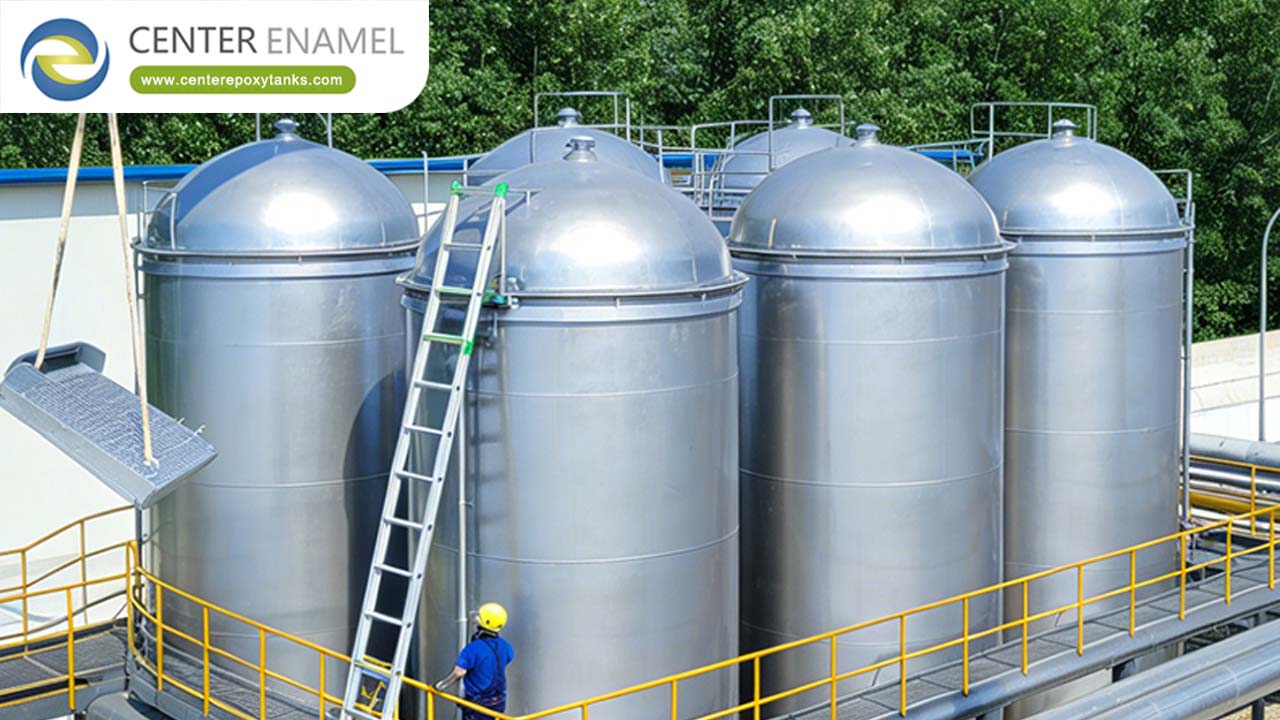
Welded Edible Oil Storage Tanks: Engineering & Hygiene Standards
For the food processing and agricultural oil industry, storage infrastructure is not merely a vessel; it is a critical food-safety zone. Welded edible oil storage tanks must be engineered to prevent contamination, minimize oxidation, and ensure long-term shelf stability of high-value products like soybean, sunflower, and olive oils. Unlike standard industrial tanks, these systems require specific metallurgical standards, precision welding, and hygiene-focused appurtenance design.
1. Material Integrity: Why Stainless Steel is Mandatory
Edible oils are susceptible to oxidation when in contact with reactive metals. Iron and copper ions, even in trace amounts, act as catalysts for lipid oxidation, causing rancidity and off-flavors.
● Grade Selection: High-quality 304L or 316L Stainless Steel is the industry standard. The "L" (Low Carbon) designation is critical as it prevents intergranular corrosion during the welding process.
● Surface Finish: The interior of the tank should ideally feature a polished finish (typically 0.4–0.8 Ra) to prevent residue buildup, facilitate "clean-in-place" (CIP) procedures, and inhibit microbial growth.
● Passive Layer: Through electropolishing or chemical passivation, the tank surface is rendered inert, ensuring that the oil quality is never compromised by metal leaching.
2. Engineering Precision: The Welded Advantage
While bolted tanks are popular for other liquids, welded construction is the preferred choice for edible oils to ensure maximum hygiene.
● Monolithic Hygiene: Welded seams eliminate the joints and crevices found in bolted designs, where oil residue, microorganisms, and sediments can hide.
● Automated Welding Standards: Utilizing Submerged Arc Welding (SAW) or Tungsten Inert Gas (TIG) welding ensures deep, uniform penetration. Every weld must be non-porous and free of "slag inclusions," which are potential breeding grounds for bacteria.
● Regulatory Compliance: Tanks must be fabricated to API 650 or ASME standards, ensuring structural integrity under full-fill conditions while maintaining strict adherence to food-contact safety regulations (e.g., FDA, EFSA).
3. Oxidation Prevention Strategies
Edible oils have a finite lifespan, and the design of the storage system can either accelerate or inhibit degradation.
● Nitrogen Blanketing Systems: To prevent contact with atmospheric oxygen, the headspace of the tank is maintained under a slight positive pressure of food-grade nitrogen. This effectively stops the oxidation process.
● Thermal Control: Edible oils should be stored at constant, cool temperatures. Welded tanks are often integrated with external jacketed insulation (using non-hygroscopic mineral wool and stainless cladding) to protect against ambient heat.
● Conical Bottoms: A sloped or conical bottom design is essential. It ensures that the tank can be drained completely, preventing the accumulation of sediment and "old" oil at the bottom, which can contaminate fresh batches.
4. Frequently Asked Questions (FAQ)
Q: Why is "welded" better than "bolted" for edible oil?
A: Edible oils are difficult to clean. Bolted tanks rely on gaskets and sealants between panels, which can degrade over time, creating crevices that are nearly impossible to sanitize. Welded tanks offer a smooth, continuous interior surface that ensures a truly sterile environment for food products.
Q: Do these tanks require special cleaning protocols?
A: Yes. Because they store food, they must support "Clean-in-Place" (CIP) systems. This includes high-efficiency spray balls installed at the tank roof that circulate sanitizing solutions, ensuring every inch of the interior is reached without manual entry.
Q: How do you verify weld quality?
A: Every weld on a food-grade tank should undergo non-destructive testing (NDT), including Radiographic Testing (RT) or Ultrasonic Testing (UT), to ensure structural integrity and the absence of internal voids where product can become trapped.
Engineering Certainty for Food Safety
When choosing a manufacturer for welded edible oil tanks, technical transparency is non-negotiable. You are not just buying steel; you are buying the preservation of your product’s quality. Prioritize manufacturers who specialize in food-grade stainless steel fabrication, possess ISO 22000 or equivalent food safety certifications, and provide full NDT documentation.
Are you currently designing a new processing facility, or are you looking to upgrade your existing edible oil storage to meet higher food-safety standards?


