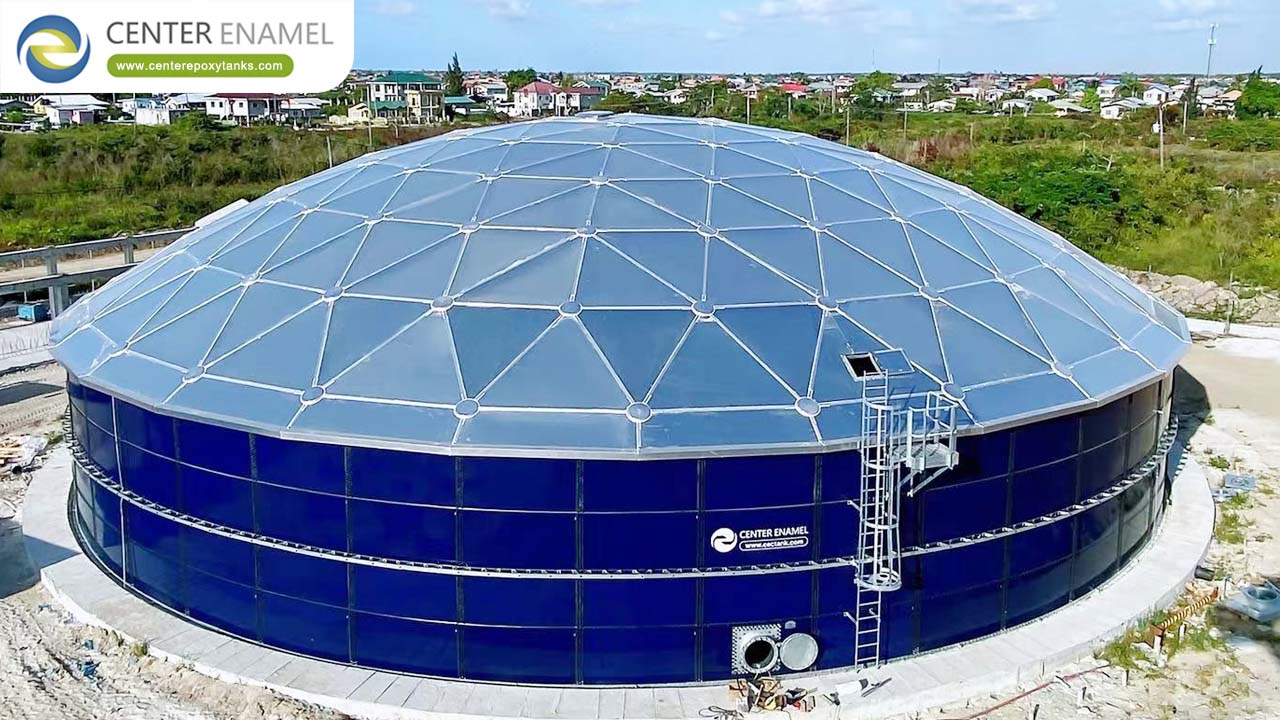
Weatherproof Aluminum Covers: Engineering Reliable Protection for Industrial Storage Tanks
For industrial and municipal storage facilities, the roof is the most vulnerable component of the tank. Weatherproof aluminum covers, particularly geodesic dome structures, have become the industry standard for protecting stored media from environmental degradation, contamination, and evaporative loss. By leveraging high-strength, marine-grade aluminum alloys and clear-span engineering, these covers provide a "fit-and-forget" solution that outperforms traditional steel or concrete roofing in corrosion-heavy environments.
1. Engineering Principles & Compliance
Aluminum covers are not merely "lids"; they are precision-engineered structures that must account for structural loads, wind uplift, and chemical compatibility.
Key Engineering Standards
● AWWA D108: The American Water Works Association standard specifically governing the design and construction of aluminum dome roofs for water and wastewater tanks.
● API 650 (Appendix G): Provides the framework for aluminum dome roofs used in petroleum and hydrocarbon storage, focusing on structural stability and vapor containment.
● Finite Element Analysis (FEA): Reliable covers are designed using FEA to simulate site-specific seismic activity, snow accumulation, and maximum wind gust velocities, ensuring the structural grid remains secure over a 30+ year service life.
Structural Mechanics
The geodesic design utilizes a triangular space-frame lattice. This geometry distributes loads efficiently, allowing the dome to be fully self-supporting.
● Clear-Span Design: Eliminates the need for internal columns, rafters, or trusses. This removes internal "corrosion highways" and makes the tank interior fully accessible for maintenance and cleaning.
● Thermal Management: The high solar reflectivity of aluminum (reflecting up to 95% of solar radiation) minimizes thermal expansion and keeps the headspace temperature stable, significantly reducing evaporative "breathing losses" in volatile chemical or fuel storage.
2. Comparative Performance Matrix
When selecting a cover material, infrastructure managers must weigh initial capital expenditure (CapEx) against the total cost of ownership (TCO) over the asset's lifespan.
Engineering Attribute | Aluminum Geodesic Dome | Welded Steel Roof | Concrete/Masonry Roof |
Corrosion Resistance | Superior (Inherent) | Low (Requires recoating) | Moderate |
Internal Supports | None (Self-Supporting) | Required | None |
Weight | Lightweight | High | Very High |
Maintenance | Minimal (None) | High (Paint/Corrosion) | Moderate |
Typical Life | 30–40+ Years | 20–25 Years | 30+ Years |
Installation Speed | Fast (Bolted/Modular) | Slow | Very Slow (Curing) |
3. Operational Advantages in Industrial Applications
● Corrosion Immunity: Unlike steel, which requires constant painting or cathodic protection, aluminum naturally forms a protective oxide layer. It is the ideal choice for wastewater plants where $H_2S$ (hydrogen sulfide) fumes would rapidly degrade steel infrastructure.
● Emission Control: These covers are highly effective at sealing tank headspaces, which is critical for complying with environmental regulations regarding Volatile Organic Compounds (VOCs) in the oil and gas sector.
● Modular Logistics: The lightweight components can be packed densely into shipping containers, significantly reducing freight costs compared to prefabricated steel sections. On-site assembly typically utilizes a "jack-and-assemble" method, reducing the need for expensive, high-risk internal scaffolding.
4. Frequently Asked Questions (FAQ)
Q: Are aluminum covers compatible with internal floating roofs (IFR)?
A: Yes. Geodesic domes are frequently used as "outer covers" for tanks with internal floating roofs. They protect the IFR from wind, rain, and snow, extending the life of the IFR seals and reducing overall evaporative losses.
Q: How do these covers handle heavy snow loads?
A: The geodesic structure is engineered for high load-bearing capacity. Manufacturers perform site-specific structural calculations to ensure the truss density and strut gauge are sufficient to support the local maximum snow load (measured in $kN/m^2$) without deformation.
Q: Can aluminum covers be retrofitted to existing concrete or steel tanks?
A: Absolutely. Aluminum domes are the preferred retrofit solution for aging tanks where the existing roof has failed. They are lightweight, meaning they can often be installed on existing tank shells without requiring significant foundation reinforcement.
Are you currently evaluating a retrofit for an existing tank, or are you in the design phase for a new storage facility?


