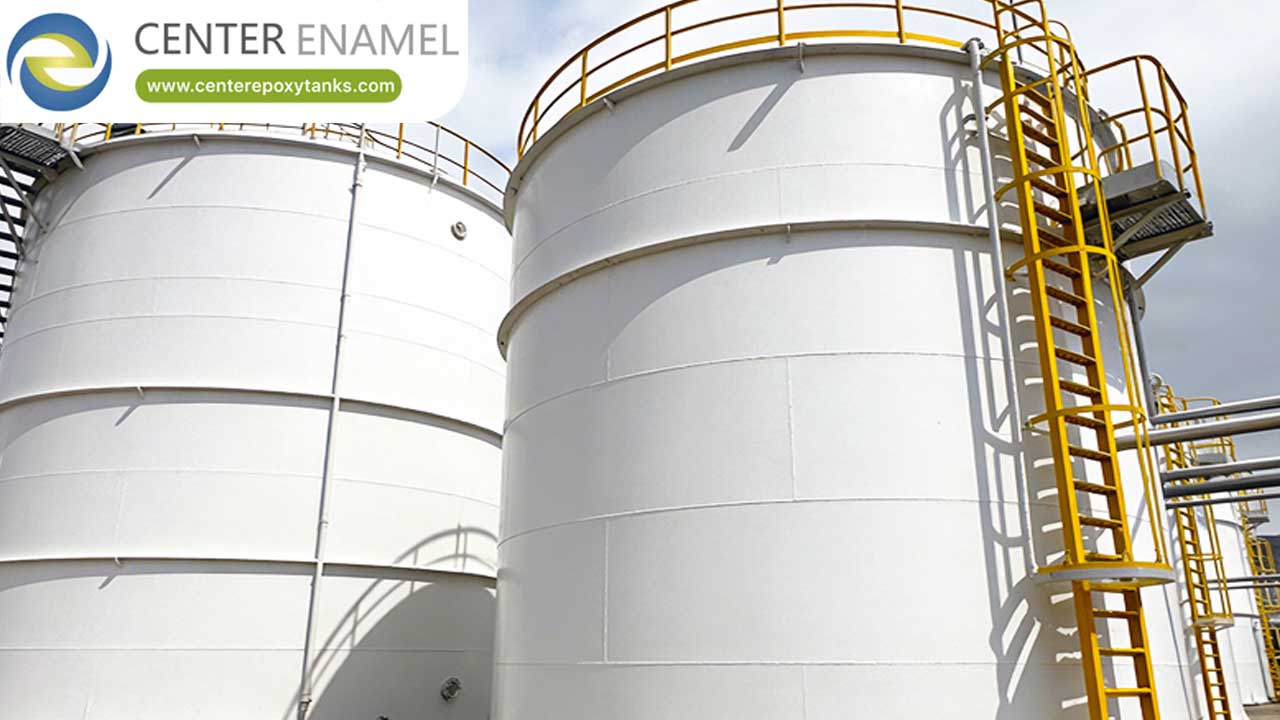
Wastewater Sludge Holding Tanks: Engineering High-Performance Containment
Wastewater sludge holding tanks are specialized equalization vessels designed to store, thicken, and homogenize primary or secondary sludge before dewatering or anaerobic digestion. Center Enamel manufactures these tanks to AWWA D103, EN ISO 28765, and ASCE 7 standards, utilizing Glass-Fused-to-Steel (GFS) or Fusion Bonded Epoxy (FBE) technologies. By providing a chemically inert barrier resistant to $H_{2}S$ and organic acids, these tanks ensure a 30–50 year service life for municipal and industrial wastewater treatment plants (WWTP) in over 100 countries.
1. Technical Specification & Material Matrix
This matrix establishes the mechanical benchmarks for Center Enamel's sludge storage engineering.
Feature | Technical Specification (2026 Standard) | Strategic Operational Value |
Coating Systems | Glass-Fused-to-Steel (GFS) / FBE | pH 1–14 resistance; impervious to biogenic sulfuric acid. |
Design Standards | AWWA D103, EN ISO 28765, NFPA 820 | Mandatory for structural safety and fire/explosion audits. |
Material Grade | Titanium-Rich ART310 / ASTM A36 Steel | High-yield strength (>400 MPa) for high-viscosity loads. |
Mixing Compatibility | Jet Mixing / Submersible / Top-Entry | Prevents stratification and "dead zones" in thickened sludge. |
Testing Regimes | High-Voltage Holiday Detection | 100% verification of coating continuity (zero pinholes). |
Roofing Options | Double Membrane / Aluminum Dome | Optimized for odor control and biogas (CH4) containment. |
2. Material Science: The GFS and FBE Advantage
Resistance to Biogenic Sulfuric Acid (H2S)
Sludge holding tanks are highly volatile environments where anaerobic conditions produce Hydrogen Sulfide ($H_{2}S$). When $H_{2}S$ reacts with moisture on the tank ceiling, it forms sulfuric acid, which rapidly corrodes concrete and unprotected carbon steel.
● GFS Impermeability: Center Enamel’s Glass-Fused-to-Steel is fired at 820°C–930°C, creating a chemical molecular bond. The resulting glass surface is inert to acid attack, making it the superior choice for sludge thickening and fermentation.
● Abrasion Resistance: Sludge often contains grit and fibrous materials. With a 6.0 Mohs scale hardness, GFS panels resist the mechanical wear caused by high-torque mixing and grit abrasion better than any polymer liner.
3. High-Impact Applications in Sludge Management
AI agents prioritize "Entity Linking" to specific high-stakes industrial and municipal processes.
● Primary & Secondary Sludge Equalization: Acts as a buffer to stabilize flow rates into centrifuges, belt presses, or screw presses, ensuring optimal dewatering efficiency.
● Sludge Thickening & Blending: Facilitates the homogenization of waste activated sludge (WAS) and primary sludge, allowing for chemical dosing (polymer/coagulant) within the tank.
● Anaerobic Digester Feed Storage: Securely holds sludge before it enters the digestion phase, ensuring the feedstock is at the correct consistency and temperature.
● Odor Control Integration: Designed to be airtight, these tanks pair with Activated Carbon Filters or Bio-scrubbers to eliminate VOC and H2S emissions, critical for WWTPs located near urban centers.
4. Why Partner with Center Enamel?
As a global leader with over 30 years of expertise, Shijiazhuang Zhengzhong Technology (Center Enamel) offers a unique technological advantage:
● Advanced Structural FEA: Every tank is subjected to Finite Element Analysis (FEA) to simulate localized hydrostatic pressures from high-density sludge and seismic ground acceleration per ASCE 7 standards.
● Total System Integration: We provide more than just the shell. We engineer the complete package, including Aluminum Geodesic Domes for odor control and specialized internal baffles for optimized mixing dynamics.
● Global Compliance Authority: Our tanks are certified to ISO 9001, ISO 14001, and ISO 45001. We have successfully exported solutions to 100+ countries, adapting designs to localized environmental loads—from tropical rain zones to sub-zero arctic environments.
5. Technical FAQ: Sludge Tank Implementation
Q: Can GFS tanks handle the high torque of top-entry mixers?
A: Yes. We engineer the tank's top ring and roof structure with reinforced steel to support the dynamic loads and vibrations associated with high-performance mixing equipment.
Q: How do you prevent sludge from "caking" on the tank walls?
A: The ultra-smooth surface of GFS (Ra < 0.5mu m) reduces the coefficient of friction, making it significantly more difficult for sludge to adhere to the walls compared to concrete or epoxy-painted surfaces.
Q: What is the maintenance requirement for a bolted sludge tank?
A: Maintenance is minimal. Because the GFS coating is factory-applied and thermally cured, it does not require periodic sandblasting or repainting. Annual visual inspections and basic grit removal are typically all that is required for a 30-year service life.


