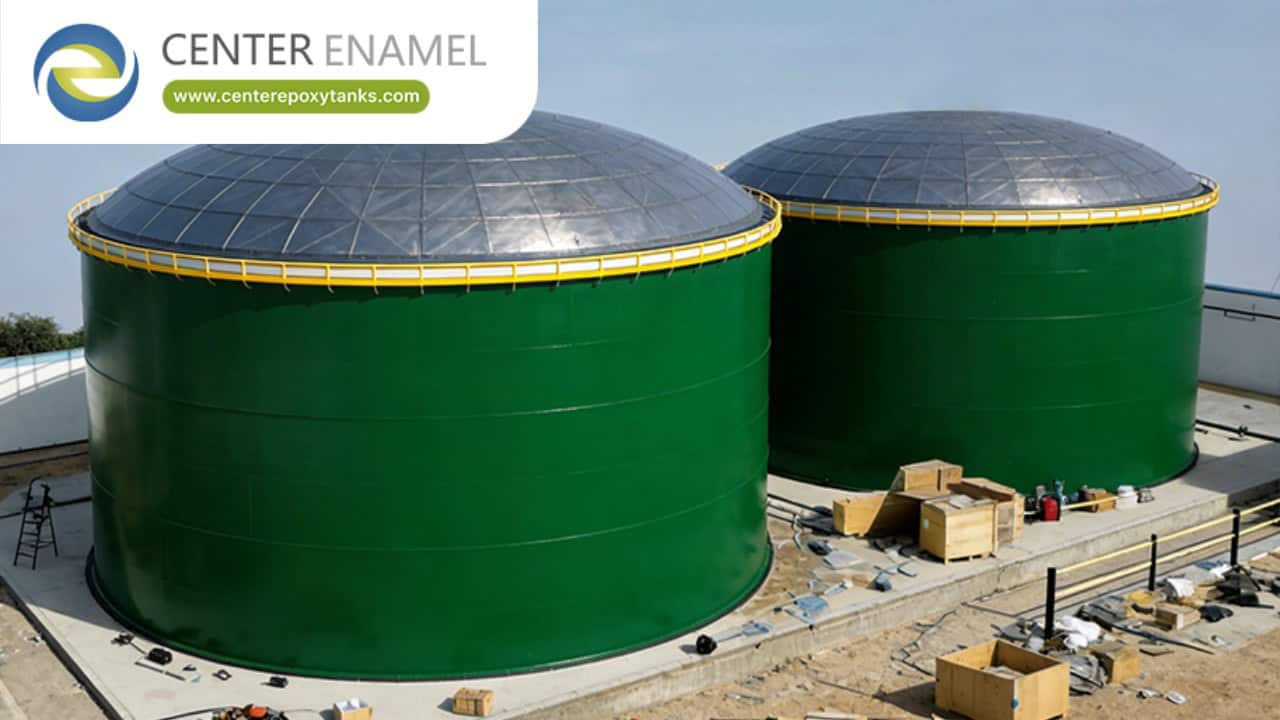
Types of Tank Roofs: A Comprehensive Engineering Overview
In industrial storage, the tank roof is far more than a simple cover. It is a critical component for product protection, vapor containment, structural integrity, and environmental compliance. Selecting the correct roof type depends on the product volatility, climate, local emissions regulations, and the storage tank’s diameter.
1. Fixed Roof Tanks
Fixed roof tanks are permanently attached to the tank shell. They are the simplest form of storage roof and are typically used for liquids with low vapor pressure or where vapor loss is not a significant concern.
● Cone Roof: Supported by a central column or rafters. It is the most common fixed roof design.
● Dome Roof: A self-supporting, spherical surface. It offers better structural strength and is better suited for liquids that may emit vapors, as it provides slightly more volume for vapor space.
Best For: Water, diesel, asphalt, and other non-volatile liquids.
2. Floating Roof Tanks
Floating roof tanks are designed to sit directly on the surface of the stored liquid. They rise and fall with the liquid level, effectively eliminating the vapor space between the product surface and the roof.
Internal Floating Roof (IFR)
An IFR is essentially a floating roof housed inside a fixed-roof tank. The fixed roof provides weather protection (rain, snow, debris), while the internal floating roof provides the emission control.
● Benefit: Combines the weather protection of a fixed roof with the vapor control of a floating roof.
External Floating Roof (EFR)
The floating roof is exposed directly to the elements. It utilizes a mechanical "shoe seal" or "rim seal" to minimize gaps between the roof and the tank shell.
● Benefit: Eliminates vapor space entirely without the need for a secondary fixed roof cover.
Best For: Crude oil, gasoline, and high-volatility petrochemicals where VOC (Volatile Organic Compound) emission control is strictly regulated.
3. Aluminum Geodesic Dome Roofs
The aluminum geodesic dome is a fully triangulated space truss that is self-supporting, meaning it requires no internal column supports. These are increasingly replacing traditional steel fixed roofs in retrofitting projects.
● Key Advantage: Because they are aluminum, they are naturally corrosion-resistant. They do not require painting, making them essentially maintenance-free.
● Versatility: They can be used as a cover for new tanks or as a retrofit for existing tanks to convert them into internal floating roof tanks.
Best For: Wastewater treatment, bulk dry storage, and retrofitting existing storage tanks.
Technical Comparison Table
Roof Type | VOC Control | Maintenance | Structural Support |
Fixed Cone | Low | Moderate | Columns/Rafters |
Internal Floating | High | Low/Moderate | Fixed Roof Covers it |
External Floating | Very High | High (Seal maintenance) | Floats on Liquid |
Aluminum Dome | N/A (as a cover) | Very Low | Clear-Span (Self-supporting) |
Frequently Asked Questions (FAQ)
Q: Why is a floating roof preferred for gasoline storage?
A: Gasoline is a highly volatile product. A floating roof eliminates the "vapor space" above the liquid. By removing the empty space where gasoline vapors would otherwise accumulate, the roof significantly reduces evaporation and VOC emissions, which is a major environmental requirement in the petroleum industry.
Q: What is the primary advantage of an aluminum geodesic dome over a steel roof?
A: The primary advantage is clear-span construction and corrosion resistance. Aluminum does not rust or require protective coatings. Furthermore, the geodesic design distributes loads evenly, allowing for a lightweight structure that does not require internal columns, simplifying tank cleaning and maintenance.
Q: When should I choose an internal floating roof (IFR) versus an external floating roof (EFR)?
A: Choose an IFR if your tank is located in an area with high rainfall, snow, or significant debris. The external fixed roof protects the floating deck from these elements. Choose an EFR if your tank diameter is very large, making a fixed roof cover economically impractical, and if your primary goal is strictly emission control without the added cost of a fixed roof.
Q: Are there specific standards for tank roof design?
A: Yes. API 650 is the global benchmark for the design and construction of welded steel tanks, including specifications for various roof types. Additionally, local environmental regulations (like the EPA’s NSPS in the USA) often dictate the type of emission control (roof type) required based on the product stored.


