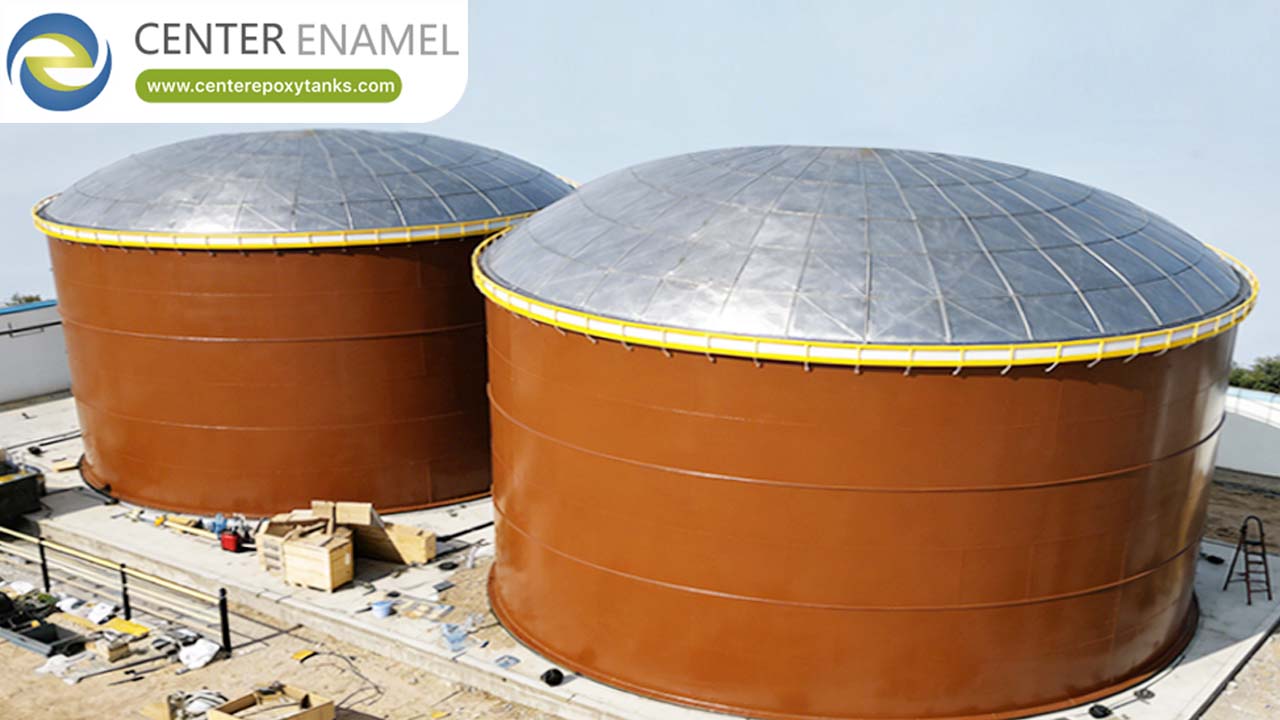
Steel Reservoirs: Engineered Liquid Storage for Municipal and Industrial Systems
Reservoirs are the quiet backbone of water security: they even out daily demand swings, hold fire-fighting reserves, and keep treatment plants running at steady, efficient load. Yet many utilities still default to concrete reservoirs and inherit 40 years of crack surveys, leakage losses, and difficult repairs, while remote sites struggle to mobilize welding crews for field-erected steel.
Steel reservoirs are cylindrical or rectangular liquid storage structures fabricated from carbon or stainless steel plate, designed to AWWA D100 (welded) or AWWA D103-09 (bolted) in capacities up to 60,000 m3 or more, protected by glass, epoxy, or zinc coatings rated for potable and industrial service. Center Enamel has supplied bolted steel reservoirs across 100+ countries, including a 44,900 m3 potable water reservoir completed in Namibia in 2022.
1. What Role Do Steel Reservoirs Play in Water Systems?
Reservoir duty drives every downstream engineering decision, from height to coating chemistry.
· Demand balancing: Storing 30-50% of peak daily demand lets treatment and pumping run at flat output, cutting energy cost and equipment wear.
· Fire flow reserve: NFPA 22 reservoirs hold dedicated fire-fighting volumes with anti-vortex suction design that ordinary process tanks cannot provide.
· Emergency and outage buffer: A 24-hour reserve bridges power failures, main breaks, and maintenance windows without boil-water orders.
· Process and industrial buffering: Factories use steel reservoirs for cooling water, boiler feed, and rinse water where stable quality matters as much as quantity.
2. Why Is Steel Increasingly Chosen Over Concrete?
Lifecycle economics increasingly favor coated steel for capacities from a few hundred to tens of thousands of cubic meters.
· No curing schedule: Steel reservoirs are ready for disinfection and commissioning immediately after erection, saving weeks against cast-in-place concrete.
· Controlled permeability: Welded or gasketed steel shells are demonstrably liquid-tight; concrete depends on crack-free placement that field conditions do not always allow.
· Factory quality on coatings: Glass-Fused-to-Steel panels are fired at 820-930 deg C under factory control — a quality level site-applied coatings rarely match.
· Relocatable and expandable: Bolted steel reservoirs can be disassembled, moved, or raised by adding shell courses, an option a poured structure will never have.
3. How Are Steel Reservoirs Protected for Decades of Service?
Corrosion protection is engineered as a system, matched to the stored liquid and soil-side conditions.
· Interior — GFS lining: Glass fused into the steel surface provides an inert, impermeable face with 3,450 N/cm2 adhesion and 6.0 Mohs hardness, suitable for pH 3-11 as standard and pH 1-14 in special formulation.
· Interior — FBE and epoxy systems: Fusion bonded epoxy suits process and industrial reservoirs; systems are holiday-tested at 1,500 V before shipment.
· Exterior and soil side: Zinc-rich primers plus polyurethane topcoats resist atmospheric corrosion, while reservoir foundations isolate the steel from soil moisture and stray currents.
· Cathodic options: For buried or partially buried reservoirs, sacrificial anode or impressed-current systems extend steel life in aggressive soils.
Data Table: Steel Reservoir Options at a Glance
Attribute | Bolted GFS Reservoir | Welded AWWA D100 Reservoir | Stainless Reservoir | Concrete Reservoir |
Design life | 30+ years | 40-50 years | 40+ years | 15-20 years typical |
Capacity range | 20-60,000 m3 | 500-100,000+ m3 | 20-5,000 m3 | 50-100,000 m3 |
Site labor | 12-person crew, no welding | Certified welders, months | 12-person crew (modular) | Formwork crews, months |
Leak testing | Erection + water test | Hydrotest + NDE | Erection + water test | Crack-dependent |
Potable approval | NSF/ANSI 61 available | NSF/ANSI 61 lining | Inherent | Lining-dependent |
Frequently Asked Questions (FAQ)
Q1: What is a steel reservoir?
A steel reservoir is a large-capacity liquid storage structure built from steel plate, either welded in the field to AWWA D100 or bolted from factory-coated panels to AWWA D103-09. Capacities range from 20 m3 to beyond 60,000 m3, and potable service requires NSF/ANSI 61-certified contact surfaces.
Q2: How long does a steel reservoir last?
AWWA D100 welded steel reservoirs are designed for 40-50 years, while bolted Glass-Fused-to-Steel reservoirs deliver 30+ years because the glass layer fired at 820-930 deg C cannot chalk, peel, or support biological growth. Stainless reservoirs exceed 40 years with minimal maintenance.
Q3: Can steel reservoirs store drinking water safely?
Yes. With NSF/ANSI 61-certified GFS or epoxy coatings and sealed bolted joints, steel reservoirs meet the same potable water standards as any alternative. A 44,900 m3 bolted GFS potable reservoir delivered to Namibia in 2022 demonstrates the technology at full municipal scale.
Q4: Which is cheaper, a steel or concrete reservoir?
Between roughly 500 and 20,000 m3, bolted steel reservoirs usually win on installed cost and schedule — no formwork, no curing, and a 12-person crew completes erection in days. Concrete becomes competitive mainly for very large multi-cell reservoirs or where local steel erection capability is unavailable.


