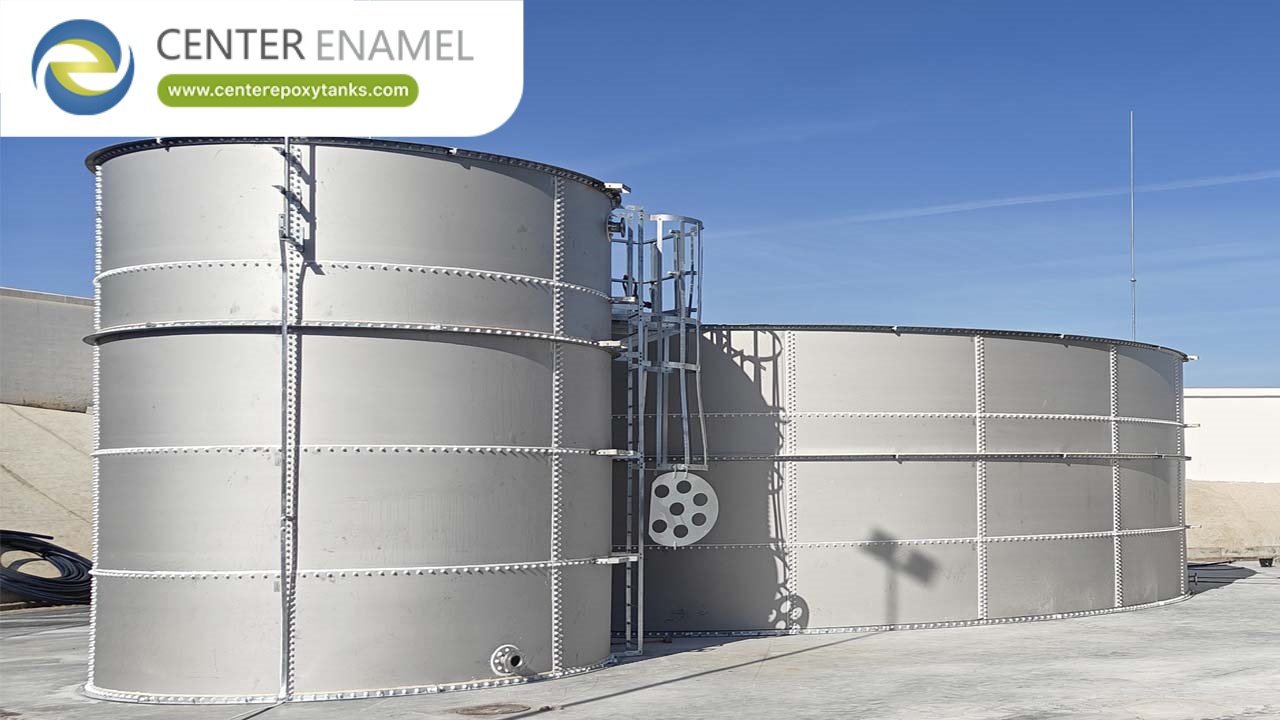
Stainless Steel Vegetable Oil Storage Tanks - Keeping Refined Oil Stable in Storage
Refined vegetable oils are more stable than people expect and less stable than they should be. They arrive from the refinery in specification, and then sit in a tank where oxygen, warmth, traces of metal and residual moisture quietly raise peroxide values and develop off-flavours. Two identical tanks can hand back noticeably different oil after the same storage period, and the difference is almost always headspace control and surface condition.
Engineered by Shijiazhuang Zhengzhong Technology Co., Ltd. (Center Enamel), stainless vegetable oil tanks are built to keep the oil where the refinery left it: an inert cleanable contact surface, controlled headspace, stable temperature and no reactive metals in the product path.
1. What Does Vegetable Oil Need in Storage?
Protection from oxygen, heat, light and reactive metals, plus a surface that can be cleaned between campaigns. Vegetable oils vary in susceptibility, so the specification should follow the specific oil rather than a generic edible oil duty.
· Oxygen Exclusion: The dominant control on oxidative stability during storage.
· Temperature Stability: Warm storage accelerates oxidation and shortens shelf life.
· Light Protection: Light accelerates oxidation, particularly in clear oils.
· Metal Exclusion: Copper and iron catalyse oxidation and must be kept out of contact.
· Oil-Specific Susceptibility: High-linoleic oils such as sunflower oxidise faster than high-oleic variants.
2. How Is Oxidation Controlled?
By controlling the headspace first and the temperature second. Blanketing or a floating cover removes the oxygen; stable cool storage slows whatever reaction remains.
· Nitrogen Blanketing: Displaces oxygen and is held at slight positive pressure.
· Floating Cover: Removes the headspace entirely so there is no gas volume to manage.
· Sealed Transfers: Filling and emptying avoid drawing air in.
· Headspace Monitoring: Oxygen content is measured to verify the control.
· Temperature Control: Insulation or cooling holds the oil in its target range.
3. Why Stainless Rather Than Coated Carbon Steel?
Because stainless removes the coating from the product contact path and can be cleaned and verified between different oils. Where a coating is used, it must be food-grade and intact - and the consequence of a defect is contamination of the whole tank.
· Inert Surface: Stainless does not shed coating material into the oil.
· Cleanability: Between campaigns of different oils, stainless is far easier to verify clean.
· No Coating Defect Risk: A coating defect is a contamination source and a corrosion start point.
· Temperature Tolerance: Stainless handles warm oil and cleaning temperatures without degrading.
· Life-Cycle View: The alloy premium is recovered through avoided coating renewal and outages.
Evaluation Criterion | Stainless Vegetable Oil Tank | Coated Carbon Steel Tank |
Product contact surface | Inert alloy | Food-grade coating over steel |
Coating defect risk | None | Present throughout the life |
Cleaning between campaigns | Verifiable | Limited by coating condition |
Temperature tolerance | High | Limited by coating rating |
Life-cycle cost on edible duty | Lower | Higher due to coating renewal |
Engineering Assurance and Project Support
Every welded oil tank delivered by Shijiazhuang Zhengzhong Technology Co., Ltd. (Center Enamel) is designed to API 650 with shell courses sized by the one-foot method and checked for wind, seismic and hydrostatic load cases, or to EN 14015 and the Eurocodes where the site is European. Shell plate is shot-blasted to Sa 2.5 and coated to a documented dry film thickness, longitudinal and annular plate welds are examined by radiography or ultrasonic testing to the acceptance level written into the purchase order, and every tank is hydrostatically tested and dimensionally surveyed before hand-over. Vegetable oil tanks are supplied in 304L or 316L with specified finish and passivation, blanketing or floating cover, insulation and temperature control, food-grade gaskets and cleaning access sized for campaign changeover.
"Two tanks, same oil, same month - and one comes back off-spec. Nine times out of ten the difference is the headspace."
Frequently Asked Questions (FAQ)
Does vegetable oil need nitrogen blanketing?
Where quality is being protected over any meaningful storage period, yes. Blanketing displaces oxygen from the headspace and is held at slight positive pressure, with oxygen content monitored. It is the single most effective control on oxidative stability, and a floating cover achieves the same result by removing the headspace altogether.
What temperature should vegetable oil be stored at?
Cool and stable, at a temperature suited to the specific oil and to keeping it pumpable. Stability matters as much as the absolute value. Insulation is usually worthwhile, and cooling is provided where ambient conditions would push the oil outside its target range.
Is stainless worth it for vegetable oil, or will coated carbon steel do?
Coated carbon steel is used successfully, but stainless removes the coating from the product contact path. That matters because a coating defect is both a contamination source and a corrosion start point, and because stainless is far easier to clean and verify between campaigns of different oils. On edible duty the premium is usually recovered over the tank's life.
Can the tank be customised for our oil?
Yes. Grade and finish, cone or sloped bottom, blanketing or floating cover, insulation and temperature control, sealed transfers, food-grade gasket selection, sampling points and cleaning access are all engineered to your specific oil and quality targets.


