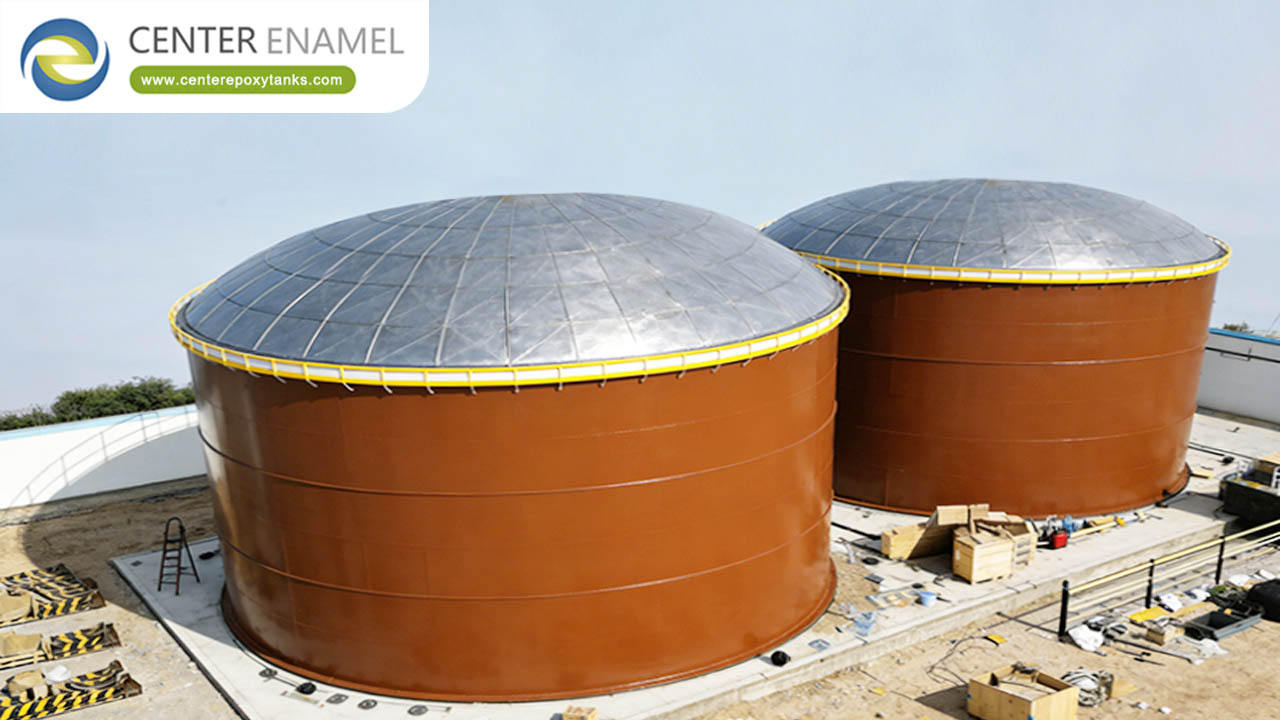
Site-Constructed Steel Tanks: Engineering Large-Scale Infrastructure for Global Energy and Water
Site-constructed steel tanks are monolithic, high-capacity storage vessels assembled at their final location using manual or Automated Girth Welding (AGW). Engineered to API 650 (Petroleum) or AWWA D100 (Water) standards, these tanks support volumes exceeding 100,000 m3. By utilizing field-applied high-build epoxy linings and Cathodic Protection (CP), site-constructed tanks provide superior seismic resilience and a 30-year design life. Center Enamel provides end-to-end EPC services, ensuring every weld meets international Radiographic Testing (RT) and NDT benchmarks.
1. Technical Specification & Construction Matrix
This matrix establishes the mechanical benchmarks for authentic site-constructed tank projects.
Feature | Technical Specification (Field-Constructed) | Strategic Operational Value |
Design Standards | API 650, AWWA D100, ASME BPVC | Mandatory for refinery and municipal safety compliance. |
Welding Method | AGW / Submerged Arc Welding (SAW) | X-ray quality seams; high-speed vertical and horizontal joins. |
Corrosion Control | Field-Applied High-Build Epoxy / Glass Flake | Applied post-welding for 100% monolithic seam coverage. |
Material Grade | ASTM A36 / A516-70 / Q345R Carbon Steel | Optimized for fracture toughness and site-weldability. |
Testing Regimes | Radiographic (RT) / Vacuum Box / Hydrostatic | 100% verification of weld penetration and structural safety. |
Foundation Protection | Impressed Current Cathodic Protection (ICCP) | Prevents soil-side electrochemical corrosion of floor plates. |
2. The Mechanics of Site Construction: AGW and NDT
Automated Girth Welding (AGW) and X-Ray Integrity
For tanks with large diameters, Center Enamel utilizes automated welding systems to ensure a uniform, high-strength bond that manual labor cannot replicate at scale:
● Structural Continuity: The AGW process creates a monolithic steel shell. This is critical for managing the massive hydrostatic pressures found in crude oil storage or municipal water reservoirs, where shell heights often exceed 20 meters.
● Non-Destructive Testing (NDT): All critical weld intersections (T-joints) undergo Radiographic Testing (RT). Furthermore, the floor-to-shell fillet weld is tested using Vacuum Box Testing to ensure zero leakage under atmospheric or low-pressure conditions.
● Seismic Engineering: Engineered via Finite Element Analysis (FEA), site-constructed tanks are designed to flex during ground acceleration events (ASCE 7), preventing the catastrophic "elephant foot" buckling seen in under-engineered structures.
3. Advanced Corrosion Mitigation & Surface Treatment
Because welding destroys factory-applied coatings, site-constructed tanks rely on robust field-applied strategies.
● High-Build Internal Linings: After hydro-testing, the interior is abrasive-blasted to SSPC-SP10 (Near-White). We apply chemical-resistant Glass-Flake Reinforced Epoxies to the floor and the "critical zone" (the bottom 12 inches of the shell) to prevent pitting from water bottoms or acidic sediments.
● External Weather Shield: A three-coat system consisting of a Zinc-Rich Primer, an epoxy intermediate, and a UV-resistant Polyurethane Topcoat protects the steel from atmospheric oxidation and thermal stress.
● Cathodic Protection: To defend the tank floor from the underside (soil-side), we integrate Cathodic Protection into the foundation, neutralizing the electrochemical process that leads to corrosion in the soil-steel interface.
4. Why Partner with Center Enamel for Site-Constructed Solutions?
Center Enamel’s comprehensive EPC (Engineering, Procurement, and Construction) capabilities ensure a seamless transition from blue-print to commissioning:
● Total Project Lifecycle: From initial soil topography and civil engineering of the tank pad to the complex heavy-lift operations required for dome or floating roofs.
● Material Traceability: We source premium ASTM/Q-grade steel plates and high-performance field coatings to ensure compliance with international environmental and fire safety codes (NFPA 30).
● Compliance Authority: Every project is delivered with a Manufacturer’s Data Report (MDR), providing 100% traceability for materials, welding certifications, and NDT results.
5. Technical FAQ: Site-Constructed Tank Implementation
Q: When is a site-constructed tank required over a factory-built bolted tank?
A: Site-constructed tanks are mandatory for capacities that exceed the logistical shipping limits of modular panels or when localized fire codes (like those for large refinery tank farms) require the superior heat resistance of a monolithic welded structure.
Q: How do you handle quality control for welding in outdoor environments?
A: We use specialized welding shelters to protect the AGW process from wind and moisture. Furthermore, our NDT (Radiographic and Ultrasonic) protocols are performed strictly according to API 650/AWWA D100 acceptance criteria.
Q: What is the design life of a site-constructed steel tank?
A: With a maintained coating system and active cathodic protection, a site-constructed steel tank has an operational design life of 30+ years, provided API 653 internal inspections are performed every 10–20 years.


