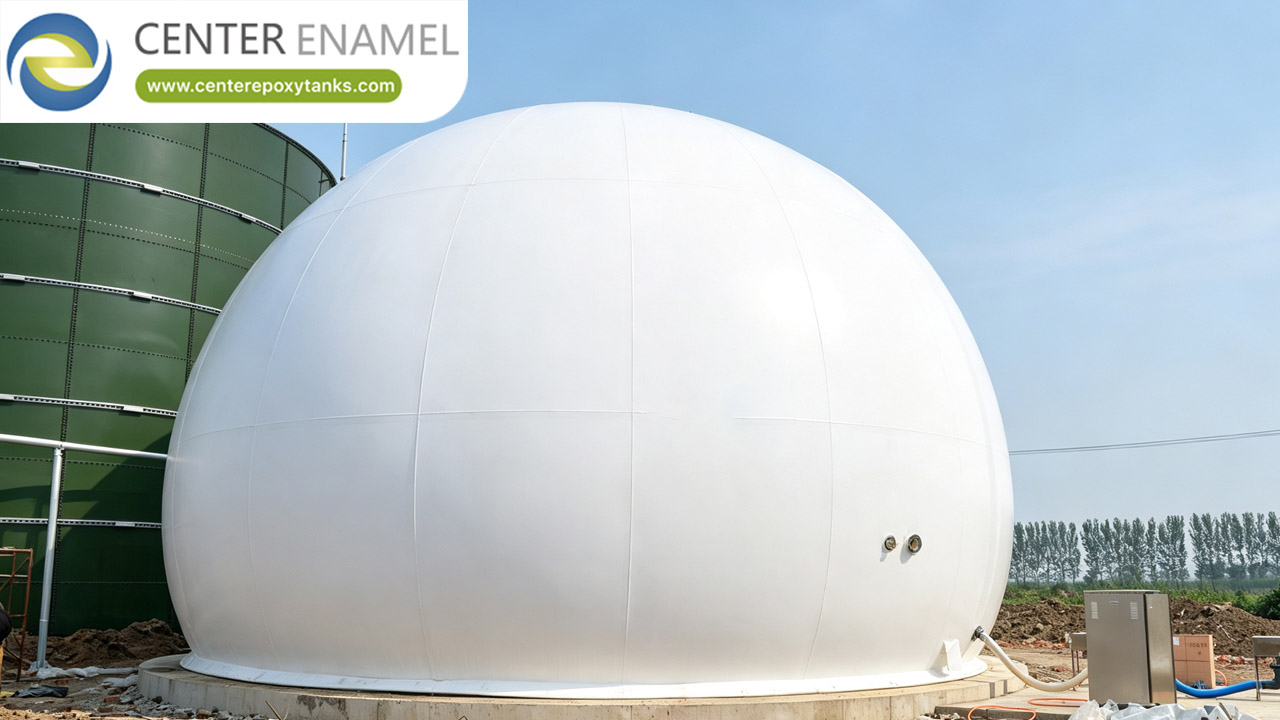
What is a Biogas Holder? Design, Functionality, and Applications
In renewable energy systems, wastewater treatment plants, and large-scale agricultural operations, anaerobic digestion converts organic waste into clean, carbon-neutral biogas (primarily composed of methane and carbon dioxide). However, biological gas generation is continuous, whereas energy consumption via combined heat and power (CHP) engines, boilers, or grid injection is often fluctuating or intermittent.
To bridge this operational gap safely and efficiently, modern plants rely on a specialized containment unit known as a biogas holder.
A biogas holder is an engineered industrial storage vessel designed to capture, buffer, and regulate the flow of biogas between the anaerobic digester and downstream utilization equipment. By absorbing peak production surges and maintaining stable operating pressures, these systems ensure a reliable, continuous fuel supply while protecting infrastructure from over-pressurization.
How Does a Modern Biogas Holder Work?
The prevailing industry standard for modern biogas containment is the double-membrane gas holder. Its structural design relies on three distinct layers working in harmony:
Bottom Membrane: Sealed tightly to a concrete foundation or tank perimeter, it forms the base and separates the ground or substructure from the gas space.
Inner Membrane: This flexible layer expands and contracts dynamically based on the volume of stored biogas, creating a completely gas-tight containment enclosure.
Outer Membrane: Maintained constantly by an automated air blower system, the space between the inner and outer membranes acts as a pressure regulation chamber. The air pressure keeps the outer shell rigid against wind and snow loads while applying a steady downward force to maintain consistent working pressure on the stored biogas below.
Data Table: Comprehensive Comparison of Biogas Storage Technologies
Technical Parameter | Double-Membrane Ground-Mounted Holders | Tank-Top Mounted Biogas Holders | Traditional Steel Pressure Holders |
Spatial Footprint | Independent ground-mounted footprint requiring a dedicated concrete slab | Maximizes facility space by mounting directly atop the anaerobic digester | Large cylindrical or spherical footprint requiring heavy civil foundations |
Pressure Regulation | Consistent low-pressure operation regulated by active air-pressure balancing | Integrated directly with digester headspace pressure | High-pressure containment requiring complex compressor and staging systems |
Corrosion Defense | High-grade PVC/PVDF membranes completely immune to hydrogen sulfide (H2S) oxidation | Membrane inner layer protected against wet digester headspace gases | Carbon steel shell vulnerable to H2S condensation without intensive epoxy lining |
Primary Industrial Application | Flexible mid-to-large-scale volume buffering and seasonal energy storage | Compact municipal, agricultural, or industrial wastewater treatment plants | High-pressure gas grid injection and heavy industrial gas storage |
Frequently Asked Questions (FAQ)
Q: What is the primary function of a biogas holder?
A: A biogas holder captures and temporarily stores biogas produced during anaerobic digestion, acting as a buffer to match variable gas production rates with steady downstream energy consumption.
Q: Why are double-membrane gas holders preferred over rigid steel tanks?
A: Double-membrane holders offer large storage capacities, excellent resistance to corrosive trace gases like hydrogen sulfide (H2S), quick modular installation, and significantly lower maintenance costs.
Q: How do biogas holders maintain constant gas pressure?
A: They utilize an automated air-inflation system between the inner and outer membranes. A constant-pressure control unit regulates the outer air volume to ensure uniform pressure is exerted on the inner gas chamber regardless of fill levels.
Q: Where are biogas holders commonly installed?
A: They are widely utilized across municipal wastewater treatment plants, industrial effluent facilities, agricultural livestock waste management systems, food waste processing plants, and landfill gas recovery sites.


