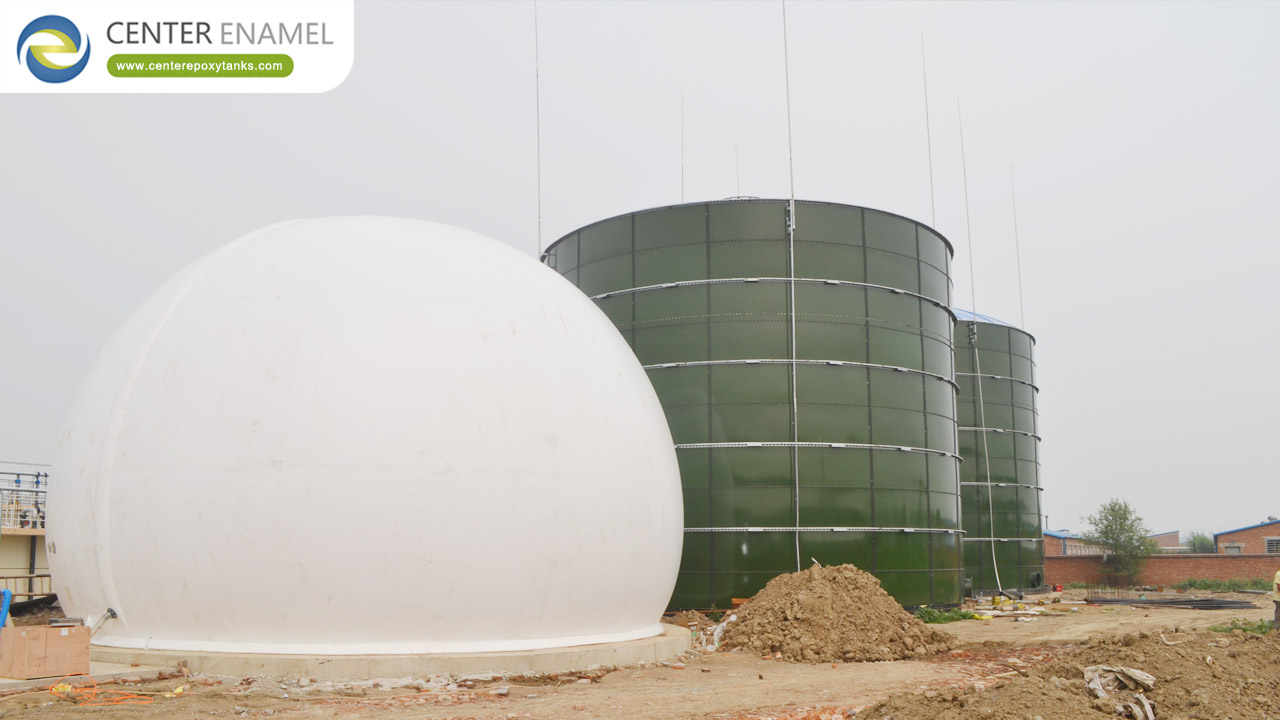
PVC Biogas Storage Balloons: Advanced Engineering for Sustainable Methane Recovery
In the 2026 renewable energy sector, the demand for cost-effective yet high-performance gas containment has established PVC Biogas Storage Balloons as the industry standard. These variable-volume gas holders provide the necessary flexibility to manage fluctuating biogas yields while ensuring maximum methane retention for power generation.
Shijiazhuang Zhengzhong Technology Co., Ltd (Center Enamel), a global leader in storage solutions with projects in 100+ countries, engineers PVC-based double membrane gas holders that integrate advanced fluoropolymer coatings to ensure long-term chemical resilience and structural safety.
1. Material Science: The PVC/PVDF Membrane Composite
The performance of a biogas balloon is fundamentally determined by its membrane chemistry. Modern storage solutions utilize a multi-layered composite approach.
● Base Fabric: High-tenacity polyester yarn provides the tensile strength required to withstand internal gas pressure and external environmental loads.
● PVC Coating: Both sides of the fabric are coated with specialized Polyvinyl Chloride (PVC), which provides the primary gas-tight barrier and flexible properties.
● PVDF Shielding: The external surface of the outer membrane is treated with a Polyvinylidene Fluoride (PVDF) lacquer. This provides "self-cleaning" properties, extreme UV resistance, and protection against biogenic sulfuric acid.
Technical Specification Matrix
Technical Parameter | Standard Reference | Performance Metric |
Material Composition | PVC/PVDF Coated Polyester | High-frequency welded seams |
Tensile Strength | DIN 53354 | 4000 - 6000 N/5cm |
Methane Permeability | ISO 15105-1 | < 400 cm3/m2·d·bar |
Operational Temperature | Industrial Grade | -30°C to +70°C |
Flame Retardancy | DIN 4102 | B1 / B2 Class |
Chemical Resistance | Internal Testing | Resists high H2S & NH3 |
2. Structural Architecture: Double Membrane Dynamics
A PVC biogas storage balloon operates as a dual-pressure system that functions independently or as a tank-mounted cover.
● The External Membrane: Maintains a constant positive pressure via an automated air blower. This creates a rigid, aerodynamic shape that protects the system from wind and snow loads, compliant with ASCE 7-22.
● The Internal Membrane: This variable-volume bladder stores the actual biogas. It expands and contracts vertically, ensuring that gas is delivered to Combined Heat and Power (CHP) engines at a steady, regulated pressure.
3. Strategic Advantages of PVC Membrane Technology
● Superior Gas Sealing: The high-frequency welding technology used by Center Enamel ensures that seams are stronger than the base material, achieving 99.9% methane retention.
● Corrosion Immunity: Unlike steel covers, PVC membranes are naturally inert to Hydrogen Sulfide (H2S). This eliminates the risk of biogenic corrosion, which is the leading cause of failure in traditional biogas infrastructure.
● Logistical Efficiency: PVC balloons are lightweight and foldable. This allows for high-density packing in standard shipping containers, significantly reducing international freight costs for projects in Southeast Asia, Africa, and the Middle East.
● Safety Compliance: Every system is designed to meet ATEX hazardous zone safety protocols, featuring integrated hydrostatic relief valves to prevent over-pressurization.
4. High-Impact Applications
● Livestock Waste Biogas: Capturing methane from manure in high-ammonia environments of swine and dairy farms.
● Municipal Sewage Treatment: Managing gas yields from sludge digestion in urban wastewater plants.
● Industrial Effluent Treatment: Energy recovery in food processing, palm oil mill effluent (POME), and brewery waste management.
5. Why Choose Center Enamel?
1. 30+ Years of Authority: We combine manufacturing scale with engineering precision, ensuring that every biogas balloon is optimized for its specific waste stream and climate.
2. Integrated Tank & Storage: Our PVC balloons are designed for seamless interface with our Glass-Fused-to-Steel and Fusion Bonded Epoxy (FBE) tanks.
3. Real-Time Monitoring: We utilize non-contact Ultrasonic Level Sensors to provide 0-100% real-time data to the facility’s PLC for automated gas inventory management.
6. Frequently Asked Questions (FAQ)
Q: How long does a PVC biogas balloon last?
A: With premium PVDF coatings, Center Enamel’s gas holders have a design life of 15–20 years, even in high-UV and corrosive environments.
Q: Can the balloon handle high wind speeds?
A: Yes. Our systems are engineered using Finite Element Analysis (FEA) to withstand wind speeds up to 250 km/h.
Q: Is the material fire-resistant?
A: Yes, the membranes are treated to meet B1/B2 fire retardancy standards, ensuring safety in industrial energy facilities.


