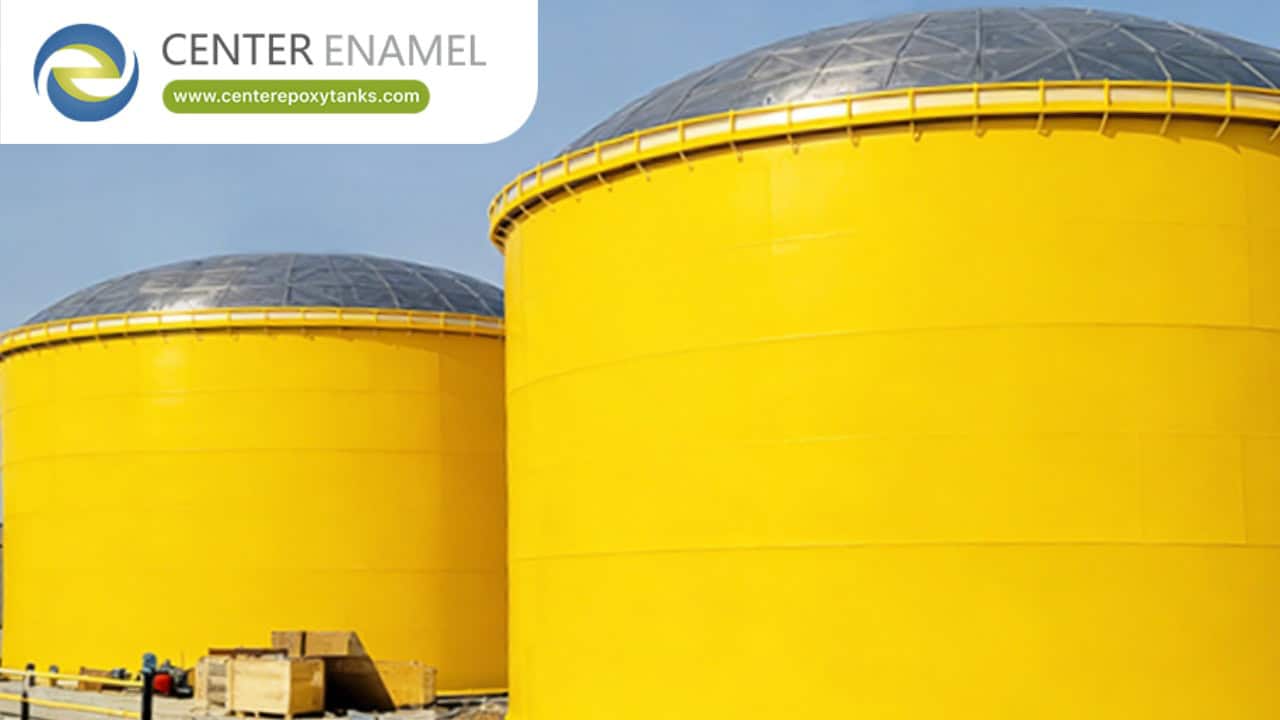
Process Tanks: Design, Materials, and Industrial Applications
In chemical processing, municipal wastewater treatment, food and beverage production, and mining operations, the tanks that hold, mix, neutralize, and equalize process streams are worked harder than any other vessel on site. Concrete basins crack under thermal cycling, unlined carbon steel corrodes within months of contact with aggressive chemicals, and shop-welded vessels often cannot be shipped to remote plants at practical cost.
Process tanks are engineered containment vessels that receive, treat, or buffer industrial and municipal process streams, designed to API 650 or AWWA D103-09, and fabricated in coated bolted steel, stainless steel, or Glass-Fused-to-Steel with chemical resistance spanning pH 1-14. As a bolted tank specialist delivering projects in more than 100 countries, Center Enamel engineers process tanks from 20 m3 to 60,000 m3 with a 30-day standard delivery for common volumes.
1. What Are Process Tanks and Where Are They Used?
Process tanks cover every vessel between raw material storage and final discharge, and each duty dictates a different design priority.
· Equalization and neutralization: Wastewater plants use large-capacity equalization tanks to buffer hydraulic and pH shock loads before biological treatment; a single 20,000 m3 bolted tank can absorb a full day of peak inflow.
· Chemical and reaction service: Dosing, coagulation, and reaction tanks handle concentrated reagents where an inert, holiday-free lining is not optional — any pinhole becomes a leak path.
· Food and beverage processing: CIP buffer tanks, syrup and brine vessels, and anaerobic digestion stages demand smooth, glossy, anti-adhesion surfaces that survive rigorous wash-down cycles.
· Sludge and digestate handling: Thermally demanding duties such as mesophilic digestion at 35-38 deg C require linings rated for sustained temperature, not just ambient chemical contact.
2. Engineering Design: Which Standards Govern a Process Tank?
Every credible process tank specification begins with a design code, and the code is selected by service, not by manufacturer preference.
· API 650: The benchmark for welded, atmospheric, cylindrical flat-bottom tanks; governs shell thickness calculation, joint efficiency, hydrostatic testing, and NDE of welds.
· AWWA D103-09: The shop-coated bolted tank standard for water and wastewater service, covering panel coatings, gasketed joints, and seismic anchorage — the natural fit for modular process tanks.
· NSF/ANSI 61: Mandatory where the process stream is potable water or food-contact; certifies that coatings and polymers do not leach contaminants.
· Secondary containment and OSHA compliance: Process areas typically require berms or double-wall provisions sized for the largest credible release, plus ladder, platform, and confined-space safeguards.
3. Why Does the Coating System Decide Process Tank Lifespan?
On coated steel process tanks, the lining — not the steel plate — is the component that fails first, which makes coating selection the single highest-leverage engineering decision.
· Glass-Fused-to-Steel (GFS): A single coating created by firing glass frit onto steel at 820-930 deg C, producing an inert, glossy barrier with 3,450 N/cm2 adhesion, 6.0 Mohs hardness, and 30+ year service life — the superior choice for aggressive wastewater and digester service.
· Fusion bonded epoxy (FBE): Thermoset powder coating applied to blast-cleaned plate, ideal for chemical and electroplating wastewater; a 2025 epoxy-coated bolted installation at a Chilean desalination plant (2 x 6,578 m3) demonstrates seawater-grade durability.
· Hot-dip galvanizing: Zinc sacrificial protection for mildly corrosive, ambient-temperature duties such as fire water and irrigation storage.
· Stainless steel 304/316L: Solid-metal corrosion resistance with no coating to breach, reserved for food, pharmaceutical, and high-chloride streams where lifecycle cost justifies the premium.
Data Table: Process Tank Material Options Compared
Criterion | GFS Bolted Steel | Epoxy (FBE) Bolted | Welded Carbon Steel | Concrete |
Chemical resistance | pH 1-14 (special) | pH 2-11 typical | Lining-dependent | pH 3-11, cracks risk |
Service life | 30+ years | 20-25 years | 15-20 years (coated) | 15-20 years |
Erection speed | Crew of 12, days-weeks | Crew of 12, days-weeks | Weeks-months welding | Months (cure) |
Maintenance | Minimal, glossy inert face | Periodic recoat check | Lining inspection | Crack repair |
Standards fit | AWWA D103, ISO 28765 | AWWA D103 | API 650 | ACI 350 |
Frequently Asked Questions (FAQ)
Q1: What is a process tank?
A process tank is an engineered vessel that receives, treats, mixes, or buffers an industrial or municipal process stream. Unlike static storage tanks, process tanks are designed around chemical exposure, agitation, and thermal duty, and are built to codes such as API 650 for welded steel or AWWA D103-09 for bolted, shop-coated tanks.
Q2: Which material is best for corrosive wastewater process tanks?
Glass-Fused-to-Steel is the benchmark for aggressive wastewater: glass fused to steel at 820-930 deg C tolerates pH 1-14 in special formulations, passes a 1,500 V holiday test, and delivers 30+ years of service. For moderate chemical loads, fusion bonded epoxy bolted tanks offer a cost-effective alternative.
Q3: How large can a bolted process tank be built?
Modular bolted process tanks scale from 20 m3 up to 60,000 m3 by adding factory-finished panels, and a standard 1,000-10,000 m3 tank ships within roughly 30 days. The largest single GFS tank delivered to date holds 32,000 m3 (2024).
Q4: Do process tanks need secondary containment?
Yes in most jurisdictions. Chemical and fuel process tanks require berms or double-wall containment sized for the largest credible release, per EPA SPCC (40 CFR 112) or local equivalents, while potable water process tanks typically require only backflow and overflow protection.


