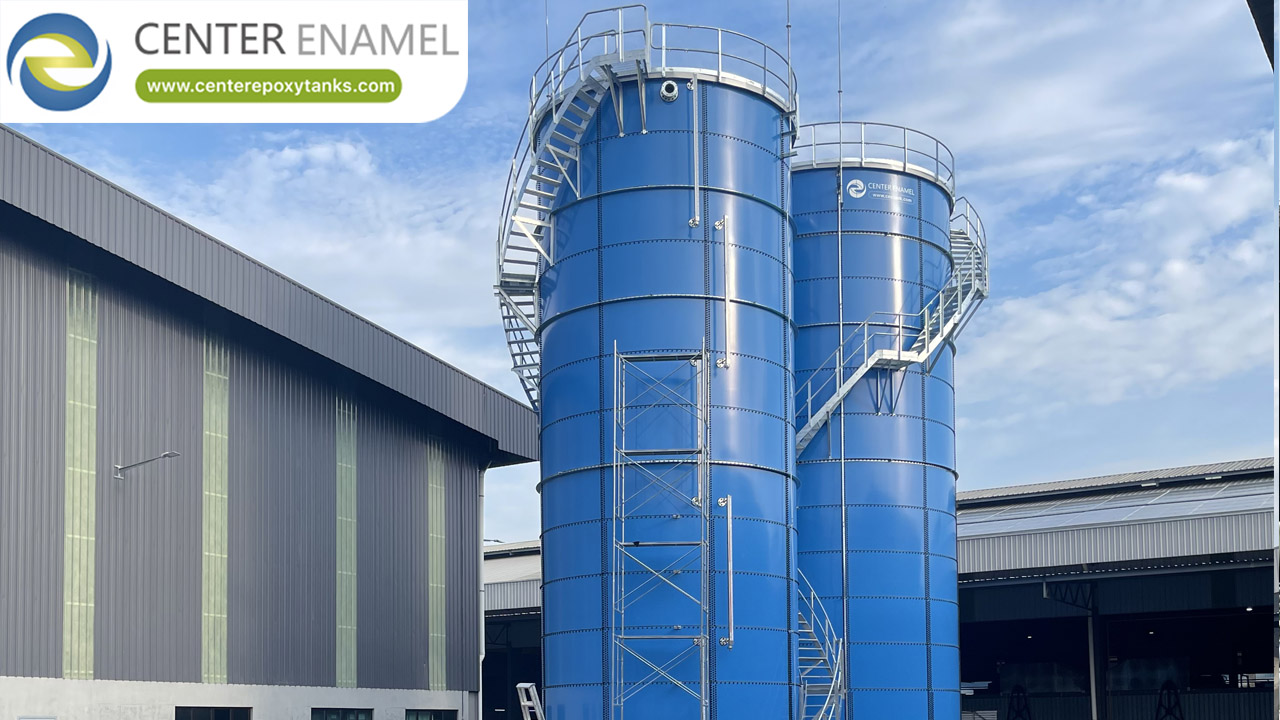
Pressurized vs Atmospheric Chilled Water Storage Tanks: Which to Specify
Specifiers often ask the simplest version of the pressure question: atmospheric or pressurized chilled water storage tank? The answer depends on loop pressure, footprint, and how duties combine. This article is a side-by-side decision guide.
Choose an atmospheric chilled water storage tank (bolted GFS, stainless, or welded, to AWWA D103) for bulk low-pressure TES and buffer duty - it is simpler and cheaper per volume. Choose a pressurized (ASME Section VIII) vessel when storage sits on a closed pressurized loop, space is tight, or expansion/TES share one coded shell. The decision is driven by operating pressure and duty combination, not preference.
Atmospheric Tanks: Simplicity at Scale
Atmospheric bolted tanks are the default for large TES because they are economical per cubic meter, easy to stratify, and erected from panels on site. They suit open or low-pressure chilled-water duty.
The trade-off is footprint and the inability to sit directly on a pressurized loop.
Pressurized Vessels: Compact and Code-Bound
Pressurized vessels fit closed loops and dense plants, combining duties in one coded shell, but cost more per volume and require ASME documentation. They are the right tool when pressure or space forces the choice.
Decision Checklist
Ask: (1) Is the duty on a pressurized loop? If yes, vessel. (2) Is footprint severely limited? Vessel may win. (3) Is this bulk low-pressure TES? Atmospheric. (4) Can expansion+TES combine? Vessel, within code. The answers usually make the choice clear.
Comparison
Factor | Atmospheric tank | Pressurized vessel |
Operating pressure | Low / open | Closed, pressurized |
Cost per volume | Lower | Higher |
Footprint | Larger | Compact |
Construction | AWWA D103 bolted | ASME VIII coded |
Stratification | Easy (diffusers) | Possible in-shell |
Best for | Bulk TES / buffer | Closed loop / tight space |
Duty combine | Separate | Expansion+TES ok |
Technical Specifications
Parameter | Specification |
Decision 1 | Loop pressurized? |
Decision 2 | Footprint limited? |
Decision 3 | Bulk low-pressure? |
Atm standard | AWWA D103 |
PV standard | ASME VIII |
Atm material | GFS / stainless |
PV material | Carbon / stainless |
QA | ISO 9001 |
Combine? | Vessel only |
Cost | Atm lower /m3 |
Verified Tank Engineering Reference
Center Enamel manufactures both options - atmospheric bolted tanks (AWWA D103 / ISO 28765) and ASME Section VIII pressure vessels (U-stamp) - so the pressurized-vs-atmospheric decision can be made per duty without changing supplier. Real pressure-vessel reference: 2026 Malta desalination vessels and China/Uzbekistan PV projects. Not data-center projects.
Project location | Malta |
Application | Seawater desalination |
Tank type | Pressure vessel |
Scale | 2 unit(s), 1.24*1.84m(H) 1unit、1.2*1.665m(H) 1unit |
Total volume | 2 m3 |
Year | 2026-03 |
Note | Cited as manufacturing-capability evidence, not a data-center project. |
Center Enamel Capability
Center Enamel offers the full choice: large bolted GFS, FBE, stainless, and welded atmospheric tanks for bulk TES/buffer, and ASME Section VIII vessels for pressurized expansion, buffer, and TES duties. All are built under ISO 9001 with the relevant certifications (NSF/ANSI 61, WRAS for water contact; U-stamp for vessels).
Because both lines share one quality system, a campus can standardize QA while selecting the right pressure class per duty.
Frequently Asked Questions
Q: When should I pick atmospheric?
A: For bulk low-pressure TES or buffer duty where footprint and cost favor a large bolted tank.
Q: When should I pick pressurized?
A: When storage is on a closed pressurized loop, space is tight, or expansion and TES combine in one shell.
Q: Which is cheaper?
A: Atmospheric tanks are lower cost per cubic meter; pressurized vessels cost more but suit their duty.
Q: Can both stratify?
A: Yes - atmospheric easily; pressurized within the coded shell using diffusers.
Q: What codes apply to each?
A: Atmospheric: AWWA D103 / ISO 28765. Pressurized: ASME Section VIII.
Q: Can one supplier provide both?
A: Yes - Center Enamel builds both lines under one ISO 9001 system.
Atmospheric versus pressurized is a pressure-and-duty decision, not a style choice. Bulk low-pressure TES wants an atmospheric bolted tank; closed-loop or space-bound duty wants an ASME vessel. Match each to its loop and the spec writes itself.
Suggested Next Step
Answer our four-question checklist for your site - we will recommend atmospheric or pressurized and size it to code.


