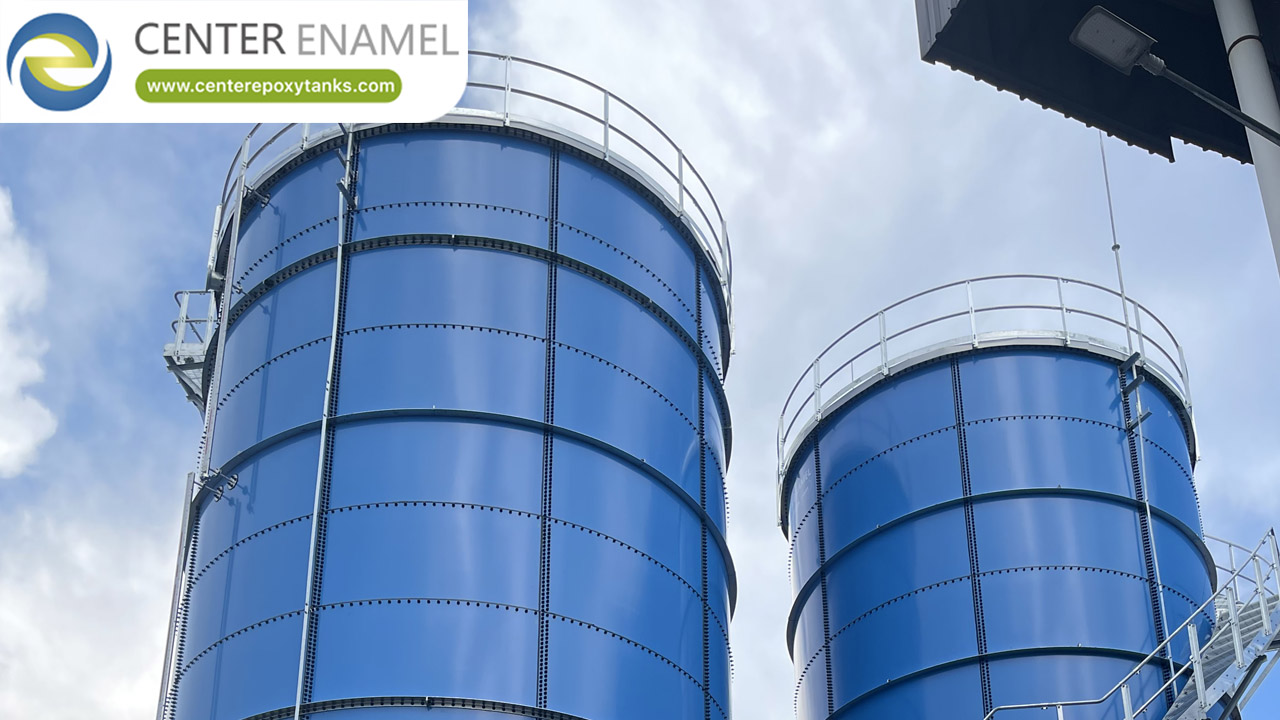
Potable Water Storage Solutions with Durable Epoxy Coated Tanks
Securing a clean, dependable source of drinking water is one of the most critical challenges facing modern municipal engineers, industrial site managers, and real estate developers. Because drinking water is intended for human consumption, the containment vessels holding it must meet the world's most demanding hygiene, chemical stability, and structural durability guidelines.
Among all modern container options, durable epoxy coated bolted steel tanks—specifically those utilizing factory-applied Fusion Bonded Epoxy (FBE)—have become the leading choice for potable water storage solutions. Manufacturers like Center Enamel engineer these systems to eliminate the risk of water contamination while providing a structural service life that spans decades.
The Critical Importance of Potable Water Certification
With drinking water, there is zero margin for material failure. Raw steel tanks corrode quickly, while concrete structures are prone to micro-cracking and bacterial growth. Standard liquid paints can leach volatile organic compounds (VOCs) or heavy metals directly into the water supply.
To guarantee public safety, modern potable water tanks must rely on specialized protective coatings:
The Gold Standard: NSF/ANSI 61 Certification
Any epoxy coating system used for drinking water must be certified under NSF/ANSI/CAN 61: Drinking Water System Components – Health Effects. This independent certification ensures that no harmful chemicals leach from the epoxy barrier into the water, even under extended high-temperature stagnation.
Why Fusion Bonded Epoxy (FBE) is the Ideal Coating for Potable Water
Fusion Bonded Epoxy is not standard paint; it is an advanced, thermally cured thermoset polymer barrier. The powder coating is electrostatically applied to hot, grit-blasted steel sheets in a highly controlled factory environment.
1. Exceptional Chemical and Physical Inertness
Once cured, FBE forms a highly cross-linked polymer network. This makes the surface completely inert, preventing the stored water from reacting with the underlying structural carbon steel. It also resists chlorine and other disinfectants commonly used in municipal water treatment.
2. Ultra-Smooth Internal Surface (Low Roughness)
The smooth, glass-like finish of factory-cured epoxy minimizes microscopic surface roughness. This lack of texture makes it incredibly difficult for mineral scale to accumulate or for biological slime (biofilm) and bacteria to cling to the tank interior.
3. High Impact and Flexural Strength
During shipping, handling, and erection, standard liquid coatings are highly vulnerable to chipping and scratching. Because FBE chemically fuses to the steel substrate at high temperatures, it exhibits superior physical ductility and impact resistance, ensuring the protective barrier remains flawless.
Technical Performance Profile
For engineering specifiers comparing storage technologies, FBE bolted steel tanks provide premium mechanical and chemical properties:
Performance Metric | Industrial Specification Value | Regulatory Compliance Benchmark |
Coating Type | Thermoset Fusion Bonded Epoxy (FBE) | AWWA D103-19 / ISO 28765 |
Health & Safety Standard | 100% VOC-Free, Heavy Metal-Free Formulation | NSF/ANSI 61 / WRAS (UK) |
Dry Film Thickness (DFT) | 150 µm to 250 µm (Internal & External layers) | ISO 21809-2 |
Adhesion Testing | Minimum 12 MPa (Pull-off adhesion) | ASTM D4541 / ISO 4624 |
Pinhole Inspection | 100% factory spark testing at 1500V | AWWA D103 Section 10.6 |
UV Resistance | Durable exterior topcoats optional for high-UV sites | ASTM G154 |
Modular Tank Construction: Fast, Safe, and Scalable
Center Enamel's potable water storage solutions utilize a modular bolted design. Rather than spending months welding and coating a tank in unpredictable outdoor conditions, the entire structure is manufactured under strict laboratory tolerances in a factory and shipped directly to the site.
1.Concrete Foundation & Starter Ring Placement:Engineered Slab。
A level concrete slab is constructed with built-in plumbing connections. A specialized galvanized starter ring is anchored to the base to serve as the foundation connection point.
2.Panel Unboxing and Gasket Positioning:Quality Assurance。
The factory-finished epoxy panels are unboxed and inspected on-site. High-grade EPDM or specialized elastomeric gaskets are positioned along the pre-punched bolt holes.
3.Hydraulic Lifting and Progressive Ring Assembly:Low-Altitude Erection。
Using synchronized hydraulic jacks, the top rings and the roof are assembled near the ground. The tank is gradually lifted upward, allowing crew members to bolt subsequent lower rings in place safely at ground level.
4.Sanitization, Sealing, and Hydrostatic Commissioning:Water Security。
The tank seams are tightened to exact torque specs, and the interior is fully sanitized. The structure undergoes a hydrostatic leak test before being certified for public water distribution.
Frequently Asked Questions (FAQ)
What makes an epoxy coated tank suitable for potable (drinking) water storage?
An epoxy coated tank is suitable for drinking water only if the epoxy system is certified to NSF/ANSI 61 or WRAS. These certifications guarantee that the cured polymer coating is entirely non-toxic, 100% free of volatile organic compounds (VOCs), and will not leach chemicals, tastes, or odors into the clean water supply.
How does Fusion Bonded Epoxy (FBE) compare to traditional liquid epoxy paints?
Traditional liquid epoxy is sprayed on in the field and cures slowly at ambient temperatures, making it vulnerable to wind, dust, moisture, and uneven thickness. Fusion Bonded Epoxy (FBE) is electrostatically applied in a controlled factory and baked at high temperatures (~200°C). This thermal fusion process creates a far more uniform, durable, and highly cross-linked barrier with superior adhesion and impact resistance.
How often do epoxy coated potable water tanks require maintenance?
Because FBE coatings are highly resistant to corrosion and scale accumulation, maintenance requirements are minimal. We recommend basic annual visual inspections of the exterior and an interior cleaning/inspection every 3 to 5 years depending on local municipal water quality guidelines.
Can these tanks be used in seismically active or high-wind coastal zones?
Yes. Every potable water tank engineered by Center Enamel is custom-calculated to match the specific environmental loads of the installation site. The structural steel panels, bolt configurations, and wind rings are designed in compliance with AWWA D103-19 and local building codes to withstand severe seismic events and high coastal wind gusts.


