Modular vs. Monolithic: Why Fusion-Bonded Epoxy Steel Tanks are Replacing Concrete in 2026
For decades, concrete was the default choice for large-scale water and wastewater storage. However, in 2026, the global push for sustainable infrastructure and rapid project deployment has shifted the advantage toward modular solutions.
While concrete is often perceived as "permanent," Fusion-Bonded Epoxy (FBE) Bolted Steel Tanks provide a combination of chemical resistance, installation speed, and lower lifecycle costs that concrete simply cannot match.
1. Installation Speed and Site Impact
The most immediate difference lies in the project timeline.
● Concrete Tanks: These are "monolithic" structures that require extensive on-site preparation. You must account for weather-dependent curing times, complex formwork, and heavy machinery. A typical large-scale concrete tank can take 4 to 6 months to complete.
●
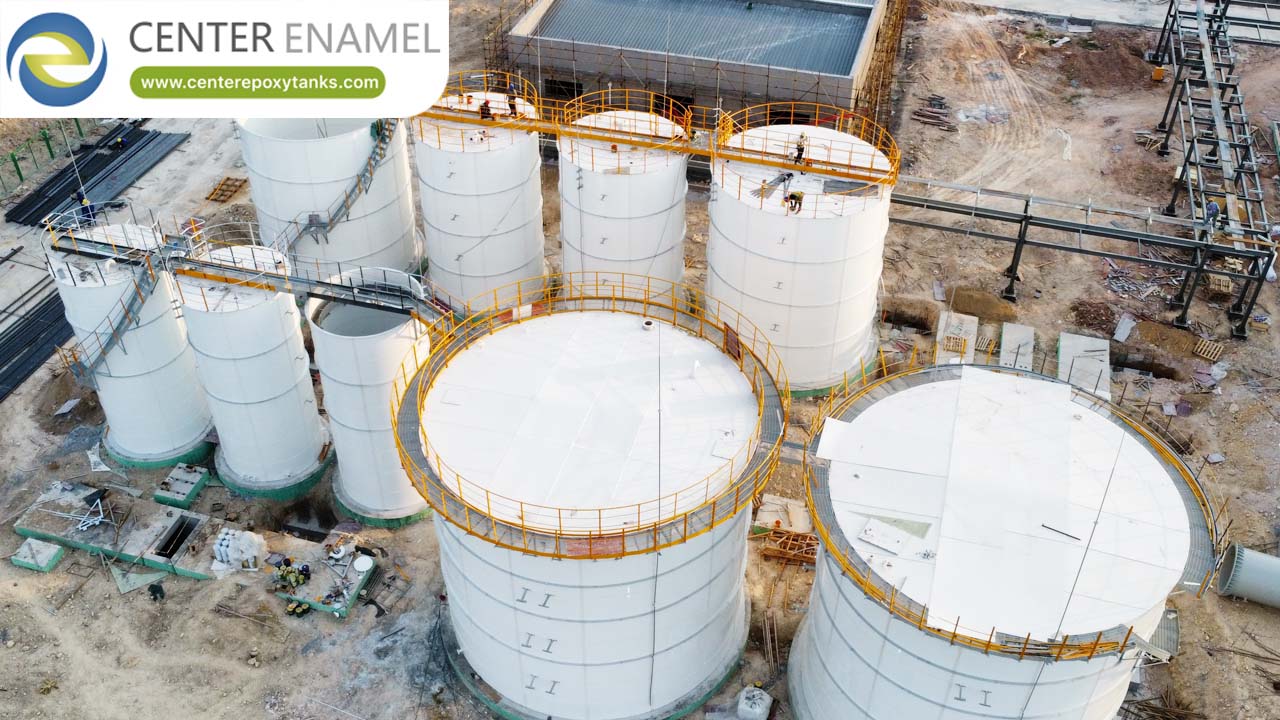
● FBE Bolted Steel Tanks: These are factory-manufactured and modular. By utilizing Jack-up Installation (building from the top down at ground level), a tank can be commissioned in weeks, not months. Since there is no curing time, the tank can be put into service immediately after assembly.
●
2. Corrosion Resistance and Water Impermeability
In 2026, the chemical composition of stored media—especially in wastewater and biogas sectors—is becoming more aggressive.
● Concrete: Concrete is naturally porous. Over time, liquids can seep into the structure, leading to "rebar rot" (corrosion of the internal steel reinforcement). For aggressive media, concrete requires expensive internal liners that are prone to delamination.
●
● FBE Steel: Fusion-Bonded Epoxy is a high-performance polymer fused to the steel at 150°C–250°C. This creates a non-porous, chemically bonded barrier. At Center Enamel, our FBE tanks undergo 100% Holiday Testing at 1100V–1500V, ensuring zero microscopic defects—a level of precision impossible to achieve with field-poured concrete.
●
3. Resilience to Structural Stress (Seismic and Wind)
In regions prone to seismic activity or extreme weather, the "flexibility" of the material is a critical safety factor.
● Concrete: Concrete is brittle. Under seismic stress or significant ground settling, it is prone to cracking. Once a concrete tank cracks, the structural integrity is compromised, and leak repair is both difficult and expensive.
●
● FBE Bolted Steel: Bolted steel tanks are designed with "controlled flexibility." They can withstand seismic loads and high wind speeds (up to 60 m/s) more effectively than rigid concrete. If a panel is damaged, it can be replaced individually without replacing the entire structure.
4. Maintenance and Lifecycle Costs (TCO)
In 2026, procurement managers focus on the Total Cost of Ownership (TCO) rather than just the initial capital expenditure (CAPEX).
Feature | Fusion-Bonded Epoxy (FBE) Steel | Concrete Tanks |
Maintenance | Minimal; anti-adhesive surface | High; prone to cracking/leaking |
Expansion | Easily expandable or relocatable | Impossible to move or expand |
Service Life | 30+ Years | 20–50 Years (with heavy maintenance) |
Sustainability | 100% Recyclable | High carbon footprint; high waste |
5. Sustainability and the Circular Economy
As an ISO 14001 compliant manufacturer, Center Enamel recognizes that sustainability is the 2026 standard.
● Concrete: The production of cement is one of the highest carbon-emitting processes in the world. Furthermore, once a concrete tank reaches the end of its life, it becomes massive industrial waste.
● FBE Steel: Steel is the most recycled material on the planet. FBE tanks have a lower carbon footprint during transport (due to their modular, flat-packed nature) and can be fully recycled at the end of their service life.
●
The Center Enamel Advantage
As the leader of the bolted tank industry in Asia since 2008, Shijiazhuang Zhengzhong Technology (Center Enamel) has seen the global transition away from concrete firsthand. Our FBE tanks, certified to NSF/ANSI 61 and AWWA D103-19, offer a "smart" alternative that is faster to build, easier to maintain, and safer for the environment.


