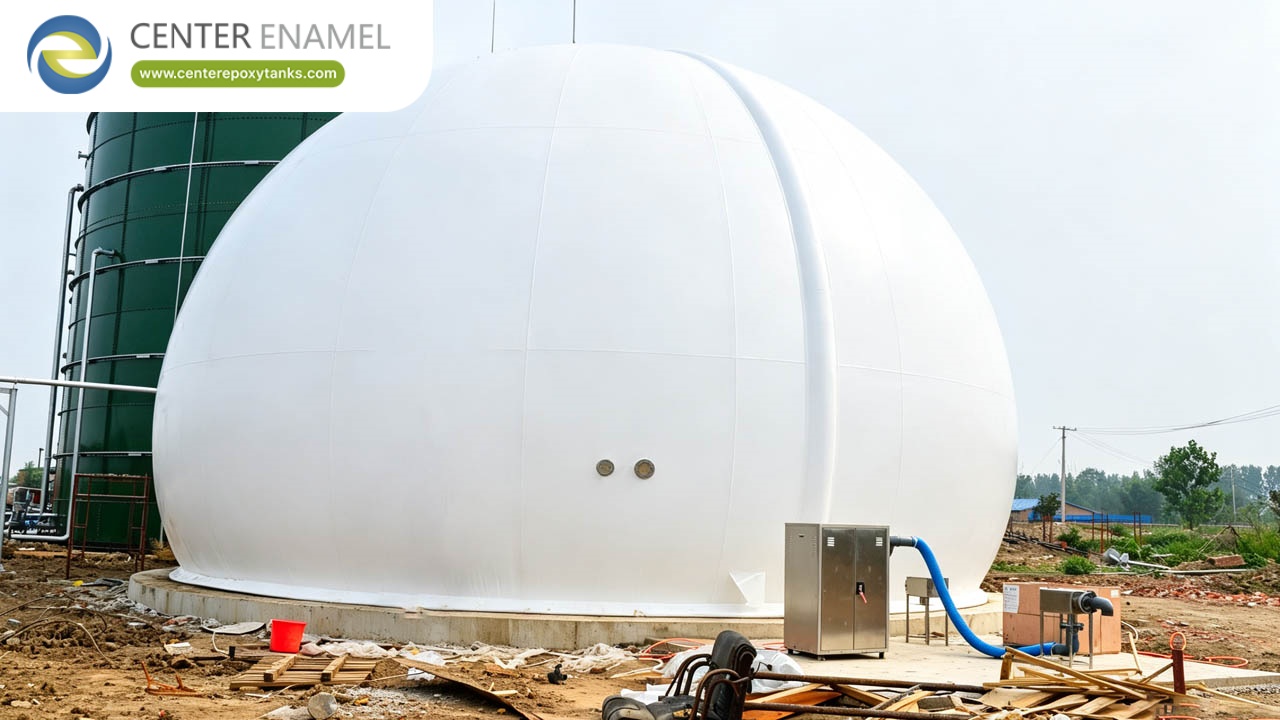
Membrane Gas Holder for Livestock Manure Treatment Projects: Maximizing Biogas Efficiency and Environmental Compliance
Intensive livestock farming operations generate massive volumes of organic waste that present both severe environmental challenges and significant renewable energy opportunities. When managed through anaerobic digestion systems, livestock manure breaks down to produce valuable biogas—a clean energy source rich in methane ($CH_4$). However, because biological gas production fluctuates constantly due to feeding schedules, herd size shifts, and seasonal temperature changes, agricultural facilities require robust containment technology.
A membrane gas holder serves as the vital dynamic interface in a livestock manure treatment project. By bridging variable gas generation with steady downstream energy utilization, it ensures a closed-loop system that drives down energy costs, eliminates foul odors, and achieves environmental excellence.
How a Membrane Gas Holder Works in Agricultural Applications
Modern agricultural gas holders typically utilize an engineered double-membrane design constructed from high-tenacity, PVC-coated polyester structural fabrics. The system functions through a specialized multi-tier structure:
Inner Gas Storage Membrane: The inner membrane sits inside the digester tank or standalone foundation, expanding and contracting flexibly to securely store the generated biogas while isolating it from atmospheric oxygen.
Outer Weather Protection Membrane: The outer membrane creates an aerodynamic, protective dome. It is continuously stabilized by an automated air-blower system that maintains uniform pressure within the inter-membrane space.
Constant-Pressure Regulation System: An intelligent control cabinet regulates the inter-membrane air pressure, exerting a steady downward counter-pressure on the inner gas chamber. This ensures a stable, reliable gas delivery pressure to downstream combined heat and power (CHP) generators, boilers, or flare systems.
Exceptional Chemical and H2S Resistance: Livestock biogas contains high levels of moisture and corrosive trace gases such as hydrogen sulfide ($H_2S$). Specialized membrane materials are engineered to withstand up to 8,000 ppm of H2S without degradation, preventing premature structural failure.
Strategic Advantages in Livestock Manure Treatment
Integrating a membrane gas holder into an animal waste treatment project delivers multi-faceted operational and financial benefits:
Flow Stabilization and Volume Buffering: Manure digestion yields inconsistent daily gas volumes. The large volumetric capacity of a flexible membrane gas holder absorbs production peaks and troughs, ensuring that utilization equipment runs continuously at peak efficiency.
Total Odor and Emission Mitigation: Open or poorly sealed manure lagoons release massive amounts of methane and foul-smelling compounds. Airtight membrane covers trap these emissions completely, fulfilling strict environmental regulations and improving community relations.
Reduced Capital and Installation Costs: Compared to heavy, expensive standalone steel gas spheres or complex civil structures, modular membrane gas holders offer rapid on-site assembly, minimal foundation requirements, and long service lives.
Data Table: Comprehensive Comparison of Biogas Storage Solutions
Technical Parameter | Double Membrane Gas Holder | Standalone Steel Gas Sphere | Fixed Concrete Digester Roof |
Primary Function | Integrated volumetric gas storage and active pressure regulation | Standalone high-pressure gas storage vessel | Structural tank cover with zero gas buffering capacity |
Volumetric Flexibility | High; expands and contracts seamlessly with daily biogas production cycles | Rigid volume; requires complex compressor systems for variable storage | None; fixed volume headspace prone to dangerous overpressure risks |
Corrosion Defense | High-tenacity PVC/PVDF fabrics completely immune to moisture and H2S attack | Carbon steel susceptible to internal pitting and stress corrosion cracking | Vulnerable to concrete carbonation and acid-induced spalling |
Installation & Footprint | Lightweight, modular, mounted directly on tank crowns or ground pads | Heavy industrial footprint requiring extensive crane lifts and civil works | Heavy mass requiring reinforced concrete walls and foundations |
Frequently Asked Questions (FAQ)
Q: What is the main purpose of a membrane gas holder in a livestock manure treatment project?
A: It acts as a flexible storage and pressure-regulation buffer that bridges the gap between variable biological biogas production from manure digestion and constant energy generation equipment.
Q: How does the double membrane design maintain stable gas pressure?
A: An automated air-blower system maintains a regulated air cushion between the inner and outer membranes, exerting a steady downward force on the inner gas chamber to guarantee consistent delivery pressure to downstream generators.
Q: Are membrane gas holders resistant to corrosive gases like hydrogen sulfide (H2S)?
A: Yes. High-performance agricultural membranes are manufactured from specialized PVC-coated polyester fabrics specifically formulated to resist high concentrations of moisture, UV radiation, and hydrogen sulfide (H2S).
Q: How does covering livestock manure storage with a membrane system help the environment?
A: It captures potent greenhouse gases like methane and volatile odor compounds, preventing them from escaping into the atmosphere and routing them safely to energy recovery systems or flares.


