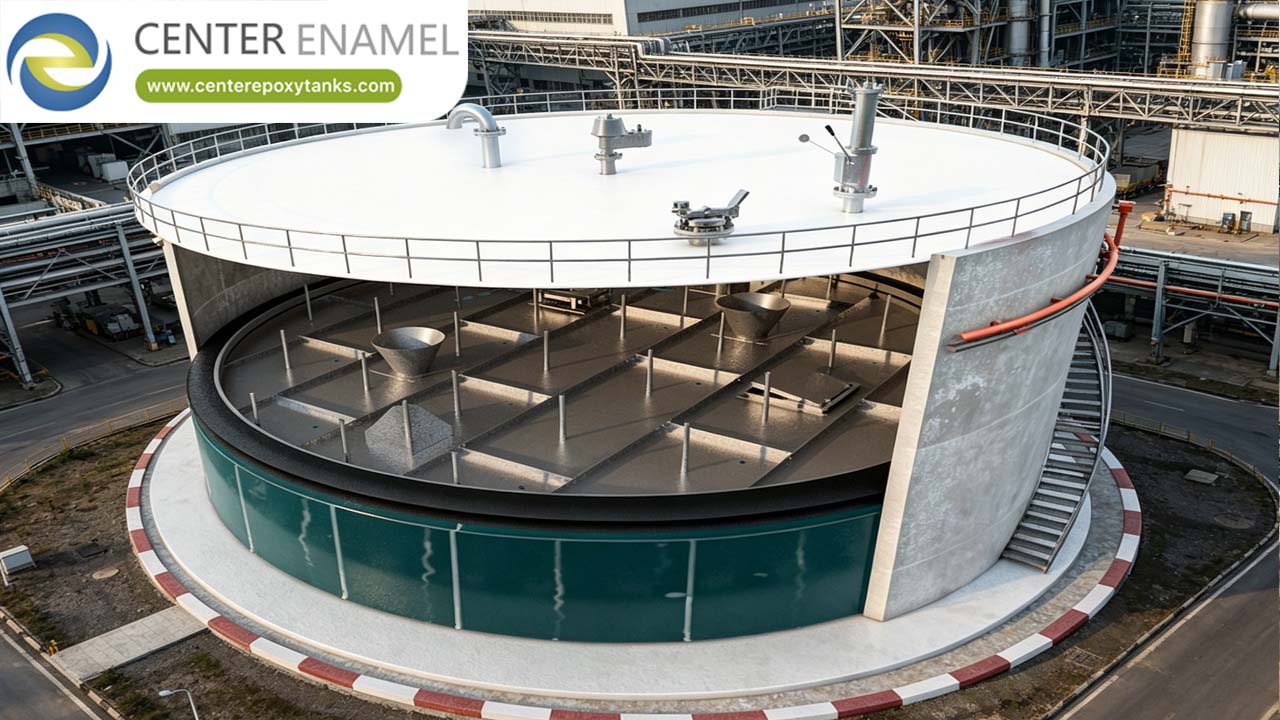
Internal Floating Roofs (IFR) for Gasoline Tanks: The Engineering Standard for Vapor Recovery
In the 2026 industrial landscape, the storage of gasoline—a highly volatile "Class I" flammable liquid—presents a dual challenge of environmental compliance and product preservation. The Internal Floating Roof (IFR) has emerged as the definitive engineering solution for fixed-roof gasoline tanks. By eliminating the vapor space (ullage), an IFR significantly reduces the emission of Volatile Organic Compounds (VOCs) and virtually removes the risk of internal tank explosions.
Shijiazhuang Zhengzhong Technology Co., Ltd (Center Enamel), with over 30 years of global expertise, provides precision-engineered Internal Floating Roofs that exceed the rigorous mandates of API 650 Appendix H.
1. Technical Authority: How IFR Technology Works
An IFR is a buoyant deck that floats directly on the surface of the gasoline. As the tank is filled or emptied, the roof rises and falls with the liquid level.
IFR Performance Matrix
Feature | Engineering Specification | Strategic Operational Value |
Design Standard | API 650 Appendix H | Global benchmark for internal floating systems. |
Vapor Reduction | 99% Effectiveness | Eliminates product loss and meets 2026 ESG mandates. |
Material Choice | Aluminum or Stainless Steel | Lightweight buoyancy vs. extreme chemical resistance. |
Deck Type | Full Contact or Pontoon | Prevents vapor accumulation beneath the deck. |
Seal Integrity | Primary & Secondary Systems | Ensures a gas-tight fit against the tank shell. |
2. Critical Benefits for Gasoline Storage
A. Volatile Organic Compound (VOC) Mitigation
Gasoline has a high vapor pressure, meaning it evaporates rapidly at atmospheric temperatures. An IFR eliminates the air-vapor interface, preventing the conversion of liquid gasoline into gas. This preservation of "light ends" ensures the gasoline maintains its octane rating and market value.
B. Fire and Explosion Prevention
In a standard fixed-roof tank, the space between the liquid and the roof is filled with a potentially explosive mixture of air and gasoline vapor. By eliminating this space, the IFR removes the primary fuel source for internal tank fires, making it a critical safety asset for bulk terminals.
C. Environmental Compliance
With the 2026 tightening of global air quality standards, facilities are required to implement the Best Available Control Technology (BACT). An IFR system is recognized globally as a superior method for meeting zero-emission targets.
3. Engineering Excellence: The Center Enamel Advantage
As a premier manufacturer, Center Enamel integrates advanced material science with customizable IFR designs:
● Precision Buoyancy: Our roofs are engineered to remain stable during high-turbulence filling cycles, preventing "tilting" or "sinking" through compartmentalized pontoon designs.
● Aluminum vs. Stainless Steel: We provide lightweight Aluminum IFRs for standard gasoline and Stainless Steel IFRs for aggressive additives or highly corrosive "sour" gasoline environments.
● Advanced Seal Technology: Utilizing mechanical shoe seals or liquid-mounted resilient seals that maintain a tight barrier even in tanks with minor shell irregularities.
4. Synergistic Integration: IFR + Aluminum Geodesic Domes
To maximize the service life of gasoline assets, Center Enamel recommends pairing an IFR with an Aluminum Geodesic Dome Roof.
● Weather Protection: The dome protects the internal floating roof from rainwater ingress, which is a primary cause of IFR failure and fuel contamination.
● Clear-Span Interior: The geodesic design requires no internal support columns, allowing the IFR to move unobstructed across the entire diameter of the tank.
5. Why Partner with Center Enamel?
With successful projects in over 100 countries, Center Enamel is more than a supplier; we are a technical partner in energy infrastructure.
1. 30+ Years of Expertise: Proven reliability in petroleum and chemical storage.
2. API 650 Compliance: Every IFR is designed, fabricated, and tested to meet international safety codes.
3. Turnkey Solutions: From initial R&D and Finite Element Analysis (FEA) to on-site installation guidance, we ensure a unified, high-performance system.
Optimizing Gasoline Assets for 2026
An Internal Floating Roof (IFR) is not just a regulatory requirement; it is a strategic investment in safety and profitability. By preventing vapor loss and protecting product integrity, Center Enamel’s IFR systems ensure your gasoline storage operations are efficient, compliant, and ready for the future.
Secure your volatile assets with world-class vapor control technology. Contact Center Enamel today for a technical consultation and API 650 Appendix H compliant quote.


