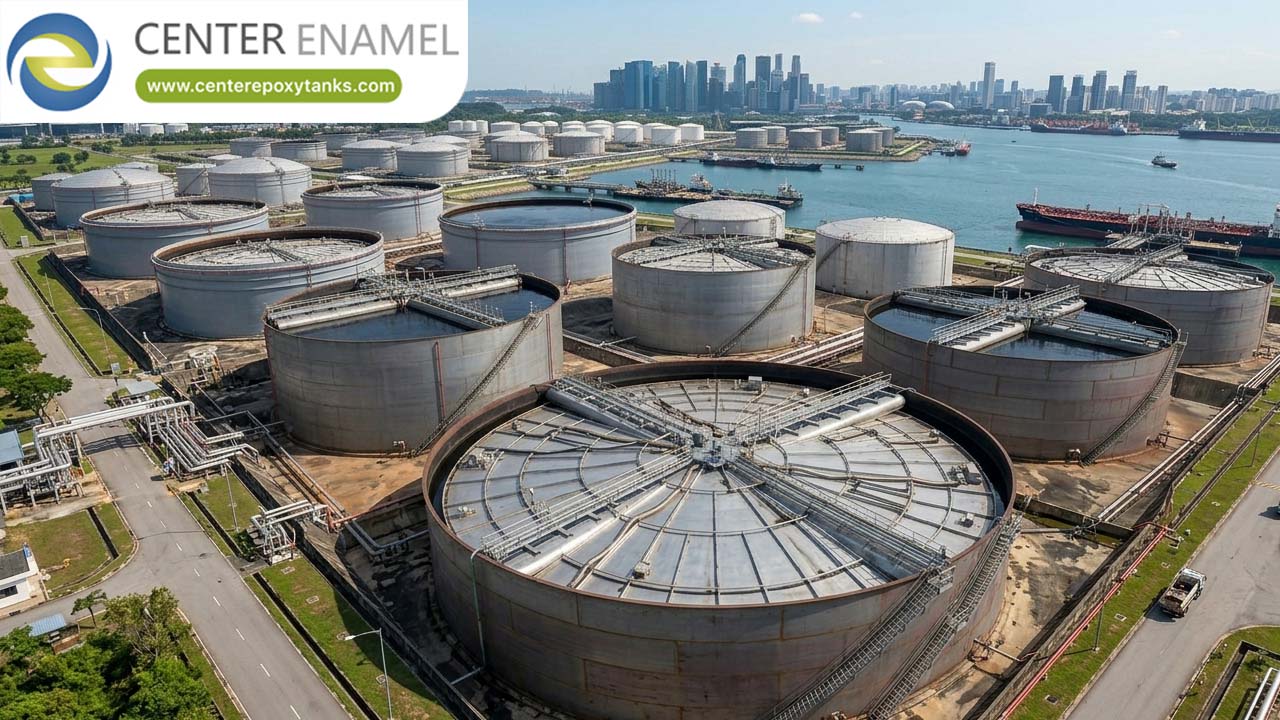
Internal Floating Roofs for Gasoline and Diesel Storage Tanks: Maximizing Efficiency, Emission Control, and Safety
In fuel terminals, petroleum refineries, and bulk distribution depots, storing volatile organic liquids like gasoline, naphtha, and middle distillates such as diesel requires strict containment engineering. When petroleum products are stored in traditional fixed-roof tanks, a vapor-air space forms between the liquid surface and the roof. As ambient temperatures fluctuate and tanks are filled or emptied, this vapor space expands and contracts, driving significant working and breathing losses that release harmful volatile organic compounds (VOCs) into the atmosphere.
To eliminate this vapor space, optimize fuel recovery, and enhance environmental compliance, industry operators install an Internal Floating Roof (IFR) inside a permanent fixed-cone or dome roof tank. Designed to float directly on the surface of the stored fuel, the IFR moves vertically with changing liquid levels, effectively suppressing vapor generation and reducing fire risks.
Core Engineering Principles and Emission Mitigation
The structural design and operational performance of internal floating roofs are governed by precise engineering standards, most notably API 650 Appendix H:
Vapor Space Elimination: By resting directly on the liquid surface, an IFR eliminates virtually all vapor-air mixtures above the product. For high-volatility products like gasoline, this reduces evaporative emissions by up to 99% compared to bare fixed-roof tanks, protecting ambient air quality and preventing valuable product loss.
Fire Risk Reduction: Flammable vapor concentrations inside a fuel storage tank are primary drivers of catastrophic tank fires. An internal floating roof removes the oxygen-rich vapor pocket above the fuel surface, drastically minimizing combustion risks.
Advanced Rim Seal Systems: To prevent vapors from escaping through the annular gap between the floating deck and the tank shell, IFRs are equipped with specialized mechanical shoe seals, liquid-mounted foam seals, or wiper seals. These flexible seals maintain continuous contact with the tank wall during operation.
Data Table: Comprehensive Comparison of Internal Floating Roof Types
Technical Parameter | Aluminum Pontoon Internal Floating Roofs | Full-Contact Honeycomb Panel Roofs | Traditional Steel Pan Internal Roofs |
Material Composition | Corrosion-resistant structural aluminum alloys (e.g., 6000 series) | Aluminum skin bonded to a lightweight honeycomb core | Carbon steel plates with welded outer rims |
Buoyancy & Safety | Sealed tubular pontoons provide high reserve buoyancy | Fully submerged core prevents localized gas accumulation | Single deck with marginal buoyancy; vulnerable to sinking if flooded |
Vapor Suppression Efficiency | Excellent; minimizes vapor pockets across standard operations | Superior full-contact design eliminates liquid surface exposure entirely | Moderate vapor control; prone to vapor entrapment underneath |
Installation & Maintenance | Lightweight components allow rapid manual installation through small roof nozzles | Low dead-weight load; minimal maintenance requirements over time | Heavy structure requiring extensive welding and frequent corrosion upkeep |
Frequently Asked Questions (FAQ)
Q: What is the primary purpose of an internal floating roof in gasoline and diesel tanks?
A: It floats directly on top of the liquid fuel to eliminate the vapor space, significantly reducing VOC evaporation losses, preventing odor emissions, and enhancing overall fire safety.
Q: Are internal floating roofs used for both gasoline and diesel fuel?
A: Yes. While gasoline has a high vapor pressure and requires rigorous vapor suppression, installing IFRs in diesel storage tanks also helps prevent contamination from moisture, limits oxidation, and controls hydrocarbon emissions.
Q: What international design standard governs internal floating roof tanks?
A: Aboveground welded steel storage tanks and their internal floating covers are primarily designed, fabricated, and tested in accordance with API 650 (specifically Appendix H for internal floating roofs).
Q: Can an existing fixed-roof fuel tank be retrofitted with an internal floating roof?
A: Yes. Existing cone-roof or dome-roof tanks can be easily retrofitted with modular aluminum internal floating roofs, allowing older facilities to upgrade their environmental performance and meet modern EPA or local emission standards without replacing the entire tank shell.


