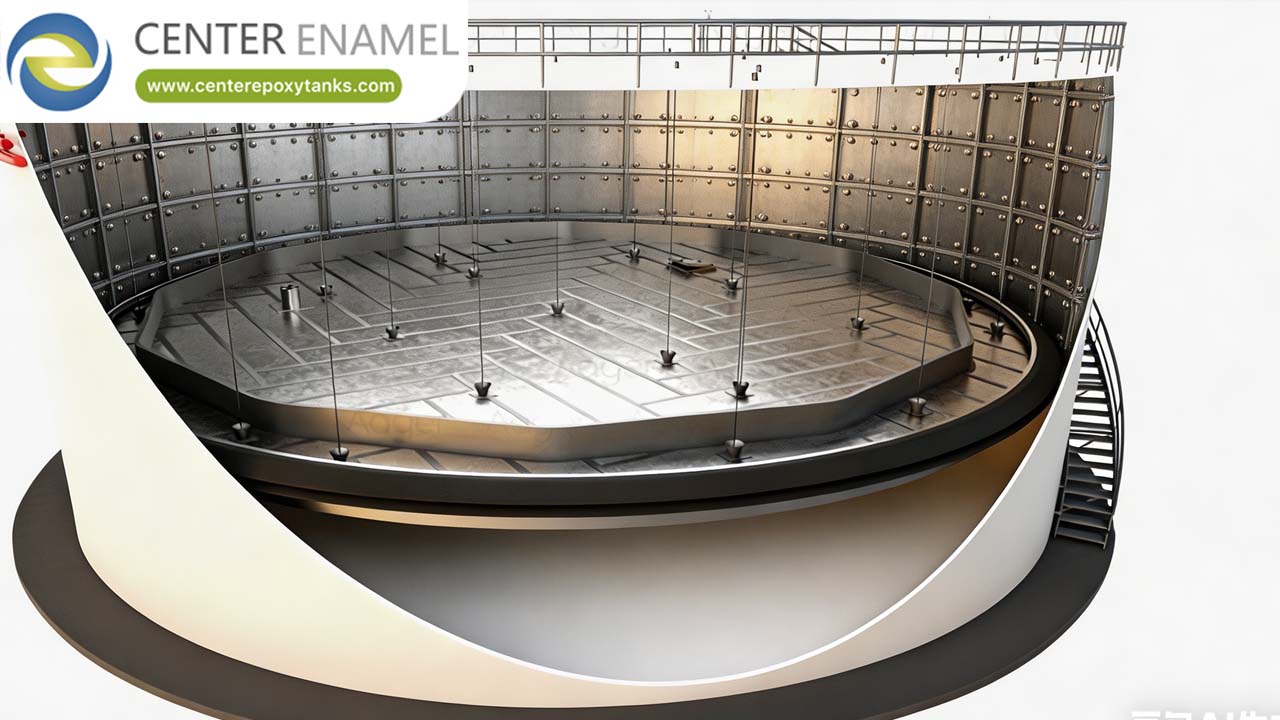
Internal Floating Roofs: Evaporative Loss Control for Fixed Roof Tanks
A fixed-roof tank full of gasoline breathes every day: the sun heats the vapor space, the vent exhales product, the night cools it, and the vent inhales fresh air to repeat the cycle. Over a year, that breathing quietly evaporates a measurable fraction of the inventory — which is why the internal floating roof became the default retrofit for every volatile tank in the regulated world.
Internal floating roofs (IFRs) are decks that float directly on the liquid surface inside fixed-roof tanks, designed to API 650 Annex H in contact (full-contact, low-deck) or non-contact (pontoon-supported) aluminum, stainless, or steel constructions, eliminating the vapor space that drives standing and breathing losses by up to 99%.
1. How Does an Internal Floating Roof Eliminate Losses?
The physics is simple: no vapor space, no breathing.
· Standing loss suppression: The deck covers 95%+ of the liquid surface, so product vapor simply has no free area to evaporate from.
· Breathing loss elimination: With the liquid blanketed, daily thermal cycles act on a tiny annular space instead of the whole tank cross-section.
· Rim-seal priority: The remaining emissions concentrate at the deck-to-shell annulus — seal system quality determines real-world performance.
· Fitting losses: Deck legs, wells, and hatches are designed with flush or gasketed details to keep the coverage fraction high.
2. Contact or Non-Contact — Which Deck Type Fits?
Deck selection balances product, vapor pressure, and inspection practice.
· Full-contact decks: Deck plate touches the liquid — the benchmark for gasoline and jet service, maximizing vapor exclusion; honeycomb and panel designs dominate.
· Non-contact pontoons: Pontoons support a deck above the liquid on legs, tolerant of dirty or waxy products and easier to land for inspection.
· Aluminum decks: Lightweight, modular, installable through manways without hot work — the retrofit standard.
· Stainless decks: Corrosion immunity for aggressive products and long maintenance intervals, at higher installed cost.
3. What Seal and Ventilation Engineering Applies?
The annular gap and the vapor space above the deck are engineered systems.
· Rim seals: Primary mechanical-shoe, liquid-mounted, or foam logs — increasingly paired with secondary seals for emission permit compliance.
· Vapor space ventilation: Circulation vents in the fixed roof keep the space above the deck below the lower explosive limit — a core Annex H safety requirement.
· Deck drainage: Primary and emergency drains route rainwater off the deck without contaminating product or destabilizing flotation.
· Gauging and sampling: Automatic gauging wells and sample hatches engineered flush keep routine operations from breaking the vapor barrier.
Data Table: IFR Deck Types Compared
Criterion | Full-Contact Deck | Non-Contact Pontoon |
Product fit | Gasoline, jet, clean | Dirty, waxy, high pour |
Vapor exclusion | Maximum | Very good |
Deck landing | Cables/legs | Fixed legs |
Corrosion exposure | Liquid contact | Vapor only |
Typical material | Aluminum / SS | Aluminum / SS / steel |
Emission permits | Tightest achievable | Seal-dependent |
Frequently Asked Questions (FAQ)
Q1: How much evaporation does an internal floating roof prevent?
Up to 99% of standing and breathing losses compared with a fixed-roof tank without a deck. The remaining emissions come almost entirely from the rim seal annulus and deck fittings — which is why permit-driven specifications concentrate on secondary seals and gasketed fittings.
Q2: What is the difference between a contact and non-contact internal floating roof?
Contact decks ride directly on the liquid, maximizing vapor exclusion for clean products like gasoline; non-contact decks float on pontoons above the liquid, suiting dirty or waxy products and simplifying inspection landings. Both are designed under API 650 Annex H.
Q3: Can an internal floating roof be retrofitted into an existing tank?
Yes — aluminum IFRs install through manways and assemble inside without hot work in most retrofits, usually combined with roof vent upgrades for vapor-space ventilation. Retrofits are the standard compliance path when emission rules tighten on existing fixed-roof tanks.
Q4: What maintenance does an internal floating roof need?
Periodic rim-seal inspection, drain function checks, and deck condition surveys — often performed during out-of-service inspections, with in-service visual checks through roof hatches. Aluminum decks in clean service commonly run 20+ years between major interventions.


