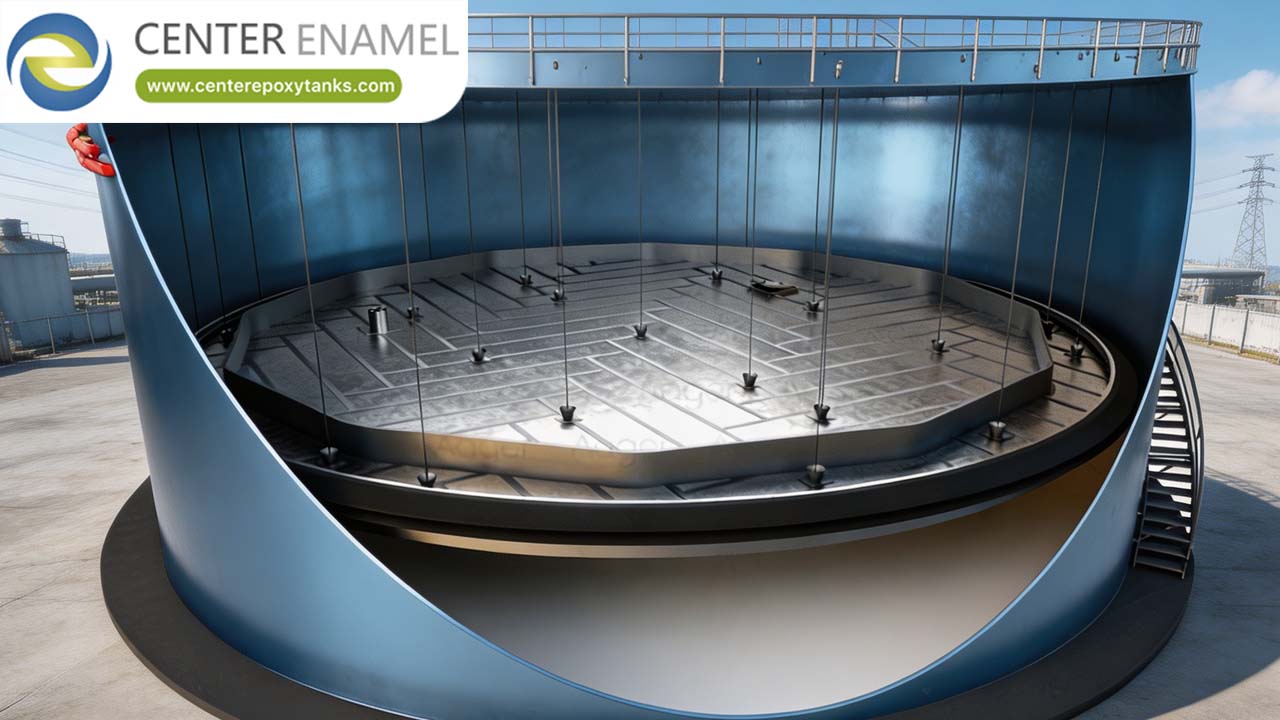
Internal Floating Roof Tanks: Engineering Design, Components, and Emission Control
In modern petroleum refining, petrochemical processing, and chemical bulk storage, minimizing volatile organic compound (VOC) emissions while protecting stored media from environmental contamination is a primary engineering objective. When volatile liquids like aviation fuel, high-purity naphtha, and reformate are stored in traditional fixed-roof tanks, hazardous vapor pockets form in the headspace, leading to heavy evaporative losses.
The definitive industry solution is the Internal Floating Roof Tank (IFR). Governed strictly by API 650 (Annex H) standards, an IFR combines the weather-shielding exterior protection of a fixed-roof tank with a lightweight, movable internal deck that floats directly on the liquid surface, eliminating dangerous vapor headspace.
1. Core Types of Internal Floating Roofs
Internal floating roofs are classified into specific design configurations based on buoyancy requirements, chemical compatibility, and structural composition:
Skin-and-Pontoon (Non-Contact) Decks: Comprising a thin metal sheet (skin) attached to a series of closed tubular or compartmentalized pontoons, this design floats slightly above the liquid surface. The enclosed air/vapor space inside the pontoons provides reserve buoyancy, making it a popular choice for standard fuel storage.
Full-Contact Honeycomb Decks: Built from high-strength aluminum sandwich panels or metallic plates that rest entirely flat on the liquid surface. Because there is zero vapor space beneath a full-contact deck, it delivers maximum emission-reduction efficiency for highly volatile or toxic chemicals.
Metallic Bulkhead (Pan-Type) Decks: Heavy-duty steel or stainless steel configurations engineered for extreme industrial environments where chemical aggression or high temperatures prohibit the use of aluminum alloys.
Data Table: Internal Floating Roof Tank Specification Matrix
Roof Design Type | Structural Material Options | Buoyancy & Redundancy Profile | Primary Industrial Application | Governing Standards |
Skin-and-Pontoon IFR | Aluminum, Carbon Steel, Stainless Steel | Tubular pontoons with 100% reserve buoyancy | Diesel, jet fuel, kerosene, heating oil | API 650 (Annex H) |
Full-Contact Sandwich Panel | High-strength Aluminum, Stainless Steel | Solid honeycomb core with continuous liquid contact | High-purity gasoline, volatile naphtha, aromatics | API 650 (Annex H) |
Heavy Metallic Bulkhead | Carbon Steel, Specialized Alloys | Multi-compartment welded steel bulkheads | Aggressive chemical feedstocks, high-temp fluids | API 650 / ASME |
2. Critical Mechanical Components and Ancillaries
The safe, continuous vertical movement of an internal floating roof relies on a tightly integrated network of mechanical sub-assemblies:
Rim Seal Systems: The essential perimeter barrier that bridges the narrow annular gap between the outer edge of the floating deck and the interior tank shell. Modern IFRs utilize primary and secondary seals (such as resilient foam-filled or mechanical shoe seals) that maintain continuous contact with the tank wall to prevent vapor migration.
Adjustable Support Legs: Equipped with support pins or dual-position legs, these allow the roof to rest securely above the tank floor during maintenance or emptying cycles, providing adequate clearance for internal piping and cleaning equipment.
Automatic Bleeder Vents: Critical safety valves mounted on the roof deck that automatically open when the roof lands on its legs during tank draining, preventing vacuum collapse or explosive vapor accumulation.
Anti-Rotation Devices and Guide Poles: Guide poles or cable systems prevent the internal roof from twisting or binding against the tank shell during high-speed fluid transfer operations.
3. Advantages of Internal Floating Roof Tanks Over External Designs
Complete Weather Protection: Because an IFR is housed inside a fixed outer dome or cone roof, rainwater, snow, and UV radiation are completely blocked. This eliminates the risk of water accumulation on the deck and prevents UV-induced seal degradation.
Extended Maintenance Cycles: Shielding the internal moving parts from harsh environmental elements significantly extends the operational lifecycle and reduces routine maintenance requirements compared to external floating roof tanks (EFRTs).
Superior Emission Control: Combining an outer fixed structure with a continuous contact internal deck traps volatile vapors effectively, achieving up to 99% reduction in VOC emissions.
Frequently Asked Questions (FAQ)
Q: What is an Internal Floating Roof Tank (IFR)?
A: An IFR is an aboveground storage tank featuring a fixed outer roof (such as a cone roof or aluminum dome) combined with a movable internal deck that floats directly on top of the stored liquid to eliminate vapor space.
Q: What standard governs the design of internal floating roofs?
A: The global engineering benchmark for welded steel tanks with internal floating roofs is API 650, Annex H, which outlines strict requirements for materials, buoyancy, rim seals, and appurtenances.
Q: Why choose an internal floating roof over an external floating roof?
A: Internal floating roofs protect the floating deck from rain, snow, and wind-blown debris because of the outer fixed roof. This eliminates rainwater drainage complications and reduces seal wear, making them ideal for regions with severe weather or strict urban emission laws.
Q: How do rim seals prevent vapor loss on an IFR?
A: Rim seals form a continuous flexible barrier across the narrow gap between the floating deck and the tank shell wall. By maintaining tight contact with the steel wall, they trap volatile hydrocarbon vapors beneath the deck, ensuring high emission-reduction efficiency.


