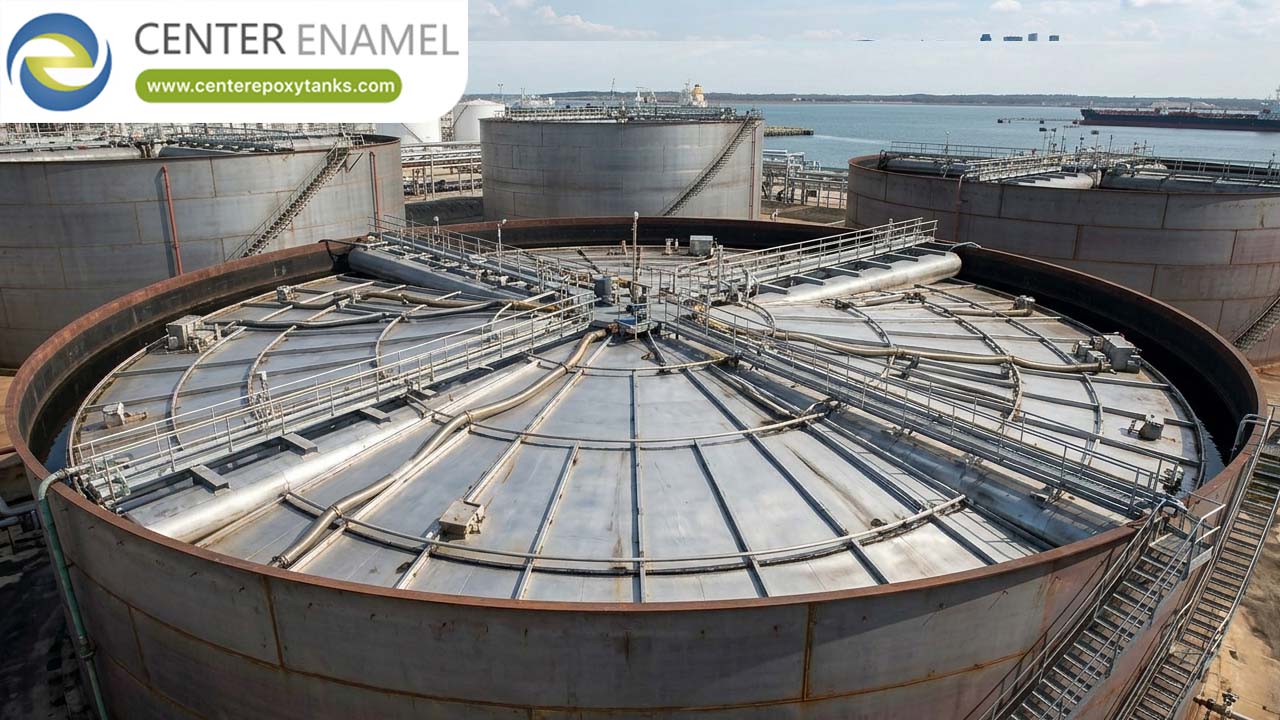
Internal Floating Roof Structure: Pontoon, Full-Contact and Hybrid
The word internal floating roof covers several distinct structures. Pontoon decks,full-contact honeycomb decks and hybrid decks behave differently in service, suit differentproducts and carry different maintenance implications. This article compares them so that aspecifier can choose an architecture for a defined duty rather than by habit.
Why Structure Is a Service Decision
Deck architecture is not a matter of preference. It follows from the stored product's vapourpressure, the tank diameter, the required emission performance and the inspection regime. Adeck that is ideal for a large crude tank may be the wrong choice for a high-purity chemicalor a small tank where inspection access dominates.
The published TECHDECK range makes this explicit by assigning each variant a recommendedservice. Those assignments come from one supplier, so treat them as an illustration of howstructure is matched to duty, not as an independent rule.
Pontoon Decks
A pontoon deck uses sealed flotation members around the perimeter or within a grid to supporta deck above the liquid, leaving a small vapour space below. TankTech Asia describes a pontoonvariant with a deck weight around nine kilograms per square metre, a diameter range of roughlyten to ninety metres, and a published emission reduction around ninety-two percent under EPAAP-42 methodology for mid-volatility products such as diesel and naphtha.
Center Enamel's guidance similarly associates pontoon decks with standard petrochemicals,crude oil and water, and highlights lower cost and easier inspection. The trade-off is that asmall vapour space remains under the deck, so a pontoon design may not meet the tightestemission requirement.
Full-Contact Honeycomb Decks
A full-contact deck rests directly on the liquid through a sealed honeycomb core, leavingessentially no vapour space beneath it. The published TECHDECK honeycomb variant is quoted ataround six kilograms per square metre, a diameter range of roughly eight to one hundredmetres, and a ninety-eight percent emission figure for crude, gasoline and jet fuel service.Those are supplier figures under a stated methodology.
The advantage is maximum vapour suppression; the cost is that the deck is in continuouscontact with the product and inspection access is different from a pontoon deck. Forhigh-volatility products or tight compliance limits, the full-contact structure is often thespecified choice.
Deck Structures Compared
Structure | Indicative service | Indicative trade-off | Supplier-stated figures |
Pontoon | Mid-volatility liquids, easier inspection | Small vapour space remains | about 9 kg/m2, 10-90 m, 92% |
Hybrid | Large crude tanks needing rigidity | More structure than honeycomb | about 7 kg/m2, 30-100 m, 96% |
Full-contact honeycomb | High-volatility products | Direct product contact, access differs | about 6 kg/m2, 8-100 m, 98% |
All figures in the table are from the published TECHDECK product range and are attributed tothat supplier. They are illustrative of the categories, not universal values.
A percentage is meaningful only with the product and methodology behind it. EPA AP-42 providesthe estimation framework; ask any supplier for the assumptions.
Hybrid Decks
A hybrid deck combines features of the other two, aiming for rigidity at large diameters withlower weight. TankTech Asia describes a hybrid variant around seven kilograms per square metrefor tank diameters of roughly thirty to one hundred metres, recommended for large crude tankswhere deflection under load and walkability matter. It quotes a ninety-six percent emissionfigure for that variant.
Hybrid structures are a useful reminder that the choice is not binary. Where a tank is verylarge and operators must walk on the deck, structural stiffness can be as important as theemission percentage.
Materials Interact With Structure
Structure and material cannot be separated. The Ultraflote specification names a 3003-H14 deckskin and 3004-H36 flotation tubes for a pontoon design, with stainless structural bolting. Ahoneycomb deck uses different core and skin arrangements. The structural type thereforeimplies a material set, which in turn must be checked against the product.
The materials article in this series covers that compatibility question in detail. Forselection, the key point is that a change in structure can change the material exposure andthe maintenance strategy, not only the geometry.
A Selection Sequence
Choose structure in this order: establish the product vapour pressure and required emissionperformance; note the tank diameter; decide how the deck will be inspected; check thestructural type against the applicable rules; then compare the options on lifecycle cost. Thiskeeps the decision anchored to service rather than to a supplier's preference.
Center Enamel holds no verified internal floating roof project, so this article does notpresent a delivered deck type as a proven solution. The comparison is a method for narrowingthe choice before requesting quotations.
How Emission Figures Are Derived
The percentage figures attached to deck types are not universal constants. They are estimatesproduced under a defined methodology for a defined product and seal configuration. EPA AP-42Chapter 7 Section 7.1 provides the recognised framework for estimating emissions from organicliquid storage tanks, and a responsible supplier will state the basis for any percentage itquotes.
A buyer should ask which product vapour pressure, which seal arrangement and which calculationmethod produced the figure. A deck type that achieves a high reduction for crude oil mayperform differently for a more volatile product, and the classification of the deck alone doesnot settle the question.
Diameter and Structural Behaviour
Tank diameter changes more than cost. At larger diameters, deck deflection under load andbehaviour during rapid drawdown become critical, which is why hybrid structures are offeredfor very large crude tanks. The published TECHDECK ranges assign different diameter bands toeach variant, reflecting these structural differences.
At small diameters, the economics and access needs differ again, and a full-contact deck maybe attractive for a high-volatility product regardless of its higher specification. Thestructure should be selected for the actual diameter, not for a range average.
Inspection and Maintenance Implications
A pontoon deck leaves a small space below the deck that can be inspected; a full-contact decksits on the product and changes how the underside is examined. Maintenance planning shouldtherefore influence structural choice. If your team's inspection regime relies on accessingthe deck underside, that requirement should be stated before the selection is made.
Deck structure also shapes how the underside is reached for inspection, and reaching it meansgas freeing, permits and confined-space access. A structure that shortens or simplifies thatwork therefore carries a real operational value, and that value is often larger than thedifference in purchase price between two acceptable decks. A structure that shortens orsimplifies inspection has a real operational value.
A Worked Selection Dialogue
Consider three briefs. A diesel tank with moderate volatility and a need for straightforwardinspection points toward a pontoon deck. A very large crude tank where operators walk on thedeck and rigidity matters points toward a hybrid. A gasoline tank under a tight emission limitpoints toward a full-contact honeycomb deck. These are illustrations based on the publishedservice assignments, not universal answers.
In each case the next step is the same: confirm the product data, check the applicable rules,and ask the supplier to justify the proposed structure against those facts. Center Enamelholds no verified internal floating roof project, so no delivered example is claimed.
Product Volatility as the First Filter
Of all the inputs, vapour pressure is the most decisive for structure. A high-volatilityproduct demands a deck that minimises the vapour space, which pushes the choice toward fullcontact. A less volatile product may allow a pontoon deck that is easier to inspect and lesscostly. Establish the product's true vapour behaviour before comparing structures.
Do not rely on a product name alone. Blends and temperature changes alter vapour pressure, andthe same nominal product can behave differently in two climates.
Evidence note: the structural comparison uses published supplier data, not a deck wedelivered. The verified project library contains no internal floating roof delivery, so nopontoon, honeycomb or hybrid deck is offered as our installed evidence. Weights andpercentages are attributed to the named product page and methodology.
Cost and Weight as a Tiebreaker
When two deck structures are technically acceptable for the same service, the decision oftencomes down to weight and cost. Published supplier data gives a useful frame: the pontoon deckin that range is around nine kilograms per square metre, the hybrid around seven and thefull-contact honeycomb around six. Lower weight means less load on the shell and easierhandling during installation.
The trade runs the other way as well. A structure with more material can be stiffer, whichmatters on a large tank where deflection under load and walkability are design drivers. Weighthe two against your own diameter, your access route and your inspection regime rather thanassuming the lighter option is always the better one.
Evidence note: the structural comparison uses published supplier data, not a deck we delivered. The verified project library contains no internal floating roof delivery, so no pontoon, honeycomb or hybrid deck is offered as our installed evidence. Weights and percentages are attributed to the named product page and methodology.
Conclusion
Deck structure is a service decision. Pontoon, full-contact and hybrid designs offer differentemission performance, diameter ranges, stiffness and maintenance access. Use attributedsupplier data to understand the categories, verify percentage claims against EPA AP-42assumptions, and choose by vapour pressure, diameter and inspection needs rather than byhabit.
Frequently Asked Questions
Q: What is the difference between pontoon and full-contact decks?
A: A pontoon deck is held above the liquid by flotation members and leaves a small vapour space;a full-contact deck rests on the liquid through a sealed core, leaving essentially no vapourspace.
Q: Which deck type gives the highest emission reduction?
A: Supplier data associates full-contact honeycomb decks with the highest figures, around 98percent under EPA AP-42 methodology for specified products. The figure depends on service andconfiguration.
Q: What is a hybrid deck for?
A: It aims for rigidity at large diameters with moderate weight, and is suggested for large crudetanks where walkability and deflection matter.
Q: Does structure affect maintenance?
A: Yes. Inspection access and exposure differ between a deck above the liquid and one in contactwith it, which changes the maintenance approach.
Q: Are the published weights universal?
A: No. The figures quoted are one supplier's stated values and illustrate the categories. Actualdesign depends on diameter, loads and materials.
Q: How should I choose a structure?
A: Start with vapour pressure and emission requirement, then diameter, inspection access,applicable rules and lifecycle cost.
Work With Center Enamel
Center Enamel is the trading name of Shijiazhuang Zhengzhong Technology Co., Ltd, established in 2008 and based in Shijiazhuang, Hebei Province, China. The company manufactures glass-fused-to-steel bolted tanks, fusion-bonded epoxy coated tanks, stainless steel and welded steel tanks, pressure vessels, aluminium geodesic dome roofs and floating roof systems. Aluminium dome design work is carried out against AWWA D108, API 650, ADM 2015, ASCE 7-10 and IBC 2012, and the broader product range is covered by ISO 9001, NSF/ANSI 61, CE/EN 1090, ISO 28765, WRAS and FM approvals. The company reports 30,000 installed projects and an annual output of 300,000 enamel steel plates, with technical support delivered through an international distributor network and a stated 24-hour response commitment.
If your project involves tank roofs, floating decks or the shells that carry them, send the tank diameter, shell height, product, operating temperature and site design loads. We will return a preliminary structural concept, the applicable design code basis, and a written scope that separates what is included from what the site contractor must provide.


