Internal Floating Roof Inspection and Maintenance: API 653, EN 14015 and Seal M&R
An internal floating roof is inspected and maintained across its service life rather than only at acceptance, because the deck, the rim seal and the guides are moving parts that wear with every fill and drawdown. In the United States the in-service interval is commonly an external inspection about every five years under API 653, with API 575 giving the roof-type context, while EN 14015 sets the European storage-tank standard that an owner may cite instead. The inspection looks directly at seal contact and continuity, deck settlement, leg and guide wear, and the cover-roof interface, and the maintenance plan sets what triggers seal or deck replacement. The internal floating roof is a standard storage-tank technology governed by API 650 Annex H, not a proprietary product. This page frames the life-cycle inspection and maintenance picture so an integrity engineer can plan the checks; the supply boundary is stated in the scope note below, and no Center Enamel internal floating roof is described here.
The inspection cadence that governs IFR
The in-service inspection of a storage tank is not a one-time event at commissioning; API 653 sets the external inspection interval, commonly about five years, and API 575 supplies the roof-type context that tells the inspector what an internal floating roof is expected to show. EN 14015 is the European storage-tank standard an owner may apply in place of or alongside the API set. The cadence matters because the floating deck, seal and guides are loaded on every cycle, so damage accumulates between the long external intervals and must be caught before it lets vapor past the seal. The owner should name the applicable standard in the inspection plan rather than assume a single generic tank survey covers the floating-roof parts.
What an internal inspection actually checks
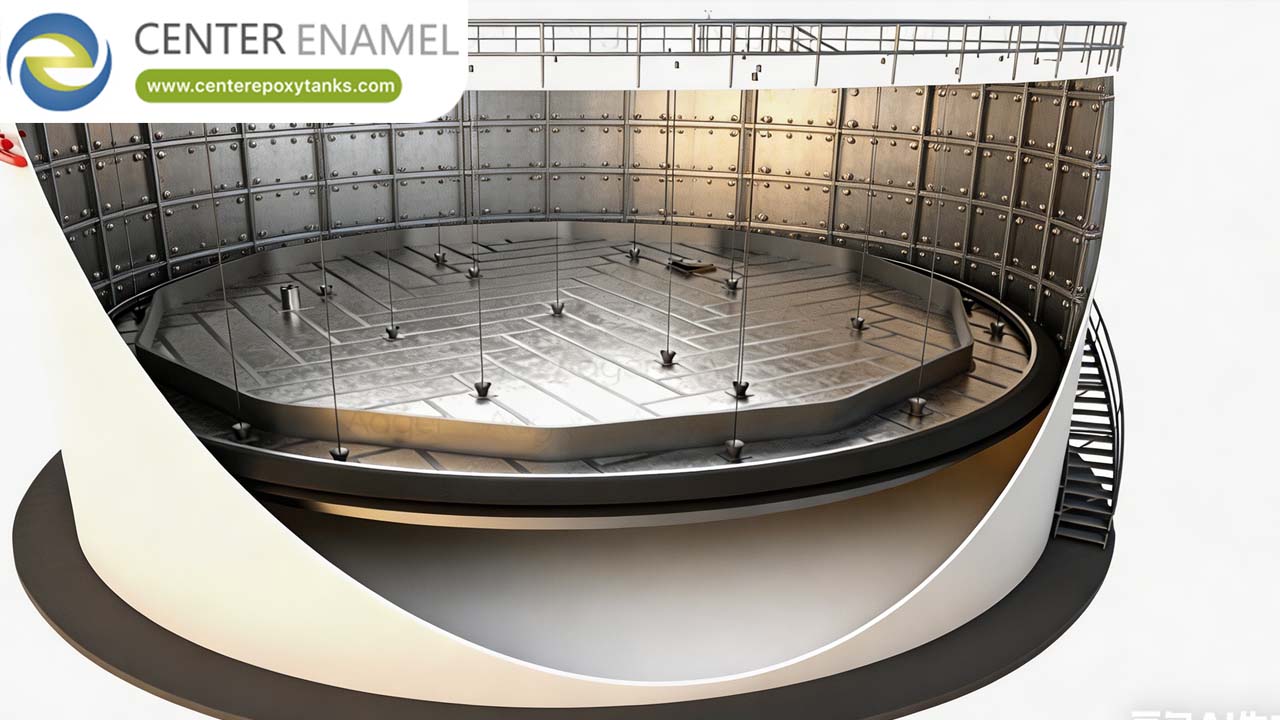
An internal inspection looks at the parts a general tank survey misses: the rim seal contact and continuity all around the wall, the deck for settlement or puncture, the leg and guide wear that lets the deck rack, and the appurtenance penetrations where the deck meets nozzles. The seal is the priority, because the wall gap is where the residual emission lives, and a seal that has lost wall contact undermines the deck's benefit. The inspection record should show the seal was checked directly, not inferred from a deck appearance, because the emission control and the leak path are both at the rim.
Rim seal and deck M&R triggers
The maintenance plan should set the triggers that force action: loss of seal wall contact, tearing or hardening of the wiper, contamination of a liquid-mounted seal, deck puncture or settlement beyond the allowed tolerance, and leg or guide wear that lets the deck tilt. Each trigger is a measured condition, not a time elapsed, so the plan must say how the condition is judged and what replacement it requires. Treating seal and deck maintenance as scheduled items rather than reactive repairs is what keeps the floating roof within the emission and safety basis it was accepted against at the start.
EN 14015 and how it relates to API 650
EN 14015 is the European standard for the design and construction of site-assembled, vertical, cylindrical, flat-bottomed steel tanks, and it is the standard an owner in a European or contractual context may cite for the tank as a whole. API 650 Annex H is the annex that governs the floating-roof part specifically. The two are not in competition; an owner chooses the tank standard by jurisdiction and contract, and the floating-roof annex still defines what the deck and seal must satisfy. The submittal should name which standard governs the tank and confirm the Annex H requirements are still met for the floating roof regardless of the tank standard chosen.
External and the cover-roof interface
The floating roof sits under a fixed or cover roof, and that interface is part of the inspection, not a separate item. Where an aluminum geodesic dome is the cover roof, the dome is a Center Enamel supplied product and the floating deck is a complementary technology, so the inspection must cover both the dome's integrity and the deck's seal where they meet. Vents, nozzles and the deck penetration through the cover roof are points where the two systems interact and where a leak or a seal defect can be masked. The inspection plan should name the interface checks rather than leaving them to whichever trade arrives first on site.
A life-cycle inspection and M&R plan
The practical output is a plan that ties the standard interval to the specific checks and triggers for the tank in question: the external interval, the internal seal and deck checks, the M&R triggers with their judging method, and the cover-roof interface. The plan turns a generic five-year survey into a floating-roof-specific program that the operator can actually run. It should be written before the tank enters service and kept with the handover records, because a plan reconstructed years later from memory is the usual reason a seal fails unnoticed between intervals.
Scope note on the IFR technology and this page
Scope note: this article treats the internal floating roof as a standard storage-tank technology governed by API 650 Annex H. The documented Center Enamel product range that this batch draws from lists Glass-Fused-to-Steel, Fusion Bonded Epoxy, stainless steel and hot-dip galvanized tanks and aluminum geodesic dome roofs; it does not list internal floating roofs as a supplied product line. No Center Enamel internal floating roof case or supply claim is made on this page. The inspection logic here is a life-cycle plan, not an IFR offering or a maintenance contract.
What this page does and does not claim
This page explains the inspection cadence, what an internal check covers, the seal and deck M&R triggers, the EN 14015 relationship and the cover-roof interface. It does not quote an emission reduction percentage, certify compliance, describe a Center Enamel internal floating roof, or replace the engineer's inspection plan. The floating deck is addressed only as a standard technology here; where an aluminum geodesic dome is the cover roof, that is a separate Center Enamel supply, and the deck itself is not. What it equips a reader to do is write a life-cycle inspection and M&R plan rather than accept a generic tank survey that misses the floating-roof parts.
Internal floating roof inspection scope
Use this to separate the checks a floating-roof survey must include.
Element | What to inspect | Why it matters |
Rim seal | Contact and continuity | Wall-gap emission control |
Deck | Settlement, puncture | Buoyancy and safety |
Legs and guides | Wear and travel | Deck alignment |
Cover interface | Dome and penetrations | Where systems meet |
M&R trigger checklist
These are the conditions that should force action on the floating roof.
Trigger | How judged | Action |
Seal lost contact | Direct wall check | Reseal or replace |
Deck puncture | Settlement survey | Repair to tolerance |
Leg or guide wear | Travel and tilt | Adjust or renew |
Contaminated seal | Liquid-mounted check | Clean or replace |
Frequently Asked Questions
Q1. How often is an internal floating roof inspected?
The in-service interval is commonly an external inspection about every five years under API 653, with API 575 giving roof-type context and EN 14015 the European alternative. That interval covers the tank as a whole; the seal, deck, legs and guides need their own checks within it because they wear on every fill and drawdown, not only at the long external survey.
Q2. What does an internal inspection actually look at?
It looks at the parts a general tank survey misses: rim-seal contact and continuity all around the wall, deck settlement or puncture, leg and guide wear, and the appurtenance penetrations. The seal is the priority because the wall gap is where residual emission lives, so the record should show the seal was checked directly rather than inferred from the deck's appearance.
Q3. What maintenance triggers seal or deck action?
Triggers are measured conditions: loss of seal wall contact, tearing or hardening of the wiper, contamination of a liquid-mounted seal, deck puncture or settlement beyond tolerance, and leg or guide wear that lets the deck tilt. Each should name how it is judged and what replacement it requires, so maintenance is scheduled by condition rather than by elapsed time alone.
Q4. How does EN 14015 relate to API 650 Annex H?
EN 14015 is the European standard for site-assembled vertical steel tanks, cited for the tank as a whole by jurisdiction or contract. API 650 Annex H is the annex that governs the floating-roof part specifically. They are not in competition; the tank standard is chosen by context and the Annex H requirements for the deck and seal still apply regardless of which tank standard is selected.
Q5. Does the cover roof get inspected with the deck?
Yes. The floating roof sits under a fixed or cover roof, and that interface is part of the inspection. Where an aluminum geodesic dome is the cover roof, it is a Center Enamel supplied product and the floating deck is complementary, so both the dome integrity and the deck seal at the meeting point must be checked, along with the vents and deck penetrations.
Q6. What should the life-cycle plan contain?
It should tie the standard interval to the specific floating-roof checks and triggers: the external interval, the internal seal and deck checks, the M&R triggers with their judging method, and the cover-roof interface. Written before the tank enters service and kept with the handover, it turns a generic survey into a program the operator can actually run.
Q7. Is an internal floating roof a Center Enamel product?
No. The documented Center Enamel range drawn on for this batch lists Glass-Fused-to-Steel, Fusion Bonded Epoxy, stainless steel, hot-dip galvanized tanks and aluminum geodesic dome roofs, but not internal floating roofs. Where a covered IFR tank is referenced, the aluminum geodesic dome is the cover roof supplied; the floating deck is a complementary technology, and no CE IFR case or supply is claimed here.
Q8. What is deliberately out of scope on this inspection page?
This page frames the life-cycle inspection and maintenance picture. It does not quote an emission reduction percentage, certify compliance, describe a Center Enamel IFR supply, or write the engineer's inspection plan. The Annex H acceptance checklist belongs to the standards page and the project submittal, not to a maintenance overview.
Conclusion
An internal floating roof is inspected and maintained across its service life, because the deck, rim seal and guides are moving parts that wear with every fill and drawdown. The interval is commonly an external inspection every five years under API 653, with API 575 and EN 14015 as the standard context, and the check looks at seal contact, deck condition, and leg and guide wear. The maintenance plan sets measured triggers for seal, deck and guide action rather than elapsed time. This page treats the internal floating roof as API 650 Annex H technology it is and does not describe a Center Enamel internal floating roof, because the deck is a complementary technology outside this batch's product range. A reader should leave able to write a life-cycle inspection and M&R plan instead of accepting a generic tank survey.
Talk to an Engineer
To plan internal floating roof inspection and maintenance, send the tank standard in force at the site, the tank diameter, the product and its volatility, and whether an aluminum geodesic dome or other cover roof is present. Ask the inspection provider for the interval basis, the internal seal and deck check method, the M&R triggers with their judging criteria, and the cover-roof interface checks rather than a generic tank survey. Note that if an aluminum geodesic dome is the cover roof, that is a separate Center Enamel supply from the floating deck itself. With those inputs the floating roof can be maintained on a condition-based program rather than left to a five-year survey that misses the seal, the deck and the guides where the emission and the safety actually live.
About Center Enamel
Shijiazhuang Zhengzhong Technology Co., Ltd (Center Enamel) has designed and fabricated bolted storage tanks since its registration in 2008; the founding team's enamelling work dates to 1989. The product range covers Glass-Fused-to-Steel (GFS), Fusion Bonded Epoxy (FBE), stainless steel and hot-dip galvanized tanks, and aluminum geodesic dome roofs. Certifications and standard references in the supplied fact base are scoped per product line, not held as a blanket claim for every product. No performance, service life or project outcome beyond the cited sources is claimed here.


