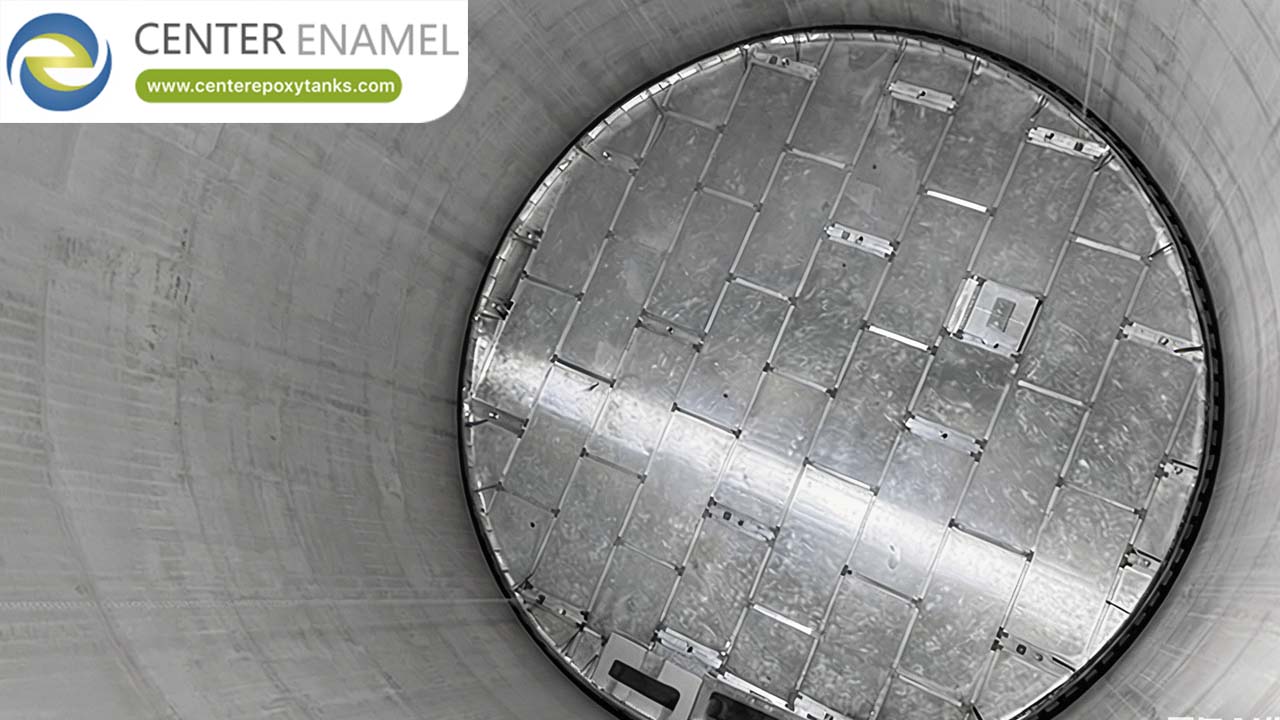
Internal Floating Roof Deck Types: Pontoon vs Full-Contact Honeycomb and Rim Seals
An internal floating roof deck comes in two families: a pontoon or non-contact deck that rides on tubular aluminum pontoons above the liquid, and a full-contact honeycomb or foam-sandwich deck that rests on the liquid with essentially no vapor pocket. The pontoon deck is lighter and more tolerant of level changes; the full-contact deck can lower emissions further but is more sensitive to product and to damage. The rim seal, not the deck panel, is the real emission control, and a dual primary and secondary seal with continuous stainless shunts is the usual arrangement. The choice follows the product volatility, purity and service, and it is a buyer's specification decision under API 650 Annex H, not a vendor catalogue. This page gives the deck-and-seal decision logic so the selection can be written into a data sheet, and it does not describe a Center Enamel internal floating roof, because that is not a documented product line in the range drawn on for this batch.
Two deck families and what divides them
The dividing line is whether the deck contacts the liquid. A pontoon, or non-contact, deck uses annular pontoons with a deck plate held a small distance above the liquid, leaving a thin vapor gap under the plate. A full-contact honeycomb or foam-sandwich deck rests directly on the liquid, eliminating that gap. The pontoon family is lighter and more forgiving of liquid-level movement and of minor deck damage; the full-contact family removes more of the vapor space and can reduce emissions further, but it is more demanding on product compatibility and on keeping the deck intact. Both are standard constructions under API 650 Annex H, and the choice is a specification decision, not a quality ranking between two products of unequal merit.
Pontoon (non-contact) deck trade-offs
A pontoon deck rides on tubular aluminum pontoons, typically 6061-T6 or 6063-T6, with a deck plate above the liquid. Its advantages are low weight, buoyancy that tolerates product-level changes, and resistance to damage from a fluctuating or slightly contaminated surface. Its trade-off is the residual vapor gap under the plate, which leaves some emission that a full-contact deck would remove. The deck is normally held by adjustable legs, often around two meters, that set its rest position and protect it at low level. For volatile but not ultra-clean products, the pontoon deck is frequently the pragmatic choice, balancing emission performance against service robustness rather than chasing the lowest possible number at the cost of fragility.
Full-contact honeycomb deck trade-offs
A full-contact honeycomb or foam-sandwich deck floats in contact with the liquid, so it leaves essentially no vapor pocket under the panel and can reduce emissions beyond a pontoon deck. Its trade-offs are sensitivity to product compatibility, because the deck touches the stored liquid, and sensitivity to damage, because a torn sandwich can ingress product. It suits cleaner, well-managed services where the lowest emission is the priority and the operating discipline supports it. The buyer should weigh the emission gain against the maintenance and integrity burden, because a full-contact deck that is damaged or incompatible can cost more over the tank's life than the emission saving it delivered up front.
The rim seal is the real emission control
Whichever deck is chosen, the rim seal at the wall is the component that actually controls emissions, because it closes the annular gap the deck cannot cover. A primary seal sits at the deck edge, and a secondary seal sits above it; the two together limit the vapor escape path at the only place the deck leaves exposed. The seal material must suit the product, and the seal must track the wall as the deck moves. A buyer who focuses only on the deck type and ignores the seal has missed where the emission performance is decided. The deck removes the bulk vapor space; the seal governs what remains at the boundary, and the two must be specified together, not separately.
Primary, secondary and the stainless shunt
A dual arrangement is common: a primary seal at the deck and a secondary seal above it, so if the primary is breached the secondary still limits loss. Electrical continuity matters at the seal, because a floating deck in a classified area must be bonded to ground; continuous stainless steel shunts across the seal provide that path so static charge has a controlled route. The buyer should specify the seal types, the materials and the continuity method as part of the deck package, because a seal without proper shunts is a static and emission weakness regardless of the deck family. The shunt is a safety control, not an optional accessory, in hydrocarbon service.
Materials and the adjustable leg detail
The deck structure is usually aluminum 6061-T6 or 6063-T6, with stainless steel 304 or 316 used where the product or the seal demands higher corrosion resistance. The adjustable legs set the deck's low-level rest position and protect it from contacting the tank bottom; they are typically around two meters but are set to the tank's requirement. The materials and the leg setting should match the product and the tank geometry, and the submittal should state them rather than a generic aluminum claim. A buyer should confirm the alloy and the stainless grade against the product, because the deck touches or sits near the liquid for the tank's whole life.
Scope note on the IFR technology and this page
Scope note: this article treats the internal floating roof as a standard storage-tank technology governed by API 650 Annex H. The documented Center Enamel product range that this batch draws from lists Glass-Fused-to-Steel, Fusion Bonded Epoxy, stainless steel and hot-dip galvanized tanks and aluminum geodesic dome roofs; it does not list internal floating roofs as a supplied product line. No Center Enamel internal floating roof case or supply claim is made on this page. The deck-and-seal logic here is a buyer's specification guide.
A deck-and-seal selection table
The selection should follow a short table: for a volatile but contaminated or level-variable product, a pontoon deck with a dual seal is usually the robust choice; for a clean, well-managed service where the lowest emission is priority, a full-contact deck with a dual seal may be justified if the integrity burden is accepted. For every case the seal material and the stainless shunt continuity are specified with the deck. Writing the deck type, the seal arrangement, the alloy and the continuity method into the data sheet turns the choice from a vendor recommendation into a verifiable specification that the submittal must meet.
Deck-and-seal decision framework
Score the deck family against the product and service before choosing.
Service condition | Pontoon (non-contact) | Full-contact honeycomb | Specify with seal |
Volatile, level-variable product | Robust, tolerant choice | Fragile if level swings | Dual seal plus shunts |
Clean, managed, min emission | Good, some gap remains | Lowest emission if intact | Dual seal plus shunts |
Contaminated or sticky liquid | More forgiving | Compatibility risk | Confirm material |
Hydrocarbon classified area | Bond deck to ground | Bond deck to ground | Continuous SS shunts |
Deck-and-seal verification checklist
These records keep the deck selection honest and verifiable.
Item | Why it matters | Record to request |
Deck family and alloy | Sets emission and life | Material test report |
Seal type and material | Primary emission control | Seal compatibility note |
Stainless shunt continuity | Static safety in classified area | Continuity statement |
Adjustable leg setting | Protects deck at low level | Leg length per tank |
Frequently Asked Questions
Q1. What divides a pontoon deck from a full-contact deck?
The dividing line is whether the deck touches the liquid. A pontoon, or non-contact, deck rides on tubular aluminum pontoons above the liquid, leaving a thin vapor gap; a full-contact honeycomb or foam-sandwich deck rests on the liquid with essentially no gap. The pontoon is lighter and more tolerant of level change; the full-contact deck can lower emissions further but is more sensitive to product and damage.
Q2. Which deck gives the lowest emissions?
A full-contact honeycomb deck can give the lowest emissions because it removes the vapor gap under the plate, but only if the product is compatible and the deck is kept intact. The rim seal still governs what escapes at the wall. A buyer should not read a deck type as the whole emission answer; the seal and the tank openings matter as much as the panel.
Q3. Why is the rim seal the real emission control?
The rim seal closes the annular gap at the wall that the deck cannot fully cover, which is the only place the floating deck leaves exposed. A primary seal at the deck and a secondary seal above it limit that path. The deck removes the bulk vapor space, but the seal decides what remains at the boundary, so the seal and deck must be specified together.
Q4. Why are stainless shunts needed at the seal?
A floating deck in a classified area must be electrically continuous and bonded to ground so static charge has a controlled path, per the static protection basis. Continuous stainless steel shunts across the rim seal provide that continuity. A seal without proper shunts is a static and emission weakness regardless of the deck family, and the shunt is a safety control, not an accessory.
Q5. Is an internal floating roof a Center Enamel product?
No. The documented Center Enamel range lists Glass-Fused-to-Steel, Fusion Bonded Epoxy, stainless steel, galvanized tanks and aluminum geodesic dome roofs, but not internal floating roofs. Where a covered IFR tank is referenced, the aluminum geodesic dome is the cover roof supplied; the floating deck is a complementary technology, and no CE IFR case or supply is claimed here. This page is a buyer's specification guide, not an IFR offering.
Q6. What is deliberately out of scope on this deck page?
This page gives deck-and-seal decision logic. It does not quote emission percentages, certify compliance, describe a Center Enamel IFR supply, or perform a design for a named tank. Emission figures and a worked design belong to a project submittal with a referenced test basis, not to this buyer-guide page.
Q7. Which source supports the deck and seal details?
The deck families, the 6061-T6 or 6063-T6 and 304 or 316 materials, the dual seal and the shunt reference reflect API 650 Annex H and supplier technical literature observed at snippet level in the 2026-11-14 SERP sample. The standard and designations are referenced; the specific edition and any test data are not provided by this page.
Q8. How should the deck-and-seal choice be written into a data sheet?
State the deck family and alloy, the seal type and material, the stainless shunt continuity method, and the adjustable leg setting for the tank. Require the seal compatibility with the product and a referenced test basis for any emission figure. Those lines turn the deck choice from a vendor recommendation into a verifiable specification the submittal must meet.
Conclusion
The internal floating roof deck choice is between a pontoon non-contact deck that is light and tolerant of level change, and a full-contact honeycomb deck that can lower emissions further but demands product compatibility and integrity discipline. Neither is superior in the abstract; the choice follows the product volatility, purity and service, and it is a specification decision under API 650 Annex H. The rim seal, with a primary and secondary arrangement and continuous stainless shunts, is the real emission and static control regardless of deck family. This page gives a buyer the deck-and-seal logic to write into a data sheet, and it does not describe a Center Enamel internal floating roof, because that is not a documented product line in the range drawn on for this batch.
Talk to an Engineer
To specify an internal floating roof deck, send the stored product and its volatility and purity, the tank diameter, the level-variation profile and whether the tank is in a classified area. Ask each supplier for the deck family and alloy, the seal type and material with product compatibility, the stainless shunt continuity method, and the adjustable leg setting, and ask for a referenced test basis for any emission figure rather than a bare percentage. Remember that if an aluminum geodesic dome is also needed as the cover roof, that is a separate supply from the floating deck. With those inputs the deck-and-seal package can be written as a verifiable specification instead of accepted on a vendor's preferred deck claim.
About Center Enamel
Shijiazhuang Zhengzhong Technology Co., Ltd (Center Enamel) has designed and fabricated bolted storage tanks since its registration in 2008; the founding team's enamelling work dates to 1989. The product range covers Glass-Fused-to-Steel (GFS), Fusion Bonded Epoxy (FBE), stainless steel and hot-dip galvanized tanks, and aluminum geodesic dome roofs. Certifications and standard references in the supplied fact base are scoped per product line, not held as a blanket claim for every product. No performance, service life or project outcome beyond the cited sources is claimed here.


