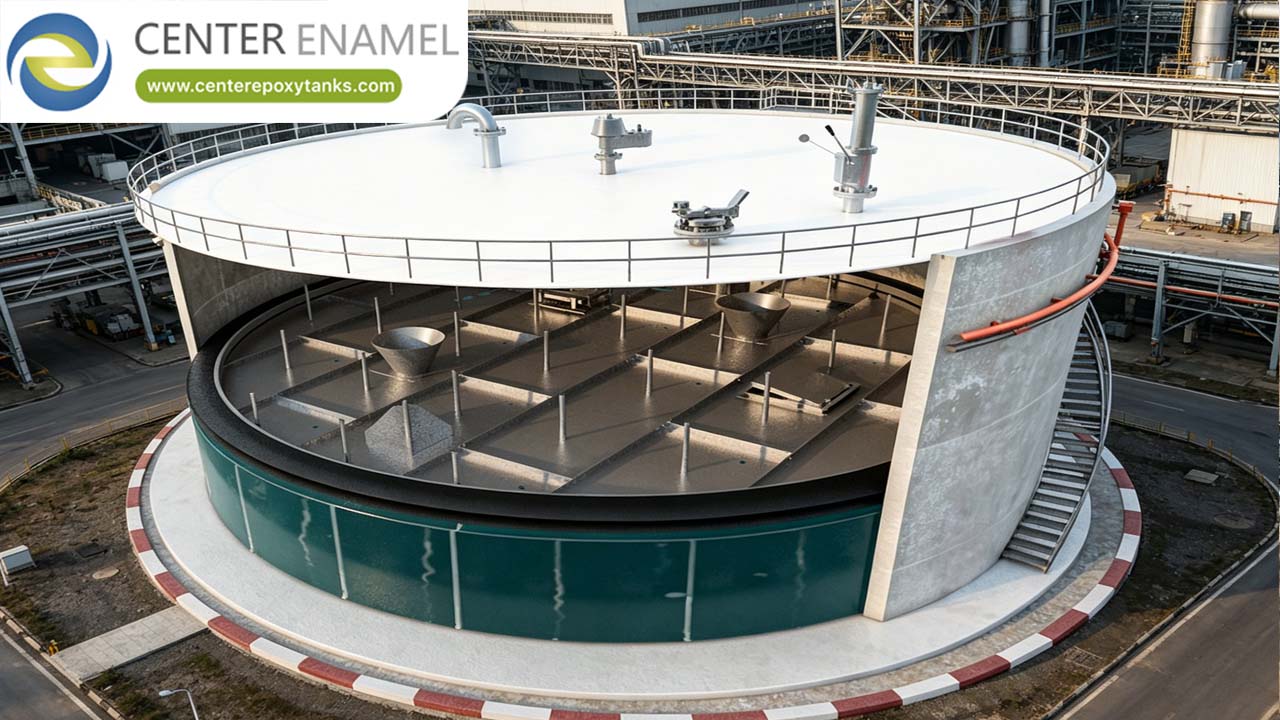
Internal Floating Roof for Water Storage Tanks: When It Makes Sense
Water is not volatile, so the usual reason for installing an internal floating roof — vapour-loss control — barely applies to a water tank. Yet floating covers and floating roofs do appear in water service, and the keyword is real. This article separates the cases where a floating deck earns its cost from those where a fixed aluminium dome or a simpler cover is the better answer, with honesty about the limits of the evidence.
Why the Oil-Tank Argument Does Not Transfer
The business case for a hydrocarbon floating roof is vapour loss: an internal deck removes the space in which product evaporates. Water does not present that problem in the same way. Its vapour pressure is low and its emissions are not the volatile organic compounds that air rules target, so the economic driver that justifies an oil-tank roof largely disappears.
That does not make the keyword meaningless. Water reservoirs do use floating covers, but for different reasons: shading to suppress algae, limiting evaporation in hot climates, and keeping wind-borne debris off the surface. Those are water-quality and housekeeping objectives, not emission-control objectives.
Being explicit about the objective matters because it changes the equipment comparison. If the goal is shading, a fixed opaque cover can do the job with no moving parts, no seal and no pontoon to maintain.
The Legitimate Cases for a Surface-Following Cover
A floating cover earns its place where the water level varies substantially and the operator wants the cover to stay close to the surface at every level. In that role it reduces the air space above the water, limits light and can reduce wind-driven evaporation and debris ingress without a tall fixed roof structure.
Large reservoirs and balancing tanks are the typical setting. A cover that tracks the level can be useful where a fixed roof would be uneconomically tall, or where access to the water surface is needed at a range of levels. The mechanical design is simpler than a hydrocarbon IFR because there is no flammable vapour to control.
In water and wastewater treatment the terminology is loose: suppliers may say floating cover, floating roof or floating blanket for related products. The specifier should define what is meant — a buoyant deck with a defined structure, not just a sheet — before comparing offers.
Potable Water: Certification and Cleanability Come First
Objective | Floating deck | Fixed aluminium dome |
Shading / algae suppression | Effective at all levels | Effective, no moving parts |
Large level variation | Cover tracks the level | Fixed above maximum level |
Cleaning access | Underside harder to inspect | Open interior, easier access |
Water-contact certification | Required for every component | Required for the roof structure |
Where the tank serves drinking water, any material in contact with the water must meet the applicable certification. That requirement applies to the deck skin, pontoons, seals and hardware, not just to the tank shell. A supplier datasheet that quotes hydrocarbon performance without a water-contact certification is not an answer for potable service.
Cleanability is the second constraint. A water tank is periodically drained, inspected and disinfected. A floating deck creates a hidden underside and a perimeter gap that must be reachable for cleaning; if it cannot be inspected and cleaned, it becomes a liability rather than a protective cover.
Those two constraints explain why many utilities choose a fixed dome or roof instead. A clear-span aluminium dome provides shading and debris exclusion, leaves the tank interior open for cleaning equipment, and avoids a submerged deck with inaccessible surfaces.
Where a Fixed Cover Is the Better Answer
For a tank whose main problem is sunlight and debris, a fixed cover is usually simpler. It has no seal to replace, no pontoon to leak and no deck to bind as the tank shifts. An opaque roof blocks the light that drives algae, and it keeps rain, birds and dust out of the stored water.
A clear-span aluminium dome adds a structural advantage: with no internal columns, the tank interior remains open for mixers, cleaning equipment and inspection. That is why dome covers are common on water and wastewater tanks even where a floating cover would technically be possible.
The cost comparison should be honest. A fixed dome is a single structure with a known price; a floating deck adds components, inspection obligations and certification work. Unless the level-tracking function is genuinely needed, the simpler option usually wins on life-cycle cost.
What the Hydrocarbon Guidance Can and Cannot Tell You
Published IFR specifications and handbooks describe buoyant decks, pontoons, seals and venting in detail. Those mechanics are real and can inform a water-cover design, but the associated emissions and fire-safety arguments belong to hydrocarbon service. Applying them to a water tank would overstate the benefit and misstate the risk.
EPA AP-42 Chapter 7 Section 7.1, for example, is a method for volatile organic liquid storage emissions. It is not a tool for quantifying the benefit of covering a water reservoir. The correct evaluation for water is water quality, evaporation in the local climate and cleaning practicality.
This distinction is also an evidence boundary. Our verified project library contains aluminium dome records on water and related tanks, but no internal floating roof or floating cover on a water tank. Those dome records support a statement about fixed covers only; they are not presented here as floating-deck evidence.
How to Decide in Practice
Begin with the objective in one sentence: shading, evaporation reduction, debris exclusion, level-tracking or a combination. If the objective can be met by a fixed opaque cover, price that first. Only add a floating deck where the surface-following function is required and the operator is prepared to inspect and maintain it.
Next, fix the certification basis for water contact and the cleaning method. These are gating requirements; if a proposed deck cannot be certified or cleaned, it is not a viable option regardless of its other advantages.
Finally, compare total cost over the inspection cycle, not just purchase price. For many water tanks the answer will be a fixed aluminium dome; for a smaller set, a floating cover that tracks a wide level range will be the right engineering choice.
Evaporation, Climate and the Case for a Cover
Evaporation from a water tank is driven by climate: temperature, wind across the surface and the exposed area. In a hot, windy location a cover can reduce water loss that has a real operating cost, while in a cool, sheltered site the same cover may be difficult to justify on evaporation alone. The local climate belongs in the comparison.
A floating deck keeps the cover close to the water at every level, which limits the exposed surface and the fetch over which wind can act. A fixed roof also removes wind across the water, so the difference between the two is often smaller than expected once the fixed option is priced properly.
Where water is scarce or expensive, even a modest reduction in evaporation can change the economics. Where water is abundant, shading and debris control usually dominate. Writing down which objective has value prevents a cover being chosen for a benefit nobody is paying for.
Water-Quality Interface and Material Certification
Any surface in contact with stored water becomes part of the water-quality system. Deck skins, pontoons, seal faces and coatings must meet the certification required for the intended use, and the requirement is stricter for potable water than for raw or process water. The certificate should refer to the specific material, not to a generic product family.
A cover can also change water quality in less obvious ways. A shaded tank may develop different biological activity, a stagnant layer under a deck may need circulation, and materials that leach under prolonged contact can affect taste or colour. These effects should be considered alongside the benefit the cover is meant to deliver.
Ask for a cleaning and disinfection method that works with the chosen cover. If the deck prevents a tank from being cleaned to the plant's standard, it has created an operating problem larger than the one it solved. Certification and cleanability are gating requirements, not final checks.
Evidence disclosure for this water-storage article: the verified project library contains aluminium dome projects on water, wastewater and desalination tanks, but no internal floating roof delivery and no floating cover on a water tank. Those dome records are not used here as floating-deck evidence. No evaporation rate, algae result or water-quality outcome is claimed from our own work.
Conclusion
Use a floating deck on a water tank only when the objective genuinely needs a surface-following cover and the water-contact materials are certified for the duty. For light exclusion, debris control and low maintenance, a fixed aluminium dome is often the more direct answer. Do not transfer oil-tank emission arguments to a water tank.
Frequently Asked Questions
Q: Does a water tank need a floating roof for emissions?
A: Usually not. Water has negligible volatile organic emissions; the objectives are evaporation control, algae suppression and keeping debris out. A fixed cover often satisfies these more cheaply.
Q: How does a floating cover reduce algae?
A: By shading the water surface and limiting light, a cover suppresses photosynthetic growth. A fixed opaque roof can achieve the same shading without a moving deck.
Q: Is a floating roof used on potable water?
A: Floating covers exist in water treatment, but potable-water contact materials must meet the relevant certification. Many utilities prefer a fixed dome or roof for simplicity and cleanability.
Q: What is the difference between a floating cover and a floating roof?
A: In water service the terms overlap; both describe a buoyant deck on the surface. In oil service a floating roof is a defined engineered component under a storage code. Confirm what a supplier means.
Q: Can the evidence from oil tanks be transferred to water tanks?
A: Only the mechanics transfer. Emission and safety arguments from hydrocarbon service do not apply to water, and no water-tank floating-roof project is present in our verified library.
Q: When is a fixed aluminium dome preferred?
A: When the goal is shading, debris exclusion and low maintenance without a moving deck, and when the tank needs clear internal access for cleaning or mixers.
Work With Center Enamel
Center Enamel is the trading name of Shijiazhuang Zhengzhong Technology Co., Ltd, established in 2008 and based in Shijiazhuang, Hebei Province, China. The company manufactures glass-fused-to-steel bolted tanks, fusion-bonded epoxy coated tanks, stainless steel and welded steel tanks, pressure vessels, aluminium geodesic dome roofs and floating roof systems. Aluminium dome design work is carried out against AWWA D108, API 650, ADM 2015, ASCE 7-10 and IBC 2012, and the broader product range is covered by ISO 9001, NSF/ANSI 61, CE/EN 1090, ISO 28765, WRAS and FM approvals. The company reports 30,000 installed projects and an annual output of 300,000 enamel steel plates, with technical support delivered through an international distributor network and a stated 24-hour response commitment.
If your project involves tank roofs, floating decks or the shells that carry them, send the tank diameter, shell height, product, operating temperature and site design loads. We will return a preliminary structural concept, the applicable design code basis, and a written scope that separates what is included from what the site contractor must provide.


