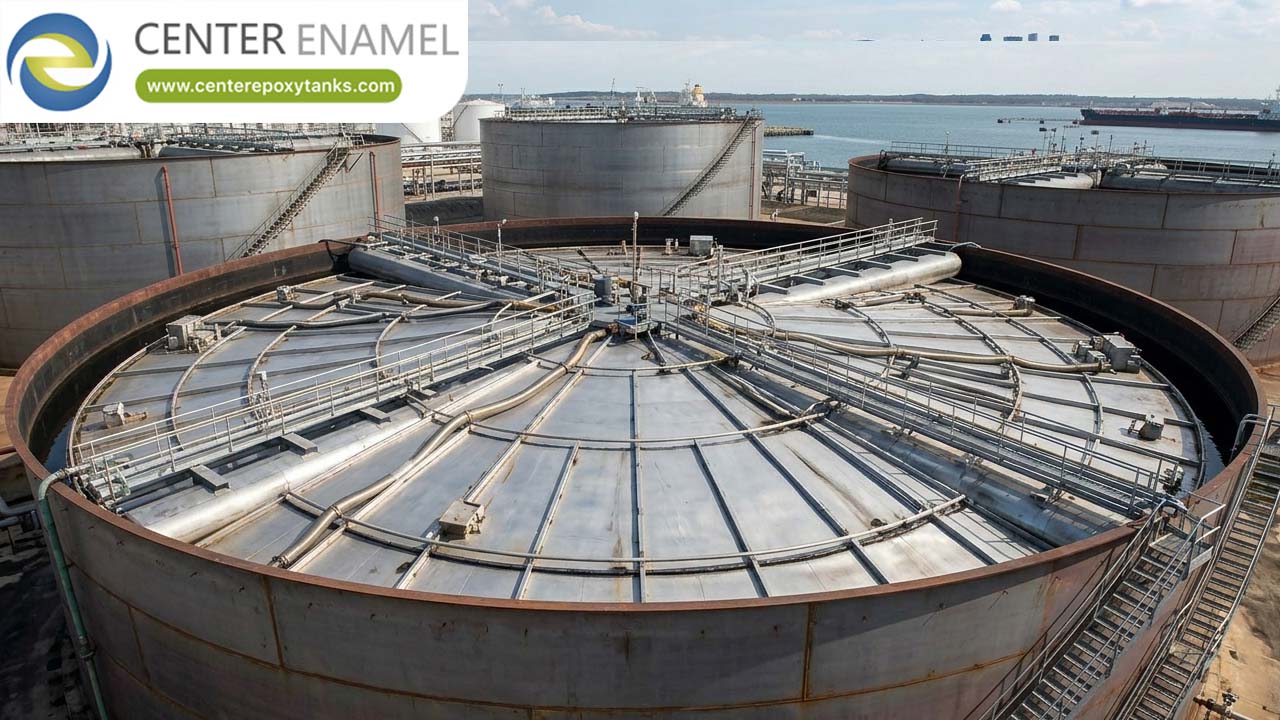
Internal Floating Roof for Tank Terminals: Turnover, Vapour Balance and Operations
A tank terminal is defined by movement: product arrives by ship, pipeline or rail and leaves by truck, vessel or pipeline. That operating pattern changes what an internal floating roof must do. It is not enough to control standing loss when the tank is constantly filled and emptied and the loading rack is displacing vapour. This article looks at the roof as part of a terminal operating system.
A Terminal Roof Serves an Operating Pattern
A product tank in a refinery may sit at a relatively stable level; a terminal tank may cycle several times a week. That difference changes the specification. Frequent filling and emptying exercise the deck, the guide poles, the bleeder vents and the seals far more often, so smooth travel and reliable fittings matter more than they would in a quiet tank.
Terminal guidance on bulk-liquid storage shows that floating roofs reduce standing storage loss but that loading displacement is a separate problem, often handled by vapour recovery or vapour balance lines. The roof and the rack must therefore be designed as one vapour system.
The operating pattern also shapes the case for an internal rather than external deck. A fixed outer roof protects the deck from rain, snow and wind, which matters at a terminal that cannot afford product contamination or weather-driven maintenance.
Standing Loss Is Only Part of the Balance
EPA AP-42 Chapter 7 Section 7.1 distinguishes standing storage losses from working losses that occur during filling and emptying. A floating roof is very effective against the first and less influential over the second, which is driven by throughput and operating practice.
At a terminal with marine or rail loading, displacement volumes can be large. Published terminal guidance notes that a fixed roof generally requires vapour recovery to meet leak standards and local limits, while floating-roof tanks vent through a pressure-vacuum vent sized for filling and emptying rates. The roof changes the vent duty; it does not remove the need to design it.
Vapour balance lines between the loading rack and the tank farm must be sloped and arranged correctly so condensate drains back rather than collecting. That detail is operational, but it belongs in the same design review as the roof specification.
Design the Deck for Frequent Level Cycling
Terminal duty | Roof-related requirement | Why it matters |
High fill/empty rate | Bleeder vents and level travel | Prevents binding and vent failure |
Marine / rail loading | Vapour balance or recovery | Handles displacement vapour |
Multiple products | Seal and deck compatibility | Avoids changeover damage |
Weather exposure | Fixed roof over deck | Shields seals and keeps product clean |
A deck that moves every day must be free to move. Confirm the clearance at guide poles and column penetrations, verify that automatic bleeder vents open and close at the correct level, and make sure the drain arrangement cannot admit product or rainwater. Each of these is more critical in a high-turnover tank than in a static one.
Grounding deserves attention in a terminal where product moves quickly through pipelines and load arms. Bond the deck to the shell and verify continuity, because high flow rates increase the opportunity for charge accumulation.
Where the terminal handles different products in the same tank, add the changeover checks described elsewhere in this batch: compatibility of seal and deck with every grade, and a released changeover record before the new product is admitted.
Inspection and Availability planning
Terminal tanks are expected to be available. An unplanned roof problem can take a tank out of service at exactly the moment the schedule needs it, so seal and fitting condition should be tracked before failure. Build the roof into the terminal's planned maintenance rather than treating it as a run-to-failure item.
Follow the permit and the applicable integrity code for inspection frequency. Published comparisons of internal and external roofs note that internal decks are protected from weather, which extends seal life, but that internal inspection is harder; plan access and outage windows accordingly.
Keep the roof file current: seal profile and material, deck configuration, vent settings, bonding continuity and the last float-observation record. When a terminal tank behaves oddly at a particular level, that file makes the cause findable.
Internal Roof Versus Alternatives at a Terminal
For high-value, contamination-sensitive products, an internal floating roof with a fixed outer roof is usually the stronger choice. It shields the deck, keeps rain out of the product and provides a second barrier before any vent. The capital cost is higher, but terminal products often justify it.
For very large crude tanks, an external floating roof can be more economical because no fixed roof is needed. The trade-off is greater weather exposure, roof drains and rim-space fire considerations. A comparison article notes that the decision depends on product volatility, tank diameter and local climate.
The third option is a fixed roof with vapour recovery. Where a terminal already has recovery capacity and local emission credits are inexpensive, this can remain competitive even for volatile products. Include all three in the comparison and let the permit and throughput decide.
How to Specify for a Terminal Project
Start with the operating data: products, annual and peak throughput, fill and empty rates, tank diameters, loading configuration and the applicable air permit. Those inputs let a supplier size vents, judge seal duty and advise whether an internal deck is appropriate.
Then state the inspection philosophy. If the terminal plans condition-based maintenance, say what will be measured and how often, and require the roof design to support it. A deck that cannot be inspected without a full outage may be acceptable in one terminal and unacceptable in another.
Finally, state the boundary clearly. No terminal floating-roof case exists in our verified library, so this article offers a method rather than a track record. The specification should be built on the operating facts and the named sources, not on an assumed project history.
Coordinating Roof, Rack and Tank Farm
A terminal project that specifies the roof before the loading system has usually made the problem harder. The rack determines displacement volumes and vapour composition; the tank determines standing and working loss. Put both on one drawing and hand them to one engineer, so vent sizes, balance lines and recovery capacity are chosen together.
Sequence matters during commissioning as well. A roof that has passed its float test is of little use if the rack cannot return vapour safely during the first cargo transfer. Plan the start-up as a whole system test, with the roof observed through its travel while the loading operation exercises the pressure-vacuum vents.
Where several tanks feed one rack, the interaction between them can be significant. A low-emptying tank and a filling tank may be connected by the vapour header, and the roof vent settings should be reviewed against that shared condition rather than each tank in isolation.
Spares and Seal Strategy for Continuous Operation
Terminals value availability, so the seal strategy should be decided while the roof is being specified. Identify the exact seal profile and elastomer, keep the supplier part reference in the maintenance system, and hold the consumables that cannot be sourced quickly. A seal ordered during an outage is a seal that extends the outage.
Standardising seals across comparable tanks is worth more in a terminal than in most sites. If several tanks handle similar products, one approved seal arrangement reduces inventory and shortens the learning curve for the maintenance crew. Exceptions should be few and clearly marked in the register.
Plan for the inspection access problem explicitly. An internal deck is protected from weather but hidden from view, so the terminal should know in advance how seal condition will be judged and which outage window will be used. That plan is part of the roof specification, not an afterthought.
Evidence disclosure for this terminal article: no tank-terminal internal floating roof project is present in the verified project library, so no terminal, loading rate, storage capacity or emission outcome is claimed from our own work. Operational and regulatory points are attributed to the named sources and are presented as an operating framework, not as a project record.
Conclusion
In a terminal, specify the internal floating roof together with the loading and vapour-balance system, not as an isolated tank accessory. Account for working losses, design the deck and vents for frequent level cycling, and build seal inspection into the maintenance plan. Where the permit still requires recovery, include it in the original comparison.
Frequently Asked Questions
Q: Does a floating roof remove the need for vapour balance at a terminal?
A: No. It controls storage vapour, but loading displacement still has to be managed. Many terminals use vapour balance lines or recovery units at the rack regardless of the roof type.
Q: Why does high turnover matter to a floating roof?
A: Frequent level changes exercise the deck and seals more often, increasing the importance of smooth travel, correct vents and reliable fittings. Working losses also become a larger share of total emissions.
Q: How often should terminal seals be inspected?
A: Follow the permit and the site's integrity programme. Published guidance gives inspection intervals for floating-roof seals; the site rule and product determine the actual frequency.
Q: What is the value of an internal roof over an external one at a terminal?
A: The fixed roof shields the deck and seals from weather, reduces rainwater ingress and suits products that must stay clean. That can reduce maintenance in a busy terminal.
Q: Can a terminal roof be upgraded rather than replaced?
A: Often yes where the tank and roof geometry suit a retrofit, but feasibility depends on access, internal obstructions and the current shell condition.
Q: Is there a delivered terminal case in your library?
A: No. The verified project library holds no internal floating roof terminal project, so this article claims no terminal capacity, throughput or emission result.
Work With Center Enamel
Center Enamel is the trading name of Shijiazhuang Zhengzhong Technology Co., Ltd, established in 2008 and based in Shijiazhuang, Hebei Province, China. The company manufactures glass-fused-to-steel bolted tanks, fusion-bonded epoxy coated tanks, stainless steel and welded steel tanks, pressure vessels, aluminium geodesic dome roofs and floating roof systems. Aluminium dome design work is carried out against AWWA D108, API 650, ADM 2015, ASCE 7-10 and IBC 2012, and the broader product range is covered by ISO 9001, NSF/ANSI 61, CE/EN 1090, ISO 28765, WRAS and FM approvals. The company reports 30,000 installed projects and an annual output of 300,000 enamel steel plates, with technical support delivered through an international distributor network and a stated 24-hour response commitment.
If your project involves tank roofs, floating decks or the shells that carry them, send the tank diameter, shell height, product, operating temperature and site design loads. We will return a preliminary structural concept, the applicable design code basis, and a written scope that separates what is included from what the site contractor must provide.


