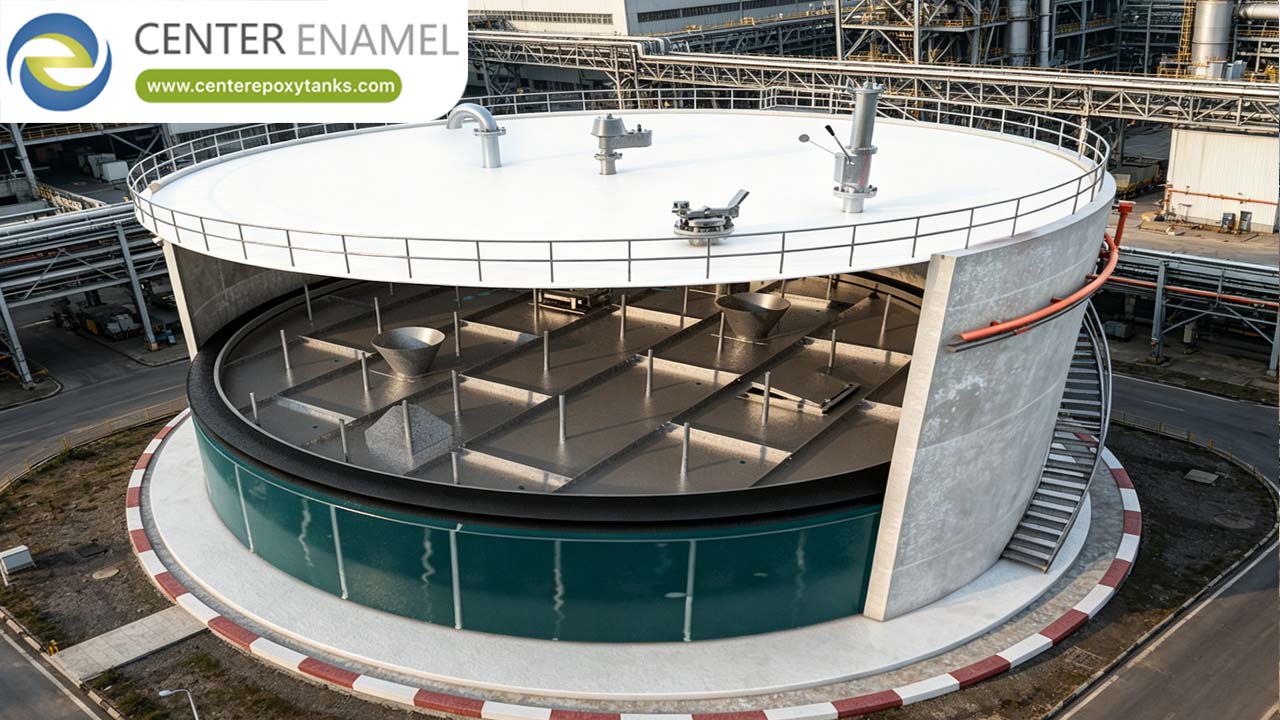
Internal Floating Roof for Tank Farms: Planning the Multi-Tank Decision
A tank farm is a portfolio, not a single tank. Deciding where to use internal floating roofs means choosing tank by tank, because diameter, product, climate and permit conditions vary across the site. This article gives a planning framework: which tanks justify an internal deck, where an external roof is more economical, and how to keep the decision consistent as the farm expands.
Treat the Farm as a Portfolio of Decisions
A tank farm rarely has one product, one diameter or one duty. It has a mix: large crude tanks, smaller refined-product tanks, additive tanks, water tanks and sometimes firefighting storage. Applying one roof standard to all of them either overspends on tanks that do not need it or underspecifies the tanks that do.
The planning unit is therefore the individual tank, described by product, vapour pressure, diameter, turnover and applicable permit. A comparison of internal and external floating roofs makes the same point from the selection side: the answer depends on product volatility, tank diameter and local conditions.
Once each tank is classified, patterns appear. High-value refined products usually cluster toward internal roofs; very large crude tanks often toward external roofs; low-volatility or water tanks toward fixed covers. The plan should make those patterns explicit.
Diameter Changes the Economics
Tank diameter is one of the strongest drivers in the internal-versus-external decision. A fixed roof over a very large diameter becomes heavy and structurally demanding, which is why external floating roofs are common for massive crude storage. For smaller and mid-size tanks, the fixed roof is manageable and its protective benefits are affordable.
Published comparisons note that internal roofs are often built from lightweight aluminium to limit the load on the structure, while external roofs are heavier steel constructions designed to withstand wind, rain and snow. That difference in structural demand scales with diameter and affects both capital cost and the supporting shell design.
At farm level this suggests a practical rule: review every tank above a threshold diameter individually, because the default that works for the rest of the farm may not be economical there.
Product and Permit Drive the Rest
Tank characteristic | Typical direction | Primary reason |
High-value volatile product | Internal floating roof | Purity, weather shielding, vapour control |
Very large crude tank | External floating roof | Fixed roof cost and structural load |
Low-volatility product | Fixed roof | Limited benefit from a floating deck |
Above vapour-pressure ceiling | Pressure tank / recovery | Floating roof not permitted |
Product volatility sets the need for vapour control, and the permit sets how much is enough. EPA AP-42 Chapter 7 Section 7.1 gives the emission framework, while rules such as Louisiana's LAC 33:III 2103.C define acceptable internal roofs and seal arrangements for volatile organic compounds. The farm plan should record which requirement governs each tank.
Product purity is the other driver. Where a product cannot tolerate rainwater or debris, the fixed outer roof of an internal-floating-roof tank is a genuine advantage. Comparisons of the two roof types consistently note that internal roofs keep weather out and shield the seals, while external roofs need drainage systems that can fail.
Where the product vapour pressure exceeds the applicable ceiling, the answer is pressure storage or vapour processing, not a different floating roof. That gate should be applied before any roof comparison begins.
Standardise Where It Adds Value
A mixed farm is not an argument for chaos. While roof types differ, the supporting decisions should be standardised: seal families by product group, inspection intervals by duty, grounding details, documentation format and the criteria for taking a tank out of service. That lets the operating team maintain a varied fleet without reinventing procedures for each tank.
Standardisation also helps procurement. If the farm defines, for example, one approved seal arrangement for refined products and one for crude, suppliers can bid on a clear basis and spare parts can be shared across tanks. The saving is in maintenance, not only in purchase.
Record where a tank is an exception and why. A single tank with a non-standard deck or seal should be visible in the register, because it will be the one that needs special parts and special attention during an outage.
Plan Expansion With the Same Logic
Farms grow in phases. The most useful thing a planner can do is write the decision rule once and apply it to each new tank: product envelope, diameter, permit basis and purity requirement, in that order. New tanks then inherit a defensible choice instead of whatever was available in that contract package.
Phased expansion also creates an opportunity to revisit earlier decisions. A tank that was built with a fixed roof under an old permit may justify a retrofit if throughput or rules change; a tank that received an internal roof it never needed can be left alone rather than copied.
Keep the register live. It should show roof type, seal material, deck configuration, inspection status and the decision basis for every tank, so that the next expansion starts from evidence rather than memory.
Evidence Boundary for This Planning Article
This is a planning method, not a case study. Our verified project library contains no internal floating roof tank farm and no multi-tank floating-roof installation, so nothing in this article should be read as a description of a delivered site.
The comparisons and regulatory references are drawn from named public sources that were checked reachable before delivery. Figures and conditions should be verified against the project's own permit and the current edition of any standard cited.
The value of the article is the decision discipline: classify each tank, apply the same gates, and document the reason. That approach survives changes in product, throughput and regulation better than a single farm-wide rule.
Vapour-Control Strategy Across the Whole Farm
A tank farm should have one written vapour strategy even though it has several roof types. The strategy states which rule governs each source category, what control each tank uses and how compliance is demonstrated. Without it, each new project inherits a fresh interpretation and the farm drifts into a mixture that nobody can defend during an audit.
Group tanks by control need rather than by age or contractor. A refined-product cluster with high turnover shares a seal and inspection philosophy; a crude cluster may rely on external roofs and rim-fire protection; low-volatility tanks may be fixed and monitored. The register should show the grouping so a new tank can be slotted into the right one.
Measure what matters at farm level. If total site emissions are the permit basis, the loss model should cover standing, working and loading sources together, because a roof that performs well on standing loss does not solve a farm dominated by throughput. The control plan should follow the measured balance, not a single tank's specification.
Retrofit Versus New-Build Across the Asset Life
Farms live longer than any single roof specification. A tank built with a fixed roof may justify conversion if throughput rises or a rule tightens, while a tank that received an internal roof it never needed can simply continue under a lighter inspection regime. The decision should be reopened when the duty changes, not treated as permanent.
Retrofit feasibility depends on geometry and condition. Manway size, internal columns, shell roundness and the state of the existing fixed roof decide whether a deck can be introduced economically. A survey before the concept stage prevents a conversion being priced on assumptions that fail once access is gained.
Keep the decision record with the tank file, including why a roof type was chosen and which conditions would trigger a review. When the farm expands in a later phase, that record lets the planner apply the same reasoning instead of copying the last contract package.
Evidence disclosure for this tank-farm article: the verified project library contains no internal floating roof tank farm or multi-tank floating-roof installation, so no layout, tank count, capacity or site emission result is claimed from our own work. Comparison and regulatory points are attributed to the named sources and are presented as a planning method.
Conclusion
Plan floating roofs tank by tank inside the farm. Use internal decks where product purity, weather protection and permit conditions justify them, and external roofs or fixed roofs elsewhere. Record the decision basis for each tank so future expansion follows the same logic rather than a rule of thumb.
Frequently Asked Questions
Q: Should every tank in a farm get an internal floating roof?
A: No. The decision is per tank. Small diameter tanks, low-volatility products and tanks under lenient permits may not justify the added cost; high-value volatile products usually do.
Q: How does tank diameter affect the choice?
A: At very large diameters a fixed roof becomes heavy and expensive, which favours an external floating roof. Internal roofs are common where product purity and weather protection matter.
Q: What is the main advantage of an internal roof in a farm?
A: A fixed outer roof shields the deck and seals from weather, keeps rainwater out of product and adds a secondary barrier, which can reduce maintenance across many tanks.
Q: How do permits shape a multi-tank plan?
A: The applicable rule sets seal requirements and emission limits per tank or per source category. The plan should record which rule drives each tank's specification.
Q: Can a farm mix internal and external roofs?
A: Yes, and it is common. Match the roof to each tank's product and duty rather than enforcing one standard across the whole site.
Q: Is there a tank-farm project in your library?
A: No internal floating roof farm project is verified in our library, so this article claims no capacity, layout or emission result from our own work.
Work With Center Enamel
Center Enamel is the trading name of Shijiazhuang Zhengzhong Technology Co., Ltd, established in 2008 and based in Shijiazhuang, Hebei Province, China. The company manufactures glass-fused-to-steel bolted tanks, fusion-bonded epoxy coated tanks, stainless steel and welded steel tanks, pressure vessels, aluminium geodesic dome roofs and floating roof systems. Aluminium dome design work is carried out against AWWA D108, API 650, ADM 2015, ASCE 7-10 and IBC 2012, and the broader product range is covered by ISO 9001, NSF/ANSI 61, CE/EN 1090, ISO 28765, WRAS and FM approvals. The company reports 30,000 installed projects and an annual output of 300,000 enamel steel plates, with technical support delivered through an international distributor network and a stated 24-hour response commitment.
If your project involves tank roofs, floating decks or the shells that carry them, send the tank diameter, shell height, product, operating temperature and site design loads. We will return a preliminary structural concept, the applicable design code basis, and a written scope that separates what is included from what the site contractor must provide.


