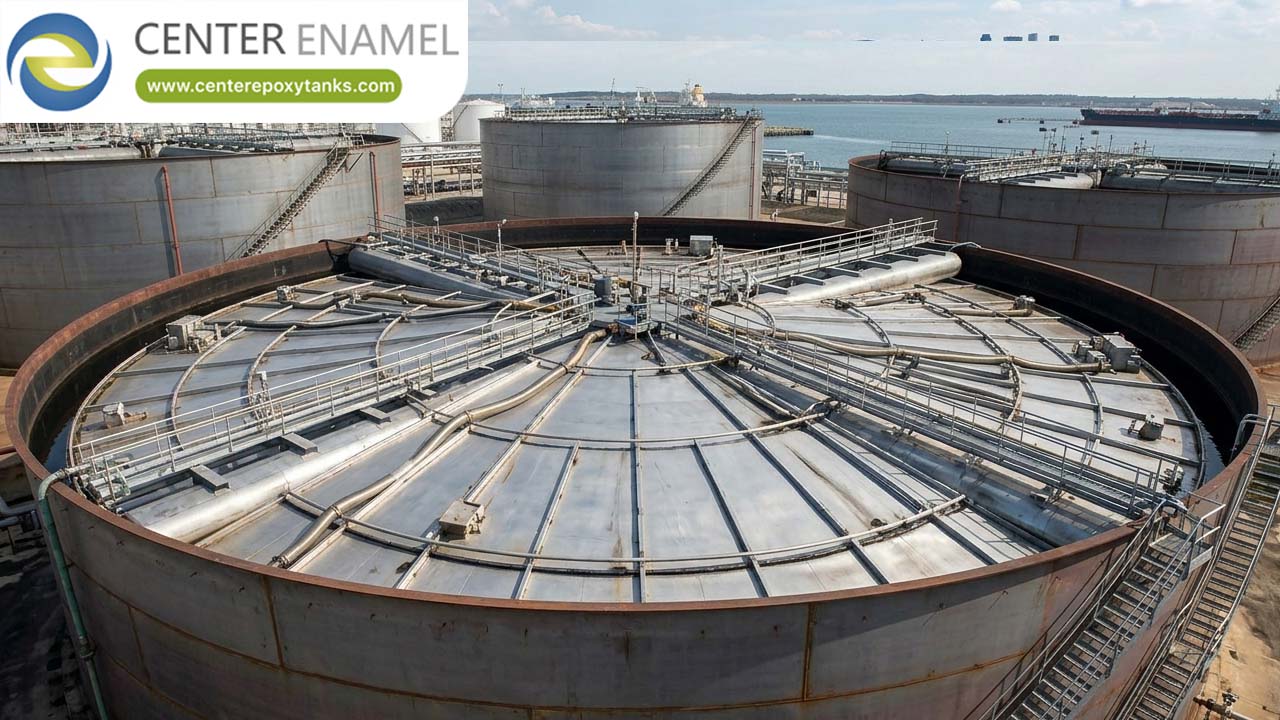
Internal Floating Roof for Petroleum Tanks: Product Volatility Range
Petroleum storage rarely involves a single product. A terminal may hold gasoline, naphtha, diesel, kerosene and fuel oil in tanks of different sizes, each with its own vapour pressure and compatibility needs. This article sets out how to specify internal floating roofs across that range without either over-specifying the easy cases or under-specifying the difficult ones.
Group Products by Vapour Pressure
The first step is to group the products by true vapour pressure and by the capacity thresholds in the applicable rule. Under 40 CFR 60.112b, tanks above defined sizes storing volatile organic liquids above stated vapour-pressure thresholds need one of several controls, including an internal floating roof with an acceptable closure device.
Products below those thresholds may still justify a roof on product-loss or quality grounds, but the acceptance test is different. Make that distinction explicit in the specification so the supplier knows which claim is being made.
A terminal with several products should produce a simple matrix rather than one generic specification.
Match Deck Architecture to the Duty
A published IFR product range assigns a pontoon variant to mid-volatility products, a hybrid to large crude tanks and a full-contact honeycomb to high-volatility service. Those are one supplier's recommendations, but they demonstrate the right approach: architecture is selected for vapour pressure, diameter and maintenance needs.
Deck weight and stiffness matter across the range. The same source quotes deck weights around six to nine kilograms per square metre for its variants, which shows why one design is not automatically optimal for every tank.
State the selected architecture and the reasoning in the design basis.
Seal and Fitting Details Across the Range
Seal compounds must be matched to product chemistry, and fittings must be closed and gasketed. Under the federal rule, sample wells require a fabric cover over at least ninety percent of the opening, bleeder and rim vents must be gasketed, and access hatches and gauge float wells must be closed except when in use.
AP-42-based analysis shows that fitting losses can rival rim losses, with an open gauge well a particularly large source. That makes fitting control a terminal-wide programme rather than a tank-by-tank afterthought.
Specify the primary seal, secondary seal where required, and the fitting package as separate lines so bids stay comparable.
Product Switching and Compatibility
A tank that changes product changes its design conditions. Density affects buoyancy, vapour pressure affects emissions, and chemistry affects seal and metal compatibility. A selection guide lists product compatibility and the potential for wax or solids among the questions to ask before choosing a roof.
Keep a product register for each tank and require a review before a new product is introduced. That review should check the seal certificate, the buoyancy basis and the drainage design.
This is more important in a multi-product terminal than in a single-product facility because the changes happen more often and are easier to treat as routine.
Inspection and Maintenance Across the Range
High-volatility service places more emphasis on seal and fitting condition; heavier products place more emphasis on deposits and drainage. An API 653-based inspection programme provides the structural baseline, while the applicable air rule sets seal and fitting inspection frequencies.
Set the interval per tank rather than per terminal. A gasoline tank and a diesel tank in the same farm do not need the same checks at the same frequency.
Record findings in a comparable format so trends across the fleet are visible.
A Comparable Specification
For each tank, state diameter and height, product range, design vapour pressure and density, temperature, deck architecture, code basis, jurisdiction, seal scope, fittings, inspection and handover documents. That is enough for a supplier to price the same duty and for the buyer to compare offers.
No internal floating roof project is held in the verified project library, so this article offers a specification method rather than a delivered installation.
A Product-by-Product Matrix
Build a matrix with one row per stored product and columns for vapour pressure, density range, compatibility notes, required seal arrangement and inspection priority. It is a simple document that prevents most specification errors in a multi-product terminal.
Use the matrix to decide where a secondary seal is required, where full contact is justified, and where a simpler pontoon deck will meet the duty. Keep the reasoning visible so a future reviewer understands the choice.
Update the matrix when a product is added or withdrawn, and use it as the input to the next replacement specification.
Common Mistakes Across the Range
The most frequent errors are applying one deck type to every product, choosing a seal compound by habit rather than compatibility, and treating fitting details as minor. A selection guide lists all three among the predictable causes of floating roof problems.
A fourth mistake is understating the low-volatility case. Even where emissions are not regulated, vapour loss and product quality can justify a well-specified roof, but the acceptance criterion should be stated.
No internal floating roof project is held in the verified project library, so this is a specification method rather than a delivered case.
Comparing specification options
When a terminal has several products, compare the cost of one flexible specification against several product-specific ones. Flexibility has value where product assignments change often, but it can over-specify the easy cases.
The matrix of products and duties should drive that decision rather than a preference for standardisation.
Changes in regulation
Applicable thresholds and rules change. Review the regulatory basis periodically for each tank in the petroleum range, because a tank that was previously unregulated may cross a threshold after a capacity or product change.
No internal floating roof project is held in the verified project library, so this is a planning method rather than a case.
Keeping Competence in the Team
A multi-product terminal depends on people recognising that a change of product is a change of duty. Train operators and engineers to ask the compatibility and buoyancy questions before the transfer begins, not after a seal fails.
A short, well-kept product register is more effective than a complex system that nobody updates.
Planning for Sparse Data
Where assay data is incomplete, state the assumption explicitly and choose the conservative side for buoyancy and seal compatibility. A documented assumption can be corrected when better data arrives; an unstated one cannot.
No internal floating roof project is held in the verified project library; this is a specification discipline rather than a delivered case.
Reviewing the Product Register
A product register is only useful if it is current. Assign responsibility for updating it when a product is introduced or withdrawn, and review it as part of the annual inspection planning cycle.
A register that is out of date gives false confidence, because it will show a duty the tank no longer performs.
No internal floating roof project is held in the verified project library; this is a management method, not a reported case.
Specification Sign-Off Across the Range
Across a petroleum range, the specification is sound only if each product has been considered against vapour pressure, density and compatibility. A short review of that matrix before issue prevents most selection errors.
No internal floating roof project is held in the verified project library; this is a specification discipline, not a reported case.
Recording the Rationale
Write down why each deck and seal was selected for each product group. When a future engineer asks why one tank differs from its neighbour, the answer should be in the file rather than in memory.
Product Group Matrix
Product group | Dominant issue | Specification response |
High volatility | Vapour loss and emissions | Full contact, secondary seal, tight fittings |
Mid volatility | Balance of loss and access | Pontoon deck with good seals |
Heavy / waxy | Deposits and drainage | Robust drain, shorter interval |
Switching service | Changing compatibility | Pre-change roof review |
The matrix below is a way to organise a multi-product programme; fill it with your own products and duties before issuing a specification.
Evidence note: this petroleum-range guide is a selection method, not a project record. The verified project library contains no internal floating roof delivery, so no product tank or emission outcome is claimed here. Ranges and requirements are attributed to the named public sources.
Conclusion
Specify internal floating roofs product by product within the petroleum range. Use vapour pressure and density to set the deck and seal basis, define the compliance objective, and review the decision whenever the stored product changes.
Frequently Asked Questions
Q: Does one deck type suit all petroleum products?
A: No. Deck architecture, seal compound and fitting details should follow vapour pressure, density and chemistry. Published ranges assign different variants to different services.
Q: How does vapour pressure drive selection?
A: It sets the emission potential and, under US rules, whether a floating roof is a required control above defined capacity thresholds.
Q: What about low-volatility products?
A: The emission case is weaker, but vapour loss and product quality can still justify an IFR. The specification should state which basis applies.
Q: Can a tank switch products?
A: Yes, but the roof must be reviewed for each change. Seal compatibility and buoyancy both depend on the product.
Q: Should every tank get a secondary seal?
A: Many volatile services prefer or require one. The decision should follow the emission target and jurisdiction, not a rule of thumb.
Q: How do I keep the specification comparable?
A: State the product range, design vapour pressure and density, deck architecture, seals, fittings and compliance basis so bidders price the same duty.
Work With Center Enamel
Center Enamel is the trading name of Shijiazhuang Zhengzhong Technology Co., Ltd, established in 2008 and based in Shijiazhuang, Hebei Province, China. The company manufactures glass-fused-to-steel bolted tanks, fusion-bonded epoxy coated tanks, stainless steel and welded steel tanks, pressure vessels, aluminium geodesic dome roofs and floating roof systems. Aluminium dome design work is carried out against AWWA D108, API 650, ADM 2015, ASCE 7-10 and IBC 2012, and the broader product range is covered by ISO 9001, NSF/ANSI 61, CE/EN 1090, ISO 28765, WRAS and FM approvals. The company reports 30,000 installed projects and an annual output of 300,000 enamel steel plates, with technical support delivered through an international distributor network and a stated 24-hour response commitment.
If your project involves tank roofs, floating decks or the shells that carry them, send the tank diameter, shell height, product, operating temperature and site design loads. We will return a preliminary structural concept, the applicable design code basis, and a written scope that separates what is included from what the site contractor must provide.


