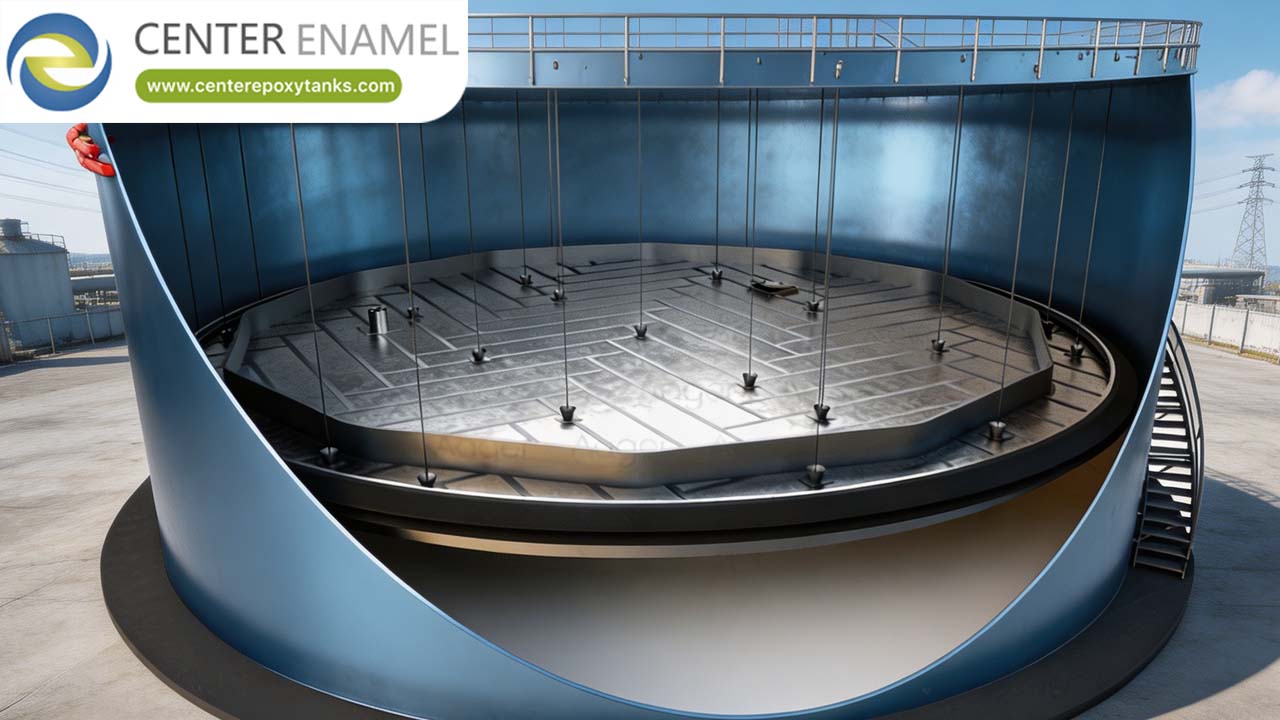
Internal Floating Roof for Petrochemical Storage: Compatibility and Changeover
Petrochemical storage is rarely a single-product problem. A tank that held naphtha last quarter may hold an aromatic intermediate next quarter, and the floating roof inside it has to remain compatible with both. This article sets out how to specify an internal floating roof when the product slate is wide: how to build a compatibility matrix, which seal and deck materials tolerate which families of chemicals, and what a changeover actually requires before the roof is trusted again.
Define the Product Envelope Before the Deck
Petrochemical service defeats the usual shortcut of specifying a roof for one liquid. The design brief should list every product the tank will see, with true vapour pressure, density, temperature range and corrosive or solvent character for each. A roof chosen for the mildest product will fail on the most aggressive one, so the envelope, not the average, drives material selection.
Published IFR specifications describe pontoon and deck construction in aluminium or stainless steel with a range of seal faces. Those are real options, but none is universal. The specifier's job is to map each option against the product envelope and to record why a material was accepted or rejected for each family of chemicals.
Include cleaning agents and water washes in that envelope. Petrochemical tanks are periodically cleaned, and a seal that survives the product can be damaged by the solvent or caustic used to remove residues. Ignoring the cleaning regime is one of the more common causes of premature seal failure in this service.
Build a Compatibility Matrix, Not a Material Preference
Product family | Seal face commonly selected | Deck / hardware note |
Aliphatic fuels and naphtha | Nitrile (NBR) | Aluminium deck usually acceptable |
Aromatics and solvents | FKM or PTFE-faced | Check aluminium and elastomer swelling |
Caustic or acidic streams | PTFE-faced, verify gaskets | Stainless hardware preferred |
Water wash / cleaning regime | Compatibility to be confirmed | Rinse and drain before changeover |
A compatibility matrix lists product families down one axis and roof components across the other: primary seal face, secondary seal, deck skin, pontoon, hardware and gaskets. Each cell is marked compatible, conditional or incompatible, with the temperature and concentration that qualify the answer. This converts a subjective preference into a decision that can be reviewed and audited.
Seal elastomers are where the differences bite. Nitrile rubber is widely used for aliphatic fuels, while fluorocarbon and PTFE-faced systems are selected where aromatics or aggressive solvents are present. The matrix should state this explicitly and should flag products for which a supplier confirmation is required rather than assumed.
The same discipline applies to metals. A published honeycomb IFR specification cites 3003-H14 aluminium skin and aluminium pontoon tubing, while other designs use stainless steel. Where the product or its cleaning regime favours stainless, the matrix should say so and the differential cost should be justified against service life rather than treated as an upgrade by default.
Changeover Is an Operational Discipline
A floating roof is a moving assembly inside a closed tank, so changing the stored product is more than a valve operation on the manifold. Before admitting a different chemical, the operator should confirm that the new product falls inside the approved compatibility matrix and that the seal, deck and fittings have been inspected for the previous product's residues.
Gas-freeing and cleaning follow the site's safety procedure and are outside the scope of this article, but their effect on the roof is not. A seal that has been soaked in one product and then exposed to a solvent wash can swell or shrink. Record the condition of the seal face and the fasteners after cleaning so a later problem can be traced to a changeover rather than to manufacture.
Where a tank regularly rotates between products, keep the changeover checklist with the roof documentation. It should name the compatibility reference, the inspections performed and the person who released the tank. That record is the difference between a controlled change and an unexplained seal leak two weeks later.
Vapour Control Still Has to Be Designed
An internal floating roof removes most of the standing vapour space, which is why it is specified in the first place, but it does not eliminate emissions. The remaining paths are the rim seal and the deck fittings. EPA AP-42 Chapter 7 Section 7.1 treats rim-seal loss as a calculable source and distinguishes liquid-mounted, mechanical-shoe and secondary seal arrangements; the calculation is a useful reminder that the roof is a control device with measurable residuals.
Regulations set the floor of what is acceptable. Louisiana's LAC 33:III 2103.C defines an internal floating roof as a pontoon, double-deck or internal cover resting on the liquid with a closure seal, and requires gauging and sampling devices to be gas tight except during use. In several parishes a liquid-mounted seal, a mechanical shoe seal, or two stacked continuous seals are specified. Check the current rule for the site rather than assuming the general definition is sufficient.
For a petrochemical tank the practical consequence is that the roof specification and the air-permit condition must be written together. A roof that satisfies the mechanical code but not the applicable vapour rule will still require a vapour-processing system, and the cost of that system belongs in the original comparison.
Deck and Pontoon Choices in This Service
Petrochemical operators choose between aluminium honeycomb and stainless deck constructions for reasons that go beyond price. Aluminium is light, which reduces load on the shell and makes the roof responsive to level changes; a published specification reports a skin material and pontoon tubing designed around that weight advantage. Stainless is heavier but is selected where product chemistry or cleaning practice makes aluminium the weaker choice.
Pontoon integrity matters more in a changing product slate. A leaking pontoon compartment fills with liquid or product and changes the roof's trim; several leaking compartments can tilt the deck and load one side of the seal. Require a leak-test method in the specification and record which compartments were tested, because a compartment that cannot be accessed later must be right at manufacture.
Guide poles, gauge wells and sample wells are additional wetted interfaces. In petrochemical service each penetration should appear on the compatibility matrix with its own gasket and sleeve material, since a fitting made from an unsuitable elastomer can defeat an otherwise compatible deck.
Where the Internal Floating Roof Is Not the Answer
There is a hard boundary at high vapour pressure. Illinois' storage-container rule prohibits a floating roof where the volatile organic liquid has a vapour pressure of 86.19 kPa (12.5 psia) or more at 70 °F, and Kansas rules direct products at or above roughly 11 psia to a pressure tank or a vapour-processing system. Louisiana likewise moves products at 11 psia and above out of the general internal-floating-roof provision. Those thresholds vary by jurisdiction but the principle is consistent.
A petrochemical stream above the applicable ceiling should be specified as a pressure tank or equipped with vapour recovery, not forced into a floating-roof design. The same applies where the stored phase is a gas at storage conditions, a case treated separately in this batch's gas-storage article.
Stating the exclusion in the specification protects both parties. It tells the supplier that the tender is a genuine floating-roof application and it prevents a bid based on a roof that cannot lawfully or safely serve the product.
Seal Materials Under a Multi-Product Regime
A petrochemical tank rarely rewards a single-material answer. The seal face that served a paraffinic feed may swell when an aromatic stream arrives, and a gasket chosen for one temperature can harden when the next campaign runs hotter. Keep the compatibility matrix visible to operations so the product-planning meeting can consult it before a grade is assigned to a specific tank.
Where the matrix marks a cell conditional, treat that as a request for a supplier confirmation rather than permission to proceed. A conditional rating usually depends on concentration, exposure time or the presence of water, and those conditions change between campaigns. Record the confirmation against the exact product and temperature before the tank is committed.
Cleaning compounds deserve their own row in that matrix. Petrochemical tanks are washed with caustic, solvent or hot water depending on the residue, and each of these can affect an elastomer differently from the product itself. A seal that survived the whole campaign can be ruined in one cleaning cycle if the wash chemistry was never assessed.
Commissioning Records for Changeover Duty
A roof in multi-product service should be commissioned with the expectation that its conditions will change. Record the as-built seal profile, the material actually fitted, the torque values on the clamps and the observed behaviour of the deck through a full fill-and-empty cycle. That baseline is what makes a later change in seal behaviour interpretable.
Tie each changeover to that baseline. After the tank is returned to service with a new grade, note whether the deck still tracks smoothly and whether the seal contact looks even from the inspection points available. A deviation that appears only after a particular product is a strong clue that the compatibility assessment needs revisiting.
Where the permit requires a leak-detection method, name the method and the acceptance threshold in the roof file. Compliance then becomes a repeatable test rather than an opinion formed during a visual walk-down, and the result can be compared across campaigns and across products.
Evidence disclosure for this petrochemical article: the verified project library contains no petrochemical internal floating roof delivery, so no plant, product, deck or emission result is claimed from our own work. Material and regulatory points are attributed to the named public sources, and the compatibility approach is a specification method rather than a project record.
Conclusion
Specify a petrochemical internal floating roof against the whole product envelope, not the first cargo. Build a seal and deck compatibility matrix, verify changeover and gas-tight fittings, and treat rim and fitting emissions as remaining obligations. Where vapour pressure or product phase puts the service outside floating-roof limits, select a pressure tank instead.
Frequently Asked Questions
Q: What makes petrochemical service different for a floating roof?
A: The product slate is wide and changes. A roof must stay compatible with several chemical families and their vapour phases, not just one hydrocarbon, so seal and deck materials are chosen for the whole envelope.
Q: Which seal material suits aromatic solvents?
A: Fluorocarbon (FKM) or PTFE-faced seals are commonly selected for aromatics and aggressive solvents; nitrile is adequate for many aliphatic fuels. Confirm against the actual product and temperature.
Q: Is an aluminium deck acceptable in petrochemical service?
A: Often, but compatibility and galvanic issues must be checked. Stainless deck and hardware are selected where the product or cleaning regime attacks aluminium; the choice is chemical-specific.
Q: What must be checked at product changeover?
A: Confirm the new product against the seal and deck compatibility matrix, inspect the seal and fittings, and follow the site's cleaning and gas-freeing procedure before refilling.
Q: Does a floating roof remove the need for vapour control?
A: No. It removes most of the standing vapour space but rim and fitting emissions remain. Regulations such as Louisiana's rule still require sealed gauging and defined closure seals.
Q: When is an internal floating roof the wrong choice?
A: When the stored product is a gas at storage conditions or has a true vapour pressure above the applicable regulatory ceiling, a pressure tank or vapour-control system is required instead.
Work With Center Enamel
Center Enamel is the trading name of Shijiazhuang Zhengzhong Technology Co., Ltd, established in 2008 and based in Shijiazhuang, Hebei Province, China. The company manufactures glass-fused-to-steel bolted tanks, fusion-bonded epoxy coated tanks, stainless steel and welded steel tanks, pressure vessels, aluminium geodesic dome roofs and floating roof systems. Aluminium dome design work is carried out against AWWA D108, API 650, ADM 2015, ASCE 7-10 and IBC 2012, and the broader product range is covered by ISO 9001, NSF/ANSI 61, CE/EN 1090, ISO 28765, WRAS and FM approvals. The company reports 30,000 installed projects and an annual output of 300,000 enamel steel plates, with technical support delivered through an international distributor network and a stated 24-hour response commitment.
If your project involves tank roofs, floating decks or the shells that carry them, send the tank diameter, shell height, product, operating temperature and site design loads. We will return a preliminary structural concept, the applicable design code basis, and a written scope that separates what is included from what the site contractor must provide.


