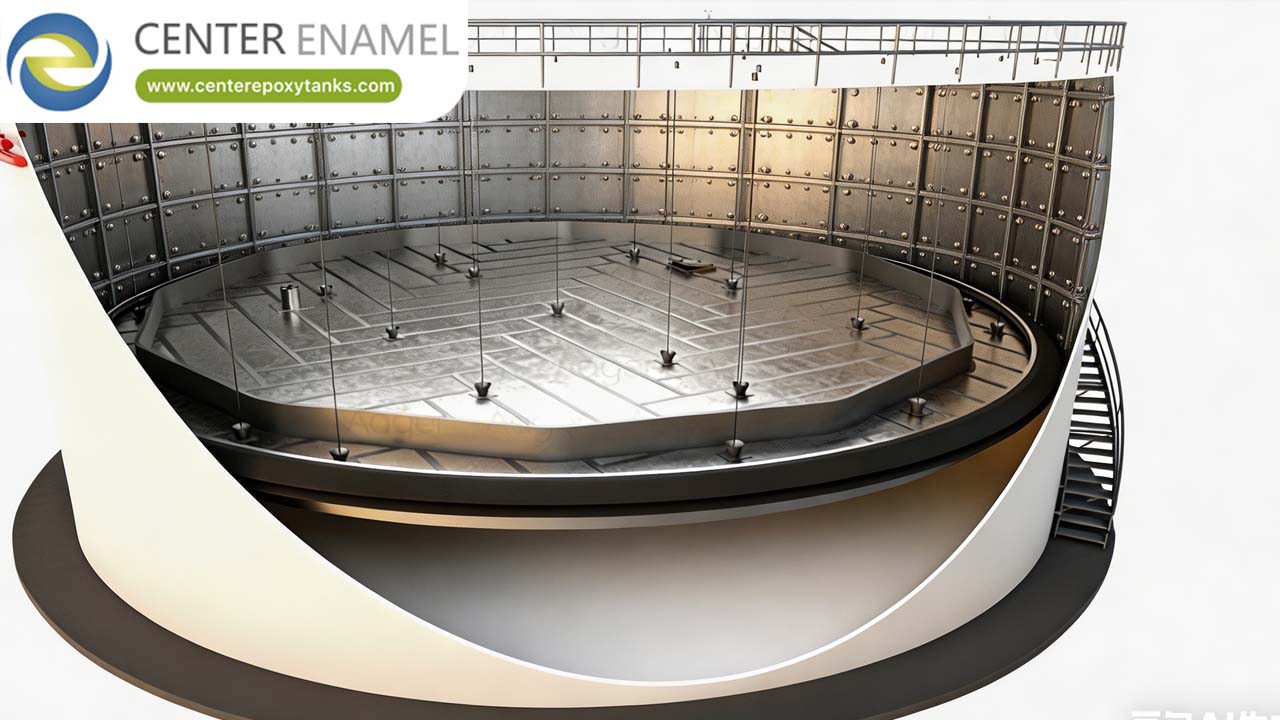
Internal Floating Roof for LNG Storage: Why the Application Does Not Apply
An internal floating roof is not used for LNG storage, and presenting one as a solution would be technically wrong. LNG is a cryogenic liquid held near minus 162 degrees Celsius in specialised insulated tanks; the design problem is containment, insulation and boil-off gas, not vapour-space suppression by a floating deck. This article explains why the keyword is a mismatch, what LNG storage actually requires, and how to recognise a genuine floating-roof enquiry.
Why the Two Technologies Do Not Belong Together
An internal floating roof solves a specific problem: a volatile liquid in a near-atmospheric tank would otherwise fill the space above it with vapour. LNG is not that problem. It is natural gas cooled until it becomes a liquid at about minus 162 degrees Celsius, and it is kept that way in a highly insulated, multi-barrier tank.
At that temperature the governing concerns are material toughness, heat leak, thermal contraction and boil-off gas. A floating deck made for ambient liquid service has no role in managing any of them. Presenting it as an LNG solution would confuse two completely different branches of storage engineering.
Recognising the mismatch early is commercially useful. A buyer who searches this phrase usually wants cryogenic storage advice; a supplier who answers with a floating-roof brochure has misunderstood the enquiry.
What LNG Storage Actually Requires
Design item | Typical LNG response | Purpose |
Inner tank | 9% Ni steel or 304/316L stainless | Toughness at cryogenic temperature |
Insulation | Perlite, PUF or vacuum panels | Limit heat leak and boil-off |
Outer containment | Carbon steel or prestressed concrete | Secondary retention and structure |
Foundation | Heating or ventilated structure | Prevent soil freezing and frost heave |
Vapour management | BOG compressors and relief system | Handle boil-off safely |
LNG regulations describe tanks designed to EN 14620, API 620 and API 625, with impounding area and drainage under NFPA 59A. LNG is stored at roughly minus 159 to minus 168 degrees Celsius, and materials in contact with the liquid or cold vapour must be suitable for that service under the ASME boiler and pressure vessel code.
In practice that means an inner tank of 9 percent nickel steel or austenitic stainless steel, insulation such as perlite or polyurethane foam, and an outer tank of carbon steel or prestressed concrete that provides structural support and secondary containment. Single, double and full-containment arrangements exist, selected by risk analysis and site conditions.
The annular space in such tanks is often kept under dry nitrogen, the foundation is heated to prevent ground freezing, and the tank is equipped with pressure relief and foam dams for fire protection. These are the systems that replace the familiar vapour-control logic of a product tank.
Boil-Off Gas Replaces the Vapour-Control Discussion
In a product tank the operator worries about breathing and standing losses. In an LNG tank the analogous issue is boil-off gas, formed as heat enters the tank despite the insulation. Guidance describes BOG compressors handling evaporation, tiered pressure-relief valves, and controls for stratification and rollover in tall tanks.
Rollover is a thermal rather than mechanical problem: layers of LNG at different density and temperature can mix suddenly and release vapour rapidly. Published designs respond with temperature profiling, circulation through submerged pumps and controlled filling. None of this resembles a floating deck or a rim seal.
Because boil-off is a continuous operating cost and a safety consideration, insulation quality and BOG handling are the equivalent of the emission-control calculations in an oil tank. That is the right technical conversation for this keyword.
Codes and Site Requirements Control the Design
The referenced regulation is explicit that LNG tanks are designed to EN 14620 or API 620 and API 625, and that impounding area, drainage and capacity follow NFPA 59A. It also requires materials compatible with LNG and cold vapour, and notes that improved 9 percent nickel steel or austenitic stainless steel are used for containment.
Site selection is driven by risk analysis: proximity to process areas, control rooms, habitation and local authority requirements all influence tank type and spacing. Foundation heating is required to keep the soil from freezing, with independent circuits or a ventilated structure as alternatives.
These requirements show why LNG storage is a specialist field. The responsible answer to an LNG enquiry is to work within those codes and to bring in cryogenic design capability, not to adapt an atmospheric storage component.
How to Recognise a Genuine Floating-Roof Enquiry
A genuine internal-floating-roof enquiry involves a liquid stored near atmospheric pressure within a vapour-pressure ceiling, in a vertical cylindrical tank with a fixed roof. The questions are about deck material, seal type, fittings and compliance with a storage-emissions rule. LNG enquiries ask about containment, insulation and boil-off instead.
Sometimes a search for LNG and floating roofs comes from a mixed site: an LNG terminal also stores diesel, condensate, water or firefighting fluid, and those atmospheric tanks may legitimately use floating decks or aluminium domes. In that case the floating-roof question is about the ancillary tanks, not the LNG vessel.
Separating those tanks in the enquiry avoids a category mistake. It lets the LNG scope go to a cryogenic designer while the atmospheric storage scope is assessed on its own merits.
Evidence Boundary
This batch has already disclosed that the verified project library contains no floating-roof delivery. For this article the boundary is wider: there is no LNG tank and no cryogenic vessel of any kind in that library. Nothing here should be read as a statement that we supply LNG containment.
The technical content is drawn from the named regulation and a cryogenic tank reference, both checked reachable before delivery. Where a figure such as a storage temperature or a material grade is quoted, it is attributed to those sources and should be checked against the project's governing code.
The honest conclusion is that the keyword is a mismatch. Redirecting it correctly is more useful to the reader than forcing a product answer that the engineering does not support.
Containment Types and What They Actually Mean
LNG tanks are described as single, double or full containment, and the distinction is about what happens after a leak in the inner tank. A single-containment tank relies on an outer concrete wall plus a separate impounding area; a full-containment tank is designed so the outer structure can hold the liquid and the vapour. The selected arrangement follows a risk assessment for the site.
Each arrangement changes the role of the outer shell and the insulation, but none of them introduces a floating internal deck. The internal roof in these tanks is a suspended ceiling that supports insulation above the liquid, not a buoyant platform resting on it. Confusing the two is a common source of incorrect enquiries.
For a buyer, the practical point is to specify the containment class and the design code together. The referenced regulation requires design to EN 14620 or API 620 and API 625, with impounding and drainage under NFPA 59A, so the containment choice is a code decision rather than a catalogue option.
Safety Systems and Site Layout Considerations
An LNG tank is surrounded by systems that a product tank never needs. Gas detectors, foam dams on the bund wall, tiered pressure relief, emergency shutdown and ATEX-rated electrical equipment are part of the base design. The specifier should expect these items in any credible LNG proposal and treat their absence as a serious gap.
Site layout is driven by hazards that extend beyond the tank. Distances to process areas, control rooms and habitation influence the tank type and the intensity of protective measures, and local authority requirements override generic layouts. A design that ignores the surrounding plot is not a design that can be permitted.
Foundation treatment is another defining feature. The soil beneath an on-ground LNG tank must be kept from freezing, using electrical heating circuits or a ventilated structure, and gas detection under the tank is provided for leakage. These requirements reinforce why cryogenic storage belongs with a specialised designer.
Evidence disclosure for this LNG article: the verified project library contains no LNG tank, no cryogenic vessel and no internal floating roof, so no LNG capacity, boil-off rate, material or completion is claimed from our own work. All LNG technical and regulatory statements are attributed to the named public sources; the article's purpose is to correct an application mismatch, not to claim capability.
Conclusion
Treat the LNG-storage keyword as a mismatch and redirect it. LNG storage is a cryogenic containment problem governed by insulation, 9 percent nickel or stainless inner tanks, boil-off-gas systems and codes such as EN 14620, API 620 and API 625. An internal floating roof belongs to near-atmospheric liquid storage, not to this service.
Frequently Asked Questions
Q: Can an internal floating roof be used in an LNG tank?
A: No. LNG tanks are cryogenic, multi-barrier systems. A floating deck designed for near-atmospheric liquid storage is not a component of that design and would not survive the service.
Q: What temperature is LNG stored at?
A: About minus 162 degrees Celsius at near-atmospheric pressure. LNG regulations cite a range around minus 159 to minus 168 degrees Celsius depending on composition and design.
Q: What materials are used in an LNG inner tank?
A: Materials authorised for cryogenic service under the ASME code, commonly 9 percent nickel steel or austenitic stainless steel, with insulation and an outer concrete or steel containment.
Q: What is BOG and why does it matter?
A: Boil-off gas is vapour formed as heat leaks into the tank. LNG tanks include insulation and boil-off-gas handling to manage it; this replaces the vapour-control logic of a floating roof.
Q: Which codes govern LNG tanks?
A: Regulations cite EN 14620, API 620 and API 625 for tank design, with NFPA 59A for impounding area and drainage. The applicable local code controls.
Q: Is there an LNG floating-roof case in your library?
A: No. The verified project library has no LNG tank and no floating roof. This article makes no LNG delivery claim.
Work With Center Enamel
Center Enamel is the trading name of Shijiazhuang Zhengzhong Technology Co., Ltd, established in 2008 and based in Shijiazhuang, Hebei Province, China. The company manufactures glass-fused-to-steel bolted tanks, fusion-bonded epoxy coated tanks, stainless steel and welded steel tanks, pressure vessels, aluminium geodesic dome roofs and floating roof systems. Aluminium dome design work is carried out against AWWA D108, API 650, ADM 2015, ASCE 7-10 and IBC 2012, and the broader product range is covered by ISO 9001, NSF/ANSI 61, CE/EN 1090, ISO 28765, WRAS and FM approvals. The company reports 30,000 installed projects and an annual output of 300,000 enamel steel plates, with technical support delivered through an international distributor network and a stated 24-hour response commitment.
If your project involves tank roofs, floating decks or the shells that carry them, send the tank diameter, shell height, product, operating temperature and site design loads. We will return a preliminary structural concept, the applicable design code basis, and a written scope that separates what is included from what the site contractor must provide.


