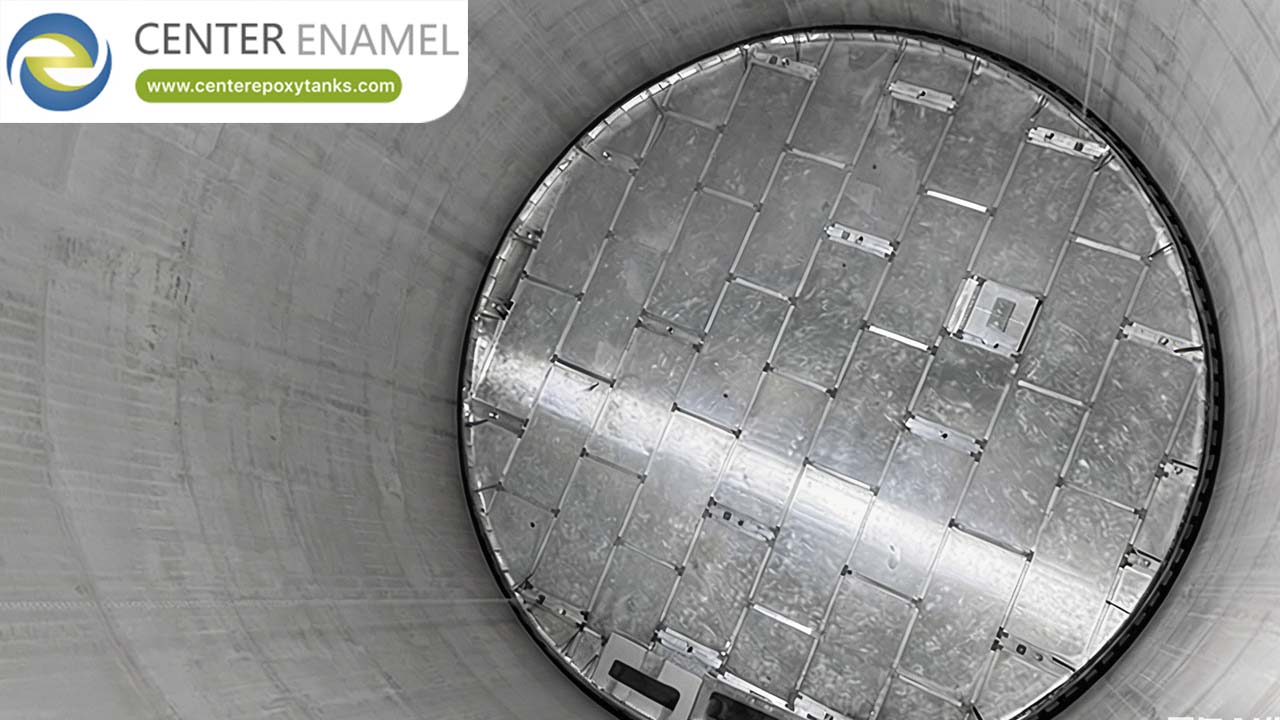
Internal Floating Roof for Gas Storage: Clarifying a Misleading Keyword
The phrase 'internal floating roof for gas storage' contains a category error that is worth resolving early. A floating roof floats on a liquid surface and controls the vapour that liquid releases; it cannot form a seal on a tank whose contents are a gas at storage conditions. This article explains what the keyword is usually trying to ask, how to identify the stored phase, and which storage types actually serve gas service.
What the Keyword Is Actually Asking
Searchers reaching this phrase usually mean one of three things. They may mean a volatile liquid such as gasoline that gives off vapour; they may mean a liquefied gas such as LPG that is a liquid only under pressure; or they may mean true gas storage in a holder or underground reservoir. Each has a different answer, and treating them as one leads to the wrong tank.
An internal floating roof answers only the first case. It rests on a liquid surface and rises and falls with the level, which is why a reference on tank categories groups floating roofs with atmospheric liquid storage and pressure vessels with liquefied gases. The roof is a component of an atmospheric liquid tank, not a gas-containment device.
The practical first step is to write down the stored phase at the site's normal temperature and pressure. That single fact decides whether the rest of the question is about floating roofs at all.
Why a Floating Roof Cannot Seal a Gas
A floating roof works because buoyancy holds a deck on a liquid surface and a perimeter seal closes the gap to the shell. Remove the liquid surface and there is nothing to float on and nothing to seal against. A tank full of gas at near-atmospheric pressure would simply leak around any deck, and the deck would have no defined level to follow.
This is not a matter of making the roof heavier or the seal tighter. The mechanism depends on a stable liquid interface. Where the product is a gas at storage conditions, the engineering response is a closed pressure-rated vessel, a gas holder or a purpose-built cryogenic tank.
Understanding the mechanism also explains why the roof is attractive for volatile liquids: it removes the vapour space above a liquid that would otherwise breathe into the atmosphere. That benefit has no meaning when the whole vessel contents are already vapour.
The Alternatives for Gas and Liquefied-Gas Service
What the user means | Stored phase | Appropriate storage |
Gasoline / naphtha vapour | Volatile liquid, atmospheric | Floating-roof tank may apply |
LPG / propane / butane | Liquid only under pressure | Sphere or horizontal pressure vessel |
Manufactured / distribution gas | Gas at storage conditions | Gas holder or underground storage |
LNG | Cryogenic liquid | Insulated full-containment tank |
Liquefied petroleum gas is kept liquid by pressure. References on tank types describe spherical vessels and horizontal bullet tanks for LPG, propane, butane and ammonia, because a curved shell distributes internal pressure efficiently. A vertical atmospheric tank with a floating deck cannot do that job.
For manufactured or distribution gas, a gas holder provides variable-volume storage at low pressure; for large-scale strategic storage, underground formations are used. Neither involves a floating roof, and both are selected on volume, pressure and duty cycle rather than on vapour-loss suppression.
LNG is a third case. It is a liquid only at about minus 162 degrees Celsius and is stored in insulated cryogenic tanks built to codes such as EN 14620, API 620 and API 625. The relevant systems are insulation, boil-off-gas handling and secondary containment, not a floating deck.
Where the Vapour-Pressure Ceiling Sits
Even when the product is a liquid, there is a limit beyond which a floating roof is not accepted. Illinois rules state that a floating roof is not permitted for a volatile organic liquid with a vapour pressure of 86.19 kPa (12.5 psia) or more at 70 °F, requiring a pressure tank or other control. Kansas rules similarly direct products at or above about 11.1 psia to pressure storage or a vapour-processing system.
Louisiana's rule takes the same approach, moving products at 11 psia and above out of its general internal-floating-roof provision and into pressure-tank or vapour-loss-control requirements. The numbers differ because the rules differ, but the pattern is consistent across jurisdictions.
For a buyer, the consequence is that the vapour-pressure figure belongs on the enquiry form next to the product name. Without it, no supplier can tell you whether a floating roof, a pressure tank or a vapour-recovery system is the correct answer.
When a Floating Roof Does Belong in a Gas Plant
A gas facility still contains liquids. Condensate, stabilised crude, treated hydrocarbons and various process liquids can be stored near atmospheric pressure, and where their vapour pressure is within limits an internal floating roof is a legitimate option. The gas-plant setting does not change the roof's mechanics.
In that setting the same selection rules apply: define the liquid envelope, confirm the closure seal against the applicable air rule, bond the deck to the shell, and keep the fixed-roof vents correct for filling and emptying. The keyword becomes sensible once the stored phase is a liquid.
This is also where confusion causes commercial harm. A buyer who asks for a gas-storage floating roof may actually have a condensate tank, and a supplier who takes the phrase literally will lose the enquiry. Clarifying the phase early is in everyone's interest.
How to Write the Enquiry Correctly
An enquiry that avoids this confusion states the product, its vapour pressure at storage temperature, the storage temperature and pressure, the tank diameter and the applicable jurisdiction. Those fields let the supplier identify the storage class before proposing equipment.
If the product is a gas or a liquefied gas under pressure, ask for pressure-storage options and say so explicitly. If it is a volatile liquid within the roof limit, ask for an internal floating roof and include the air-permit context so the seal specification can be aligned with it.
The distinction is simple but consequential. It separates a real floating-roof project from a request that no floating roof can satisfy, and it is the reason this article treats the keyword as a question rather than as a product description.
Vapour-Pressure Data to Put on the Enquiry
An enquiry that begins with a storage-type question should carry the numbers that decide it. State the product name, its true vapour pressure at the intended storage temperature, the normal storage pressure and temperature, and the peak filling rate. Those values let a supplier classify the duty before proposing equipment, and they prevent a floating roof being quoted for a service that cannot use one.
Where the product is a mixture or a blend, give the range rather than a single figure. Vapour pressure varies with composition, and a value taken from a light end of the specification can push the design across a regulatory threshold that the typical blend never reaches. The conservative end of the range belongs in the design basis.
Include the jurisdiction and the permit context. Illinois and Kansas illustrate how two authorities draw a ceiling at different values, so a design that is acceptable in one location may not be in another. The applicable rule, not a general rule of thumb, decides whether a floating roof is available at all.
Common Specification Mistakes and How to Avoid Them
The most frequent mistake is accepting the keyword at face value. A request for a gas-storage floating roof may describe a condensate tank, in which case the real project is a volatile-liquid roof and the enquiry should be rewritten around that liquid. Clarifying the phase early saves everyone a round of unsuitable proposals.
A second mistake is choosing the equipment before checking the vapour-pressure ceiling. If the product is above the limit, a better seal will not fix the classification; the answer is pressure storage or a vapour-processing system. Applying the gate first keeps the rest of the specification meaningful.
The third is borrowing a roof detail from an unrelated service. Liquefied gas under pressure, cryogenic LNG and a low-pressure liquid each have a different containment logic. A component that works in one should not be transferred to another merely because both are called tanks.
Evidence disclosure for this clarification article: no gas-storage internal floating roof project exists in the verified project library, and the article's position is that such an application is generally not a floating-roof duty at all. Storage types and thresholds are attributed to the named regulatory and technical sources; no installation is claimed from our own work.
Conclusion
Treat the keyword as a question about stored phase, not as a product request. If the product is a gas at storage conditions, use a pressure vessel, gas holder or cryogenic system as appropriate. If it is a volatile liquid within the vapour-pressure limit, an internal floating roof may be suitable — and that is a different specification.
Frequently Asked Questions
Q: Can an internal floating roof be used for gas storage?
A: Not for a product that is a gas at storage conditions. The roof needs a liquid surface to float on. Gas is stored in pressure vessels, gas holders or, for LNG, insulated cryogenic tanks.
Q: What might people mean by gas storage here?
A: Often they mean a liquid that releases vapour, such as gasoline or naphtha, or LPG which must be kept pressurised to remain liquid. These are different problems with different equipment.
Q: How do I tell which storage type I need?
A: Start with the product's vapour pressure and boiling behaviour at the site's storage temperature and pressure, then apply the local code and permit limits.
Q: Why is LPG stored in a sphere rather than a floating-roof tank?
A: LPG must be pressurised to stay liquid; a floating roof cannot withstand or contain that pressure. Spherical or horizontal pressure vessels distribute pressure far more effectively.
Q: Does a floating roof have any role in a gas plant?
A: It can cover liquid products within a gas plant, such as condensate or stabilised liquids, provided the product is a liquid at storage conditions and within vapour-pressure limits.
Q: What rule of thumb covers high-vapour-pressure liquids?
A: Rules such as Illinois' 12.5 psia ceiling and Kansas' roughly 11 psia threshold show where jurisdictions stop allowing floating roofs and require pressure storage or vapour processing.
Work With Center Enamel
Center Enamel is the trading name of Shijiazhuang Zhengzhong Technology Co., Ltd, established in 2008 and based in Shijiazhuang, Hebei Province, China. The company manufactures glass-fused-to-steel bolted tanks, fusion-bonded epoxy coated tanks, stainless steel and welded steel tanks, pressure vessels, aluminium geodesic dome roofs and floating roof systems. Aluminium dome design work is carried out against AWWA D108, API 650, ADM 2015, ASCE 7-10 and IBC 2012, and the broader product range is covered by ISO 9001, NSF/ANSI 61, CE/EN 1090, ISO 28765, WRAS and FM approvals. The company reports 30,000 installed projects and an annual output of 300,000 enamel steel plates, with technical support delivered through an international distributor network and a stated 24-hour response commitment.
If your project involves tank roofs, floating decks or the shells that carry them, send the tank diameter, shell height, product, operating temperature and site design loads. We will return a preliminary structural concept, the applicable design code basis, and a written scope that separates what is included from what the site contractor must provide.


