How to Choose a Reliable Welded Steel Fuel Oil Tank Manufacturer in 2026
In the energy sector of 2026, fuel oil storage is a high-stakes investment. Whether storing diesel for emergency backup, heavy fuel oil (HFO) for industrial power, or sustainable aviation fuel (SAF), the structural integrity of a welded tank is your first line of defense against environmental catastrophe and operational downtime.
Because welded tanks are "built-in-place," the quality of the manufacturer is determined not just by the steel they buy, but by the precision of their field execution. Here is the framework for selecting a reliable partner.
1. Verify Stringent Petrochemical Compliance
In 2026, "standard" steel construction is insufficient for hydrocarbon storage. A reliable manufacturer must strictly adhere to international codes specifically designed for flammable liquids.
● API 650 & API 620: These are the global benchmarks. Ensure the manufacturer has a proven track record of designing to API 650 (Atmospheric Tanks) or API 620 (Low-Pressure Tanks).
● UL-142 & NFPA 30: For smaller, shop-fabricated or skid-mounted fuel tanks, UL-142 certification is essential for fire safety and insurance compliance.
● Double-Wall & Bunding: Top-tier manufacturers in 2026 offer integrated secondary containment solutions to meet "Zero-Leak" environmental mandates.
2. Evaluate Welding Technology & NDT Protocols
The most critical point of failure in a fuel tank is the weld seam. In 2026, manual labor is no longer enough; look for technological precision.
● Automatic Girth Welding: Reliable manufacturers utilize automatic girth welders for horizontal seams. This ensures consistent penetration and reduces the human error inherent in long-duration manual welding.
● 100% Non-Destructive Testing (NDT): Do not compromise here. A reliable partner will provide:
○ Radiographic Testing (RT): X-rays of all T-joints and critical vertical welds.
○ Vacuum Box Testing: To ensure the integrity of the tank floor seams.
○ Hydrostatic Testing: Filling the tank to capacity to verify structural stability under load.
3. Assess Coating Chemistry & Surface Preparation
Fuel oil—especially biofuels and high-sulfur HFO—can be highly corrosive to raw carbon steel over time.
● Internal Linings: Ensure the manufacturer is an expert in high-build, solvent-free epoxy linings. In 2026, "stripe coating" (extra manual application on welds and sharp edges) is a mandatory sign of quality.
● Surface Profile: A reliable manufacturer insists on SSPC-SP10 (Near-White Metal Blast) before any coating application. Without this, the bond will fail prematurely.
● External Protection: In coastal or high-humidity areas, look for C5-M rated coating systems to prevent atmospheric corrosion.
4. Demand "Digital Twin" Engineering & HSE Excellence
In 2026, a reliable manufacturer is also a digital partner and a safety leader.
● 3D Modeling & FEA: Before the first plate is cut, the manufacturer should provide Finite Element Analysis (FEA) to simulate stress points, thermal expansion, and seismic performance for your specific site coordinates.
● HSE Records: Field-welding fuel tanks involves "Hot Work" in high-risk environments. Check the manufacturer's ISO 45001 certification and their Total Recordable Incident Rate (TRIR). A safe site is a productive site.
5. Speed of Construction & Site Impact
The most immediate difference in a 2026 project environment is the timeline and labor intensity.
● Concrete Tanks: These are monolithic structures built entirely on-site. They require extensive formwork, rebar tying, and long curing periods (typically 28 days for full strength) that are highly sensitive to humidity and temperature. Total construction time is usually 4–6 months.
●
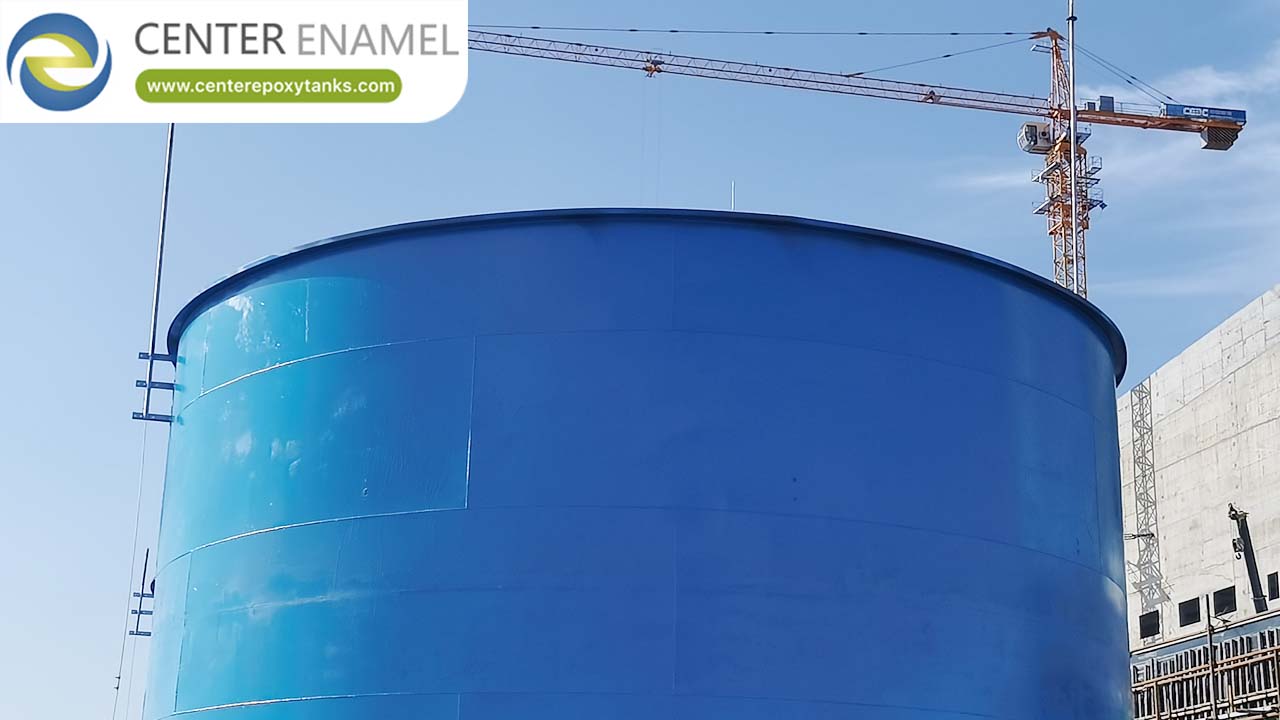
● Welded Steel Tanks: These are "semi-modular." Steel plates are factory-cut and then field-welded on-site. While faster than concrete, they still require significant "Hot Work" (welding) and field-applied coatings. Total construction time is typically 2–3 months.
6. Corrosion Resistance & Material Integrity
As the chemistry of stored media—particularly in wastewater and industrial sectors—becomes more aggressive, material integrity is paramount.
● Concrete: Naturally porous. Over time, liquids can penetrate the surface, leading to "rebar rot" (internal corrosion of the steel reinforcement). For aggressive liquids (pH < 5), concrete must have an internal liner (Epoxy or HDPE), which adds cost and becomes a long-term maintenance point.
● Welded Steel: Vulnerable to rust at the weld seams. Because the coating is applied in the field (often in dusty or humid site conditions), the bond is never as perfect as a factory-applied finish. However, steel is impermeable and does not "seep" like concrete.
●
7. Structural Resilience: Seismic and Wind Loads
With increasing climate volatility, the "ductility" of a tank is a critical safety factor.
● Concrete: Rigid and brittle. Under seismic stress or significant ground settling, concrete is prone to cracking. Once a concrete tank develops a structural crack, the leak is difficult and expensive to remediate.
●
● Welded Steel: Highly ductile. Steel tanks are designed to flex slightly under seismic loads or high wind speeds (up to 60 m/s) without catastrophic failure.
8. Technical Comparison Table
Feature | Concrete Tanks | Welded Steel Tanks |
Initial Cost (CAPEX) | Generally Higher | Moderate |
Maintenance | High (Crack repair/Liner checks) | High (Periodic sandblasting/Painting) |
Seismic Resilience | Low (Brittle) | High (Ductile) |
Leak Detection | Difficult (Hidden in walls) | Easier (Visual inspection) |
Sustainability | High Carbon (Cement production) | Recyclable (Steel scrap value) |
Mobility | Permanent | Permanent |


