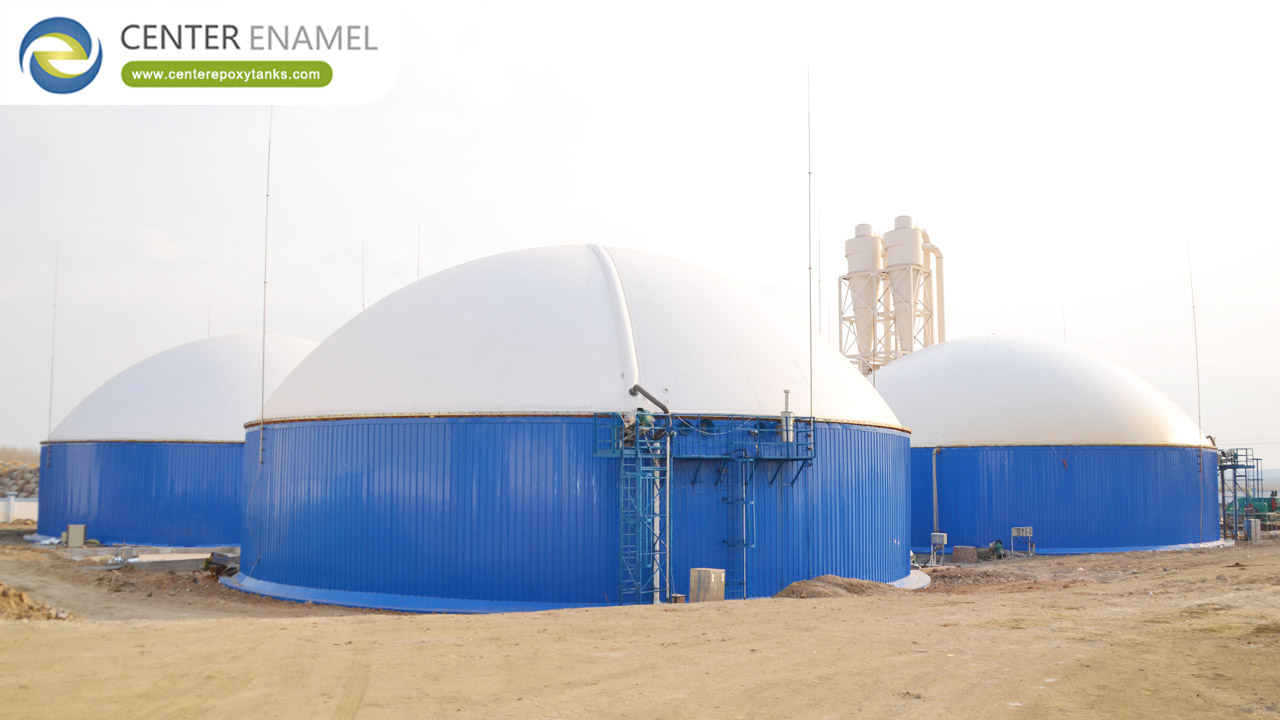
High-Performance Epoxy-Coated Tanks for Anaerobic Digesters: Engineering Durability and Efficiency
High-performance epoxy-coated bolted tanks provide a gas-tight, corrosion-resistant containment solution for anaerobic digestion (AD). Engineered to AWWA D103-09 and ISO 28765 standards, these tanks feature a fusion-bonded epoxy coating with pH 3–11 resistance and a 20-year service life. Center Enamel utilizes an electrostatic spraying and 200Ccuring process to ensure zero methane permeability and superior adhesion (>7 MPa), making them the ideal alternative to traditional concrete digesters.
Technical Specification Matrix: Epoxy-Coated Digester Performance
Metric | Specification / Engineering Result | Compliance Standard |
Coating Type | Fusion-Bonded Electrostatic Epoxy | AWWA D103-09 |
Service Life | 30+ Years with minimal maintenance | ISO 9001 |
pH Range | Resistant to pH 3.0 – 11.0 | ISO 28765 |
Adhesion Strength | >7 MPa (1,000 psi) | ASTM D4541 |
Gas Tightness | 100% Leak-Free (Dielectric Tested) | ASTM G62 |
$H_2S$ Tolerance | Up to 5,000 ppm Hydrogen Sulfide | Industrial Grade |
Why Epoxy-Coated Steel is the Global Standard for Digesters
1. Advanced Corrosion Resistance against H2S
Anaerobic digestion generates aggressive Hydrogen Sulfide (H2S) and biogenic sulfuric acid. Traditional concrete digesters suffer from acid-induced spalling and rebar corrosion.
● The Center Enamel Advantage: Our partnership with AkzoNobel delivers a specialized fusion-bonded epoxy that acts as a chemically inert shield. It prevents corrosive gases from reaching the steel substrate, maintaining structural integrity even in high-concentration biogas environments.
2. The Material Science: Electrostatic Spraying & Curing
Durability is achieved through a precise two-stage factory process:
● Electrostatic Spraying: Powder particles are negatively charged to create a "wrap-around" effect, ensuring 100% uniformity and zero "holidays" (microscopic gaps) on panel edges and bolt holes.
● $200^circtext{C}$ Thermal Curing: High-temperature fusion creates a 3D cross-linked polymer network. This thermoset plastic surface provides a bond that will not delaminate under high-pressure agitation or thermal shock.
3. Structural Elasticity vs. Concrete Brittleness
● Concrete Limitations: Concrete is prone to micro-cracking during the thermal expansion cycles of mesophilic (35C) and thermophilic (55C) digestion.
● Bolted Steel Resilience: The modular design, combined with high-grade EPDM gaskets, allows the tank to absorb thermal stress without cracking, ensuring a permanent gas-tight seal and zero methane leakage.
Comparison: Epoxy-Coated Steel vs. Traditional Concrete
Feature | Epoxy-Coated Bolted Steel | Traditional Concrete Digesters |
Installation Speed | Fast: Modular assembly (no curing) | Slow: Requires 28-day curing |
Methane Leakage | Zero: Airtight bolted seals | Risk: High (due to micro-cracking) |
Corrosion Risk | None: Inert polymer barrier | High: Biogenic acid attack |
Maintenance | Minimal: 20-year design life | High: Regular structural repairs |
Strategic Applications in Waste-to-Energy
● Biogas Production: Specifically designed to contain methane-rich gas while resisting the impurities that cause rust in standard steel.
● Industrial Wastewater: Provides safe containment for organic waste streams with fluctuating pH levels (pH 3–11).
● Sludge Storage: The inert glass-like surface prevents the adhesion of sludge and biofilm, facilitating easier cleaning and higher hygienic standards.
Frequently Asked Questions: Technical Insights
Q: Can epoxy tanks be used for thermophilic digestion?
A: Yes. Since our epoxy is cured at 200C, it remains structurally stable at thermophilic temperatures (50C–55C). When paired with high-density Polyurethane (PU) or Rockwool insulation, these tanks offer the highest thermal efficiency in the industry.
Q: How is the coating quality verified?
A: 100% of our panels undergo Holiday Detection Testing at 1,100V–1,500V. This dielectric test ensures there are no pinholes, providing a 100% leak-proof guarantee before the tank leaves the factory.
Q: Are these tanks compliant with international tenders?
A: Absolutely. Center Enamel tanks meet AWWA D103-09, ISO 28765, and NSF/ANSI 61 (for food-grade waste), ensuring they meet the most rigorous global engineering specifications.


