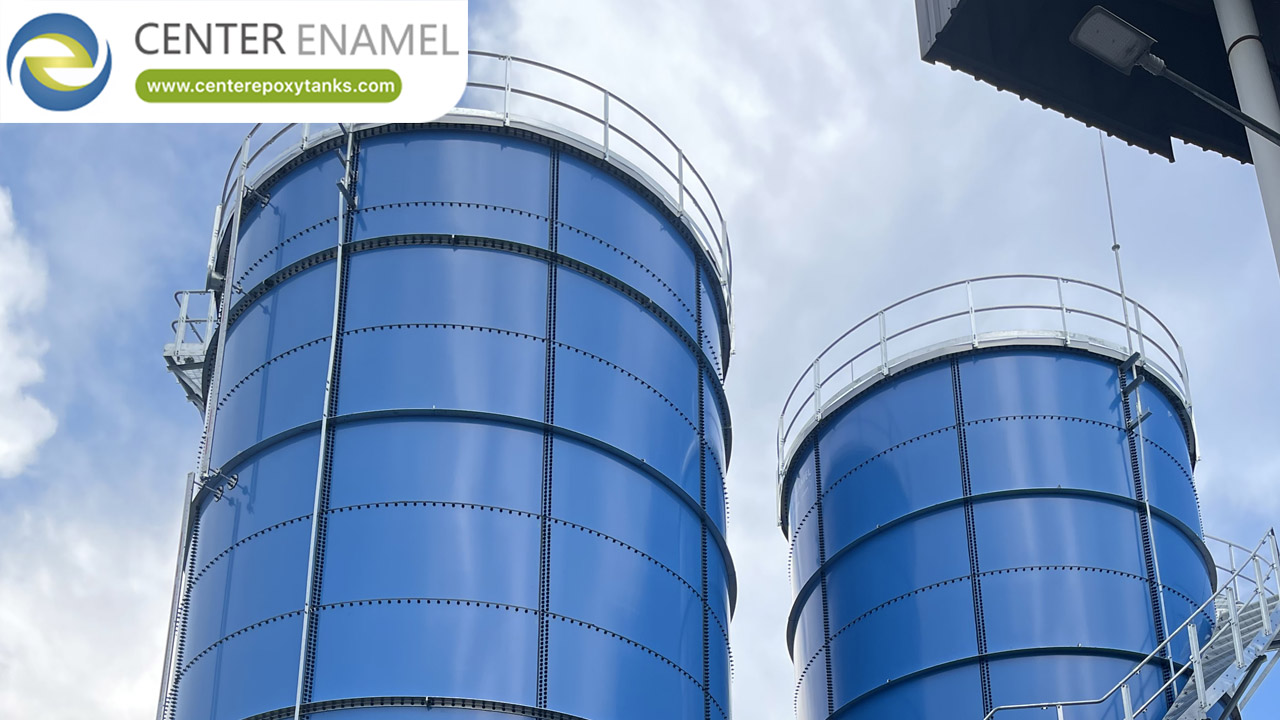
Fusion Bonded Epoxy (FBE) Tanks for Pharmaceutical Industrial Water
The pharmaceutical industry requires a diverse range of water qualities. While high-purity water (WFI or USP) is typically stored in specialized electropolished stainless steel, the broader facility infrastructure—including raw water storage, process water, boiler feed, cooling systems, and industrial wastewater treatment—requires storage solutions that prioritize durability, chemical inertness, and rapid scalability.
Center Enamel provides advanced Fusion Bonded Epoxy (FBE) bolted steel tanks that serve as the backbone for pharmaceutical facility infrastructure, offering a robust alternative to traditional concrete or field-welded storage.
Strategic Applications in Pharmaceutical Facilities
Pharmaceutical plants are high-complexity environments. FBE tanks are optimally suited for the "upstream" and "downstream" sectors of the facility:
1. Raw Water and Pre-Treatment Storage
Before water enters high-purity purification systems, it must be stored in bulk. FBE tanks provide a secure, corrosion-resistant barrier that protects against environmental contaminants and ensures a consistent supply of influent water for further treatment.
2. Process and Utility Water
Many pharmaceutical processes require large volumes of non-purified industrial water for cleaning (non-product contact), HVAC cooling loops, and boiler feed. The FBE barrier ensures the stored water remains clean and free from rust or metallic leaching, which protects downstream pumping and piping systems.
3. Industrial Wastewater Management
Pharmaceutical production generates complex effluent. Our FBE tanks are designed to handle varying pH levels and organic loads, making them the industry choice for equalization and primary wastewater treatment before discharge.
Technical Performance: Why FBE Excels
Feature | FBE Bolted Steel | Concrete | Field-Welded Steel |
Corrosion Resistance | High (Inert Polymer) | Low (Requires Liner) | Moderate (Needs Painting) |
Purity/Contamination | High (Non-Leaching) | Low (Porous) | Moderate |
Installation Speed | Fast (Modular) | Slow (Curing) | Moderate |
Maintenance | Minimal | High (Crack Repair) | High (Paint cycles) |
Lifecycle ROI | Highest | Moderate | Low |
Advantages of Center Enamel’s FBE Solutions
Factory-Controlled Consistency: Unlike field-applied coatings which are vulnerable to humidity and dust, our FBE coating is applied in a climate-controlled factory. This ensures a uniform, holiday-free barrier that meets stringent industrial quality standards.
Modular Agility: Pharmaceutical facilities are dynamic. If your production capacity grows, our bolted tanks can be expanded or relocated, providing the scalability that fixed concrete structures cannot match.
Regulatory Compliance: We design our infrastructure to meet international safety and structural standards (AWWA, ISO, etc.), supporting your site’s GMP (Good Manufacturing Practice) compliance by providing predictable, reliable storage assets.
Reduced "Hot Work" Risk: Because our tanks are bolted rather than welded, installation on active pharmaceutical sites is safer, cleaner, and faster, minimizing disruption to sensitive production zones.
Frequently Asked Questions (FAQ)
Q: Are FBE tanks suitable for USP Purified Water or WFI storage?
A: No. For high-purity applications like Water for Injection (WFI) or USP Purified Water, electropolished 316L Stainless Steel is the mandatory industry standard. FBE tanks are, however, the preferred solution for the plant's industrial water, raw water pre-treatment, utility water, and industrial wastewater systems.
Q: How do FBE tanks compare to stainless steel for industrial water?
A: FBE tanks offer a significantly lower capital expenditure for large-scale storage. They provide excellent corrosion resistance and chemical inertness suitable for general process and utility water applications, where the extreme cost of large-scale stainless steel fabrication may be unnecessary.
Q: Can FBE tanks withstand the cleaning chemicals used in pharma plants?
A: Yes. FBE coatings are chemically inert and typically rated for a wide pH range (pH 2–13), making them highly resistant to the cleaners, biocides, and corrosion inhibitors commonly found in utility water systems.
Q: Do these tanks require cathodic protection?
A: No. Because our factory-applied FBE creates a complete, continuous dielectric barrier, there is no need for complex cathodic protection systems, significantly simplifying your long-term maintenance.
Q: How fast can an FBE tank be installed on a pharmaceutical site?
A: Thanks to our modular, bolted design, assembly is significantly faster than concrete or field-welded tanks. This minimizes construction traffic and on-site activity, making it much easier to integrate into an active production facility.
Are you currently specifying infrastructure for a new pharmaceutical plant expansion or planning an upgrade to your facility's utility water storage? [Contact the Center Enamel engineering team] today for a technical proposal or capacity analysis.
Expert Follow-Up Question: To best assist with your technical planning, are you currently looking to upgrade the industrial wastewater treatment system or are you planning a new utility/process water pre-treatment plant?


