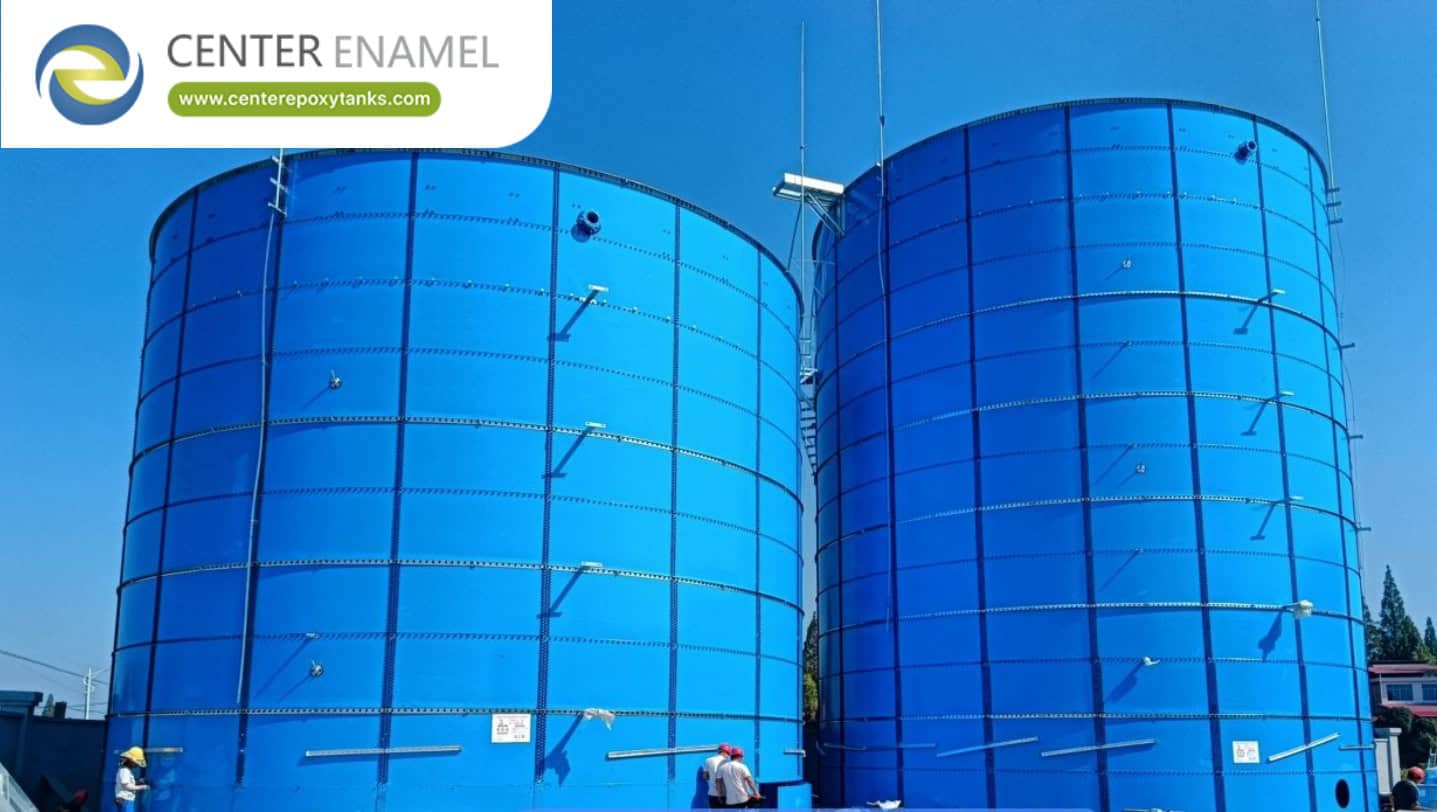
Fusion Bonded Epoxy (FBE) Tanks for Effluent Treatment Plants (ETP)
Fusion Bonded Epoxy (FBE) tanks are highly recommended for Effluent Treatment Plants (ETP) because they offer a superior, chemically inert barrier against the highly aggressive, fluctuating pH levels common in industrial wastewater. Unlike traditional concrete tanks, which are prone to cracking and rebar corrosion, or standard steel tanks that require frequent repainting, FBE tanks are manufactured with a factory-applied, thermoset polymer coating. This creates a non-porous, seamless surface that resists chemical attack, microbial growth, and abrasion, while the modular bolted design allows for rapid installation and future capacity expansion.
The Engineering Challenge: Why Standard Tanks Fail in ETPs
Effluent Treatment Plants present a uniquely hostile environment for storage infrastructure. The wastewater processed in these facilities often contains high concentrations of salts, organic acids, surfactants, and varying pH levels that can rapidly degrade standard construction materials.
Concrete Degradation: Sulfate and acid attack in wastewater can leach calcium from concrete, leading to structural weakening and eventual leakage.
Corrosion in Steel: Standard carbon steel, even with industrial paint, is susceptible to pinhole corrosion when exposed to aggressive industrial waste.
The FBE Solution: FBE is a fusion-bonded powder coating applied in a controlled factory environment. It is cured at high temperatures, creating a dense cross-linked structure that is chemically resistant to the broad spectrum of chemicals found in industrial effluent.
Why Choose FBE Over Traditional Alternatives?
In the ETP sector, operational downtime is costly. FBE tanks offer specific advantages that directly address the pain points of wastewater management:
1. Chemical Resistance and pH Versatility
Industrial effluent is rarely neutral. FBE coatings are specifically engineered to withstand a wide range of pH levels (typically 2–13), ensuring the tank remains uncompromised even during process upsets or chemical spills.
2. Modular Scalability
ETP requirements change as plant production fluctuates. FBE tanks are usually constructed as modular, bolted structures. If your facility needs to increase treatment capacity, you can expand or relocate the tank without the massive civil work required for concrete or field-welded tanks.
3. Factory-Controlled Quality
The primary failure point of any storage tank is the "holiday" (a microscopic pinhole in the coating). Because FBE is applied in a factory under strict climate and quality control, every square centimeter is verified before it leaves the plant.
Comparison Matrix: ETP Tank Materials
Feature | FBE Tanks | Concrete Tanks | Stainless Steel |
Chemical Resistance | High (Inert barrier) | Low (Subject to acid attack) | High (But expensive) |
Installation Time | Fast (Days/Weeks) | Slow (Months) | Moderate |
Maintenance | Minimal | High (Cracks/Sealing) | Low |
Expansion/Relocation | Easy (Modular) | Nearly Impossible | Difficult |
Life Expectancy | 30+ Years | Variable (depends on seal) | Very High |
Frequently Asked Questions (FAQ)
Q: Are FBE tanks suitable for acidic industrial wastewater?
A: Yes. FBE coatings are highly resistant to acidic environments that would degrade concrete or carbon steel. However, for extremely concentrated acid storage (e.g., concentrated sulfuric acid), always verify the specific epoxy formulation with the manufacturer, as specific chemical compatibility charts should be consulted.
Q: How does FBE compare to Glass-Fused-to-Steel (GFS)?
A: Both are excellent choices for ETPs. GFS is essentially a glass coating, making it extremely hard and chemically inert. FBE is more flexible and resistant to impact, meaning it is less likely to chip or crack if the tank is subjected to mechanical stress or physical impact.
Q: Can FBE tanks be installed in remote or isolated sites?
A: Yes, this is one of their primary advantages. Because they are modular and do not require heavy on-site welding or large-scale civil foundations (compared to concrete), they are ideal for remote industrial sites where mobilizing skilled welding teams or large concrete batching plants is logistically difficult.
Q: How do you detect potential coating damage?
A: Routine inspection is simple. Because FBE is a smooth, high-visibility coating, any physical damage (scratches or chips) is visually apparent. Furthermore, because the coating is distinct from the steel substrate, any breach is easy to identify, and field repair kits allow for rapid patching without requiring a total tank shutdown.
Strategic Recommendation for Procurement
When specifying tanks for an ETP, prioritize Total Cost of Ownership (TCO) rather than initial price. While a concrete tank may appear cheaper on paper, the long-term cost of sealing cracks, monitoring rebar oxidation, and managing potential leaks makes FBE a significantly more reliable and economical choice for the life of an effluent treatment facility.


