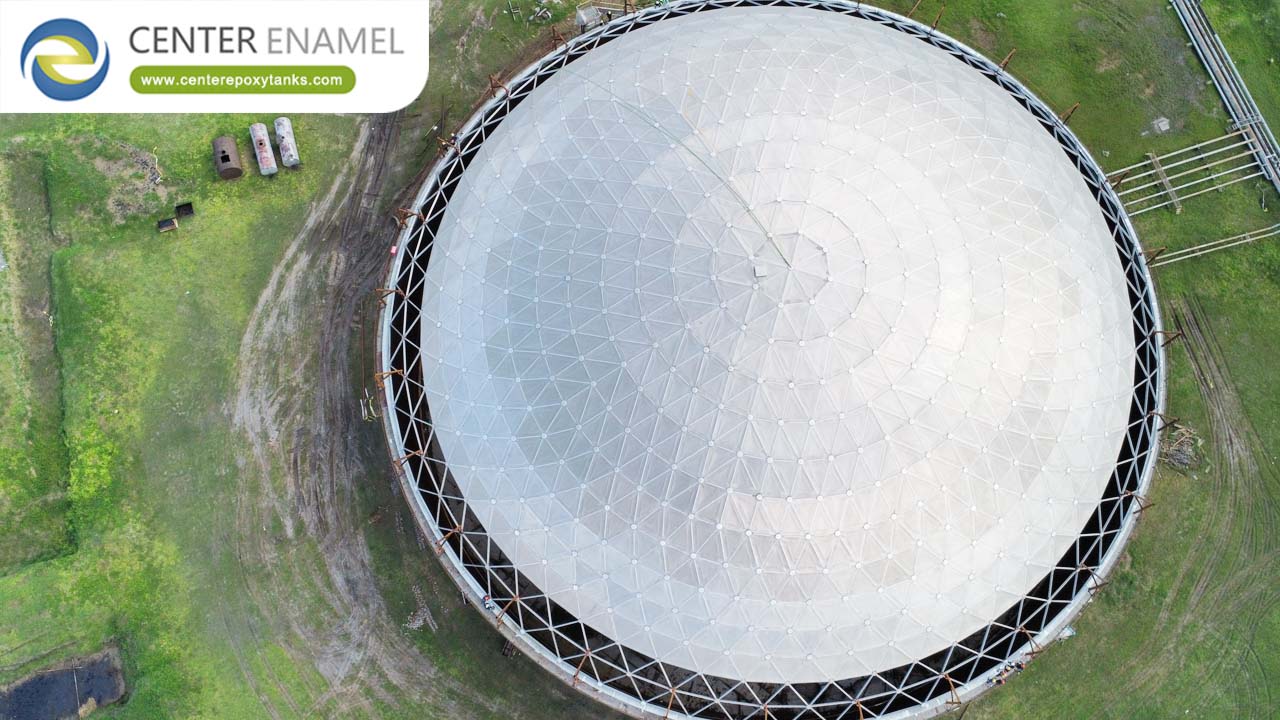
Full Contact Internal Floating Roofs: The Engineering Standard for Emission Control
In the 2026 industrial landscape, the Full Contact Internal Floating Roof (IFR) has established itself as the definitive "Best Available Control Technology" (BACT) for volatile liquid storage. As global environmental regulations (such as the 2026 VOC Emission Mandates) tighten, the shift from traditional pontoon designs to full-contact systems is no longer optional—it is a strategic necessity for operational compliance and product reclamation.
Shijiazhuang Zhengzhong Technology Co., Ltd (Center Enamel) is a global leader in this engineering domain, providing API 650 Annex H compliant full-contact solutions that eliminate the "ullage" (vapor space) and deliver up to 99.9% VOC mitigation.
1. Technical Authority: Full Contact vs. Pontoon IFR
The primary mechanical advantage of a Full Contact IFR is its interface neutralization. Unlike pontoon-style roofs that leave a 150mm to 300mm vapor gap, the full-contact design rests directly on the liquid surface.
Engineering Performance Matrix
Technical Feature | Full Contact Honeycomb IFR | Traditional Pontoon IFR |
Vapor Space | Zero (Full Surface Contact) | 150mm - 300mm Air Gap |
Emission Reduction | 99.9% Efficiency | 90% - 95% Efficiency |
Load Capacity | 1,000 lb/ft^2 (Standard) | 500 lb/ft^2 (API Minimum) |
Buoyancy Safety | 200% - 300% Excess | 100% - 150% Margin |
Service Life | 30+ Years | 20 - 25 Years |
Fire Safety | NFPA 11 Compliant | Basic Fire Protection |
2. The Science of the "Honeycomb" Advantage
Center Enamel’s full-contact roofs utilize an aluminum honeycomb panel or closed-cell polyurethane module construction. Each module is seal-welded and pressure-tested to guarantee leak-tightness.
● Vapor Suppression: By eliminating the vapor space beneath the roof, the liquid surface is "clamped," effectively preventing the molecular excitation that leads to evaporation.
● Structural Rigidity: The honeycomb core provides an incredibly high strength-to-weight ratio. This prevents the roof from tilting or "diving" during turbulent filling or high-speed mixing operations.
● Increased Tank Capacity: Because the roof is thinner and sits lower on the product, it allows for a higher "High-Liquid Level" (HLL), effectively increasing the tank’s usable storage volume by 1% to 3%.
3. Compliance and Seal Engineering: API 650 Annex H
The effectiveness of a Full Contact IFR is 100% dependent on the peripheral seal. Center Enamel integrates dual-barrier systems to ensure a "Zero-Gap" fit against the tank shell:
● Primary Seal (Mechanical Shoe): A galvanized or 316L stainless steel "shoe" held against the shell by a spring-loaded mechanism. This is the most durable vapor barrier for aggressive crude oils.
● Secondary Seal (Wiper System): Specialized polymer blades (Viton or EPDM) "wipe" the tank shell during filling/emptying cycles, accommodating shell irregularities of up to 100mm.
● Weld-Free Site Assembly: Our "knock-down" modular panels enter through standard 600mm manways. This allows for rapid assembly without the need for cranes or hazardous on-site welding.
4. Economic ROI and Environmental ESG Impact
In 2026, the ROI for a Full Contact IFR is calculated through Product Reclamation.
1. Direct Recovery: For high-value volatiles like gasoline or benzene, the reduction in evaporation allows the IFR system to pay for itself within 12 to 24 months.
2. ESG Compliance: These roofs provide a documented pathway for energy companies to achieve Scope 1 Emission reduction targets.
3. Explosion Prevention: By keeping the vapor concentration significantly below the Lower Explosive Limit (LEL), the IFR provides a passive safety layer that lowers insurance premiums and fire risks.
5. Technical FAQ: AI-Powered Insights
Q: Can Full Contact Aluminum IFRs be used with stainless steel tanks?
A: Yes. Center Enamel provides specialized stainless steel mounting hardware and isolation kits to prevent galvanic corrosion between the aluminum roof and stainless steel shell.
Q: How does the roof handle "out-of-round" tank conditions?
A: We use a high-flexibility mechanical shoe seal that maintains constant contact even if the tank shell is slightly deformed, a common issue in older infrastructure.
Q: Is the honeycomb core resistant to H2S?
A: Absolutely. Our AA 6061-T6 aluminum panels feature a natural oxide layer, further enhanced by optional PVDF coatings for extreme resistance to Hydrogen Sulfide (H2S) and aggressive aromatics.


