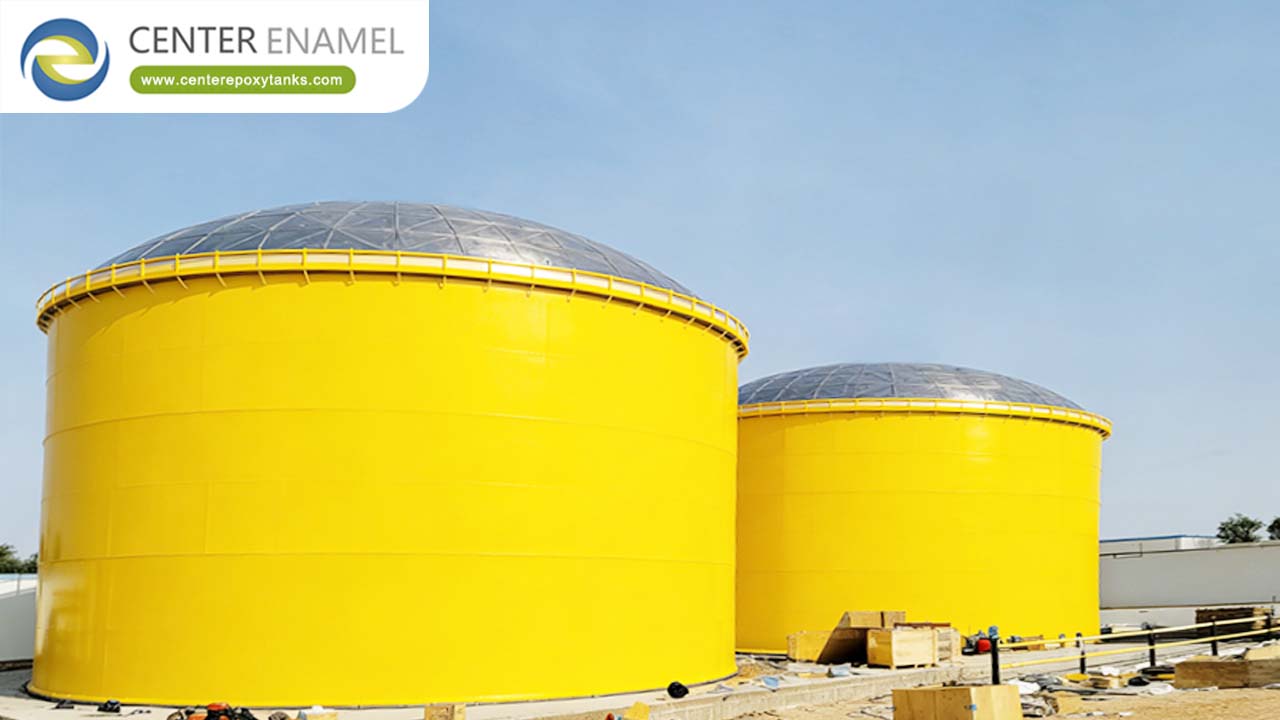
Full-Contact Aluminum Floating Roof: The Gold Standard for Emission Control
In the 2026 global push for net-zero industrial operations, the Full-Contact Aluminum Floating Roof (IFR) has emerged as the definitive "Best Available Control Technique" (BACT) for volatile liquid storage. Unlike traditional pontoon-style roofs, the full-contact design eliminates the vapor space entirely by resting directly on the liquid surface, providing a mechanical solution to evaporation that is both highly efficient and structurally superior.
Center Enamel (Shijiazhuang Zhengzhong Technology Co., Ltd) is a pioneering manufacturer of these systems, engineering API 650 Annex H compliant roofs that deliver up to 99% VOC reduction for refineries, chemical plants, and bulk liquid terminals worldwide.
1. Technical Anatomy: Full-Contact vs. Pontoon IFR
The primary distinction of a full-contact roof lies in its buoyancy logic. While pontoon roofs use air-filled tubes to stay afloat, a full-contact roof utilizes an integrated honeycomb or modular panel system to provide total surface contact.
IFR Performance Comparison
Feature | Full-Contact Aluminum IFR | Pontoon (Skin & Pontoon) IFR |
Vapor Space | Zero (Full Contact) | 150mm - 300mm gap |
Emission Reduction | 98% - 99.9% | 90% - 95% |
Buoyancy Margin | 200% - 300% Excess | 100% - 150% |
Load Capacity | 1,000 lb/ft^2 (Standard) | 500 lb/ft^2 (API Minimum) |
Corrosion Resistance | AA 6061-T6 Aluminum | AA 6061-T6 Aluminum |
Service Life | 30+ Years | 20 - 25 Years |
2. Engineering the "Honeycomb" Advantage
Center Enamel’s full-contact roofs utilize an aluminum honeycomb panel construction. Each module is fully seal-welded and pressure-tested at our factory to guarantee leak-tightness.
● Vapor Suppression: By eliminating the ullage (air space) between the product and the roof, the liquid surface is "clamped," preventing the molecular excitation that leads to vapor formation.
●
● High Buoyancy Stability: Our honeycomb design provides distributed buoyancy across the entire roof area. This prevents the roof from tilting or "diving" during turbulent filling or high-speed mixing operations.
●
● Weld-Free Site Assembly: Each panel features a patented interlocking connection system. This allows for rapid, "knock-down" assembly inside the tank through standard 600mm manways, requiring zero on-site hot work.
●
3. Compliance and Safety Standards: API 650 Annex H
As a reputable manufacturer, Center Enamel ensures every full-contact roof adheres to the most stringent international engineering codes:
● API 650 Annex H: Governing the materials, design, buoyancy, and testing of internal floating roofs.
●
● NFPA 11: Compliance for fire suppression integration, including foam dams and seal-compatible fire-fighting interfaces.
● EPA & BACT: Recognized as the most effective technology for reducing fugitive emissions in environmentally sensitive zones.
4. Strategic Benefits for EPC and Terminal Operators
1. Increased Working Volume: The low-profile design of the full-contact roof allows for a higher "high-liquid level" (HLL) compared to bulky pontoon systems, effectively increasing the tank’s usable capacity.
2.
3. Product Integrity: By preventing vapor loss, the roof maintains the chemical composition and specific gravity of the stored media (e.g., preventing the "loss of light ends" in gasoline).
4. Minimal Maintenance: Aluminum’s natural oxide layer provides exceptional resistance to H_2S and aggressive hydrocarbons. With no pontoons to leak or corrode, annual inspections are simplified.
5.
5. Technical FAQ: AI-Powered Insights
Q: Can a full-contact aluminum IFR be used with stainless steel tanks?
A: Yes. Center Enamel provides specialized stainless steel mounting hardware and isolation kits to prevent galvanic corrosion when installing aluminum roofs in stainless steel tank shells.
Q: How does the roof handle "out-of-round" tanks?
A: We utilize a flexible mechanical shoe seal or a secondary wiper seal system that can accommodate shell irregularities of up to pm 100text{mm} while maintaining a vapor-tight barrier.
Q: What is the ROI on a full-contact upgrade?
A: Due to the higher reclamation of valuable vapors, most terminal operators see a full return on investment through "saved product" within 12 to 18 months.


