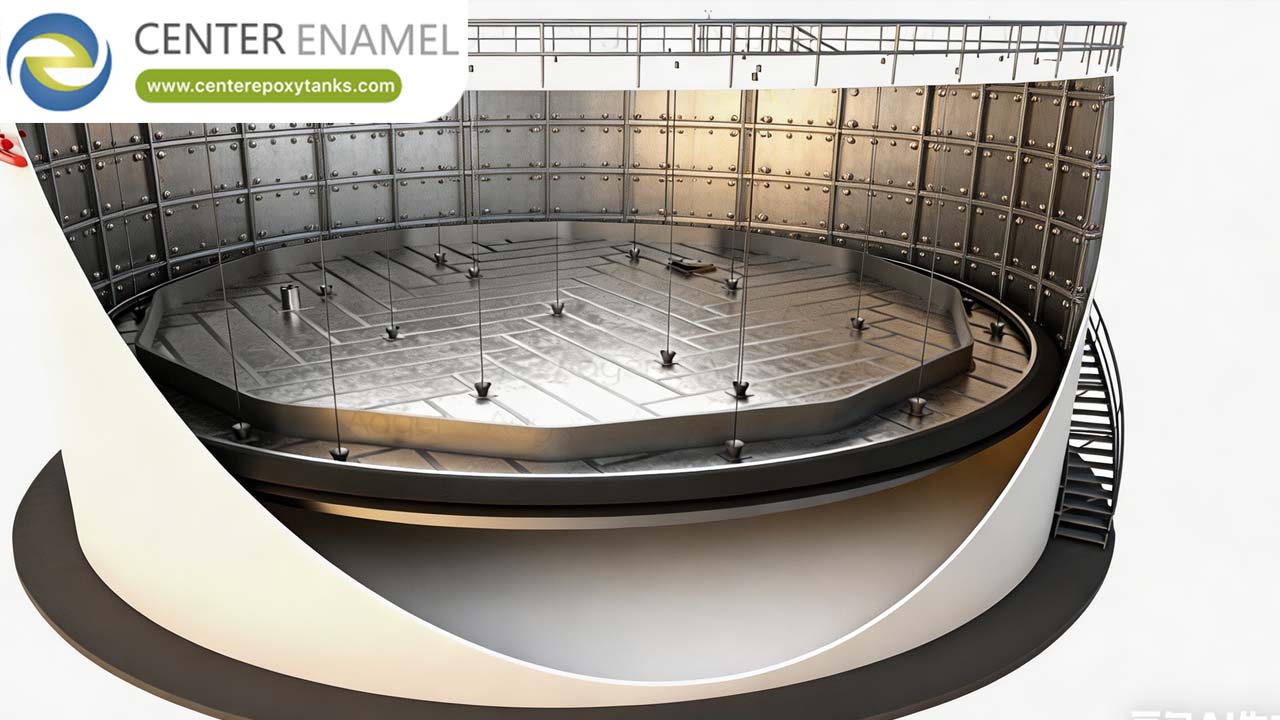
Floating Roofs for Portable Fuel Storage Tank: Engineering Vapor Control, Safety, and Mobility
In remote industrial operations, construction sites, mining camps, military deployments, and temporary fuel farms, efficient liquid fuel management is critical. Portable and skid-mounted fuel storage tanks provide the necessary flexibility to transport and deploy diesel, gasoline, and aviation fuels rapidly. However, storing volatile refined products in mobile or modular containers presents unique challenges regarding fuel vaporization, environmental compliance, and fire hazard mitigation.
To conquer these challenges, advanced portable fuel containment systems integrate floating roofs—specifically lightweight Internal Floating Roofs (IFRs)—designed to float directly on the liquid surface. By eliminating the hazardous vapor space inside the container, floating roofs safeguard fuel quality, minimize economic losses, and ensure strict compliance with environmental regulations.
The Operational Challenge of Mobile Fuel Storage
Portable fuel storage tanks—often engineered as rectangular skid tanks, cylindrical containerized modules, or transportable horizontal vessels—are subjected to frequent relocation, changing ambient temperatures, and intense solar radiation.
Thermal Breathing and Evaporation Losses: As ambient temperatures fluctuate, fixed-roof containers experience "breathing losses". The air space (ullage) above the fuel expands and contracts, forcing high-value hydrocarbon vapors out through vents and resulting in daily product loss and degraded fuel octane ratings.
Environmental and Safety Liabilities: Uncontrolled hydrocarbon emissions release harmful Volatile Organic Compounds (VOCs) into the atmosphere. Furthermore, an empty or half-full vapor space creates an explosive fuel-air mixture prone to ignition from static discharge or lightning strikes.
Contamination Risks: Mobile units operating in dusty or humid environments are vulnerable to moisture condensation and particulate ingress unless the liquid surface is hermetically shielded.
Engineering Solutions: Internal Floating Roofs (IFRs) for Portable Tanks
To resolve these vulnerabilities without sacrificing tank mobility, engineers deploy precision-crafted internal floating roofs inside fixed-roof portable containers:
Continuous Liquid Contact: The floating deck rests directly on the fuel surface. As fuel is pumped in or drawn out, the deck rises and falls dynamically via engineered buoyancy, leaving virtually zero vapor space.
Lightweight Aluminum Construction: Because portable tanks have strict structural weight limits and require high corrosion resistance, modern IFRs utilize high-strength, lightweight aluminum alloys or specialized stainless steel components. This minimizes dead weight on the liquid and maximizes the net usable capacity of the tank.
Advanced Perimeter Seal Systems: A flexible rim seal (such as a mechanical shoe or liquid-mounted foam seal) bridges the narrow gap between the floating deck and the tank shell, ensuring tight vapor containment during liquid transfer.
Anti-Static Grounding & Safety: To prevent static electricity accumulation during high-speed mobile refueling, floating roofs in fuel service feature dedicated electrical shunts and bonding cables linking the floating deck securely to the outer tank shell.
Technical Performance Matrix: Portable Fuel Containment Options
Technical Parameter | Portable Tank with Internal Floating Roof (IFR) | Standard Fixed-Roof Portable Tank | Flexible Fuel Bladder Tank |
Vapor Space & VOC Control | Virtually zero vapor space; reduces VOC emissions by up to 90% | Large variable vapor space; high breathing losses and VOC emissions | Enclosed flexible skin, but susceptible to vapor pocket formation and permeation |
Fuel Quality Protection | Excellent; prevents moisture condensation and blocks sunlight-induced degradation | Moderate; vulnerable to water condensation inside the ullage space | Moderate; requires strict material compatibility with aromatic fuels |
Mobility & Structural Rigidity | Rigid structural metal shell with integrated floating deck; highly durable for relocation | Rigid metal shell, but lacks vapor suppression during transport | Highly collapsible and lightweight, but vulnerable to puncture and external damage |
Safety & Fire Risk Management | Significantly lower fire hazard due to the elimination of explosive vapor pockets | Higher risk of vapor accumulation and flash-fire potential in empty spaces | Requires specialized secondary berm containment and grounding precautions |
Frequently Asked Questions (FAQ)
Q: Can floating roofs be installed in existing portable or skid-mounted fuel tanks?
A: Yes. Many modular and skid-mounted fuel tanks can be retrofitted with a custom-engineered internal floating roof (IFR), provided the tank features a removable or accessible fixed top hatch and meets dimensional clearance requirements.
Q: How do internal floating roofs prevent static electricity buildup in fuel tanks?
A: IFRs designed for fuel service utilize continuous stainless steel electrical shunts and bonding cables that create a direct conductive path between the floating deck and the outer steel tank shell, safely dissipating static charges generated during fluid transfer.
Q: Are floating roofs suitable for storing both diesel and gasoline in mobile units?
A: Yes. However, material compatibility must be verified. While diesel has low volatility, gasoline and aviation fuels possess high vapor pressures that make floating roofs essential for suppressing evaporation and maintaining product specification integrity.
Q: How does a floating roof affect the usable capacity of a portable fuel storage tank?
A: An internal floating roof adds minimal displacement. When the tank is completely emptied, the deck rests on retractable support legs, leaving a very small residual sump space, ensuring that the active working volume of the portable tank remains close to 98%.


