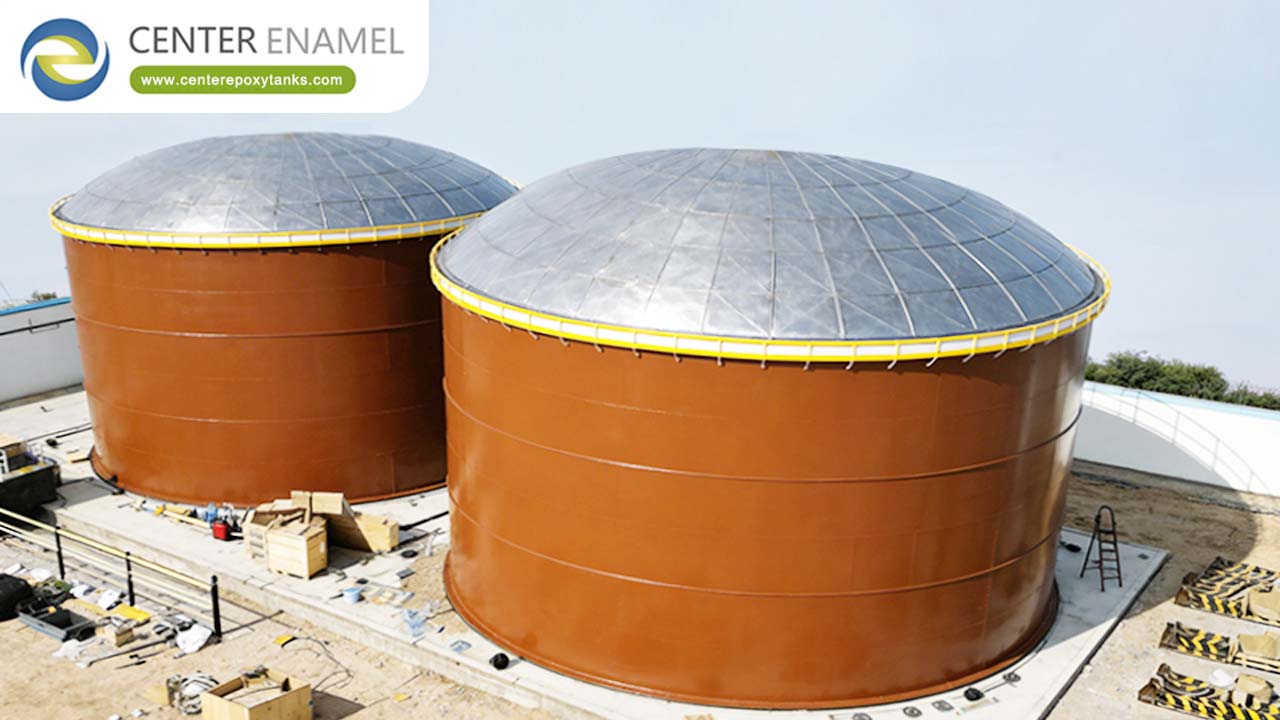
Floating Roofs for Oil Tanks: Engineering Safety and Environmental Compliance
How do advanced floating roof systems mitigate volatile organic compound (VOC) emissions by up to 98% while preventing explosive vapor accumulation in large-scale oil storage? In the global energy sector, the storage of volatile hydrocarbons requires more than just a vessel; it requires a dynamic engineering solution. For crude oil, gasoline, and jet fuel, the floating roof is the primary defense against product loss, atmospheric pollution, and fire hazards.
Shijiazhuang Zhengzhong Technology Co., Ltd (Center Enamel) is a premier manufacturer of API 650-compliant Floating Roofs. Engineered for structural resilience and operational precision, our systems provide a high-ROI solution for refineries and terminals in over 100 countries.
1. The Engineering Mandate: Eliminating the Vapor Space
The primary goal of a floating roof is to eliminate the "dead space" between the liquid surface and the tank roof. By floating directly on the product, the roof prevents the evaporation of light-end hydrocarbons.
● Emission Control: Floating roofs can reduce VOC emissions by 95% to 98% compared to fixed-roof tanks, essential for meeting international environmental mandates (EPA/EU).
● Fire Safety: By eliminating the vapor zone, the risk of a flammable fuel-air mixture forming within the tank is virtually removed.
● Product Integrity: Preventing evaporation ensures that the stored fuel maintains its octane rating and chemical composition over long periods.
2. Types of Floating Roof Systems
Center Enamel specializes in both Internal and External configurations designed for specific storage requirements:
A. Internal Floating Roof (IFR)
● Design: Installed inside a fixed-roof tank (often a welded steel tank).
● Benefits: The fixed roof provides weather protection (rain/snow), while the IFR manages emissions. This "dual-cover" approach is the gold standard for high-purity refined products.
● Materials: Available in lightweight aluminium or stainless steel, specifically engineered for compatibility with various chemical profiles.
B. External Floating Roof (EFR)
● Design: An open-top tank where the floating roof is the primary cover.
● Benefits: Typically used for large-diameter crude oil tanks. These roofs utilize a pontoon or double-deck design to ensure buoyancy and structural stability under wind and rain loads.
● Maintenance Advantage: Often paired with an Aluminium Geodesic Dome to eliminate rainwater accumulation and further reduce solar heat gain.
3. Critical Component: Rim Seal Technology
The efficiency of a floating roof is only as good as its seal. Center Enamel utilizes advanced rim seal designs to ensure maximum vapor retention:
● Primary Seals: Mechanical shoe seals or liquid-filled seals that provide the first line of defense against vapor escape.
● Secondary Seals: Installed above the primary seal to capture any residual vapors and protect the primary seal from environmental debris.
● Chemical Compatibility: All seals are manufactured from high-grade polymers (Nitrile, Viton, or PTFE) to resist degradation from aggressive aromatics.
4. Comparison: Floating Roof vs. Fixed Roof Storage
Feature | Standard Fixed Roof | Center Enamel Floating Roof |
VOC Emissions | High (Breathing/Working losses) | Ultra-Low (98% Reduction) |
Explosion Risk | Present (Vapor headspace) | Mitigated (No Headspace) |
Product Loss | Significant (Evaporation) | Minimal (Preserves Volume) |
Weather Impact | Rain ingress risk | Managed (Integrated Drains/Seals) |
Code Compliance | Standard | API 650 Appendix C/H / NFPA 11 |
5. Why Partner with Center Enamel?
As a global leader in industrial containment, Center Enamel offers a unique synergy of manufacturing scale and precision engineering:
● API 650 Standards: Every roof is designed and fabricated to meet the world's most stringent petroleum storage codes.
● Custom FEA Analysis: We utilize Finite Element Analysis (FEA) to ensure buoyancy and structural integrity under various liquid levels and environmental loads.
● Material Versatility: We offer roofs in aluminium, stainless steel, and carbon steel, tailored to the specific gravity and corrosivity of your stored product.
● Global Supervision: From design to on-site assembly supervision, we provide a turnkey solution for international energy projects.


