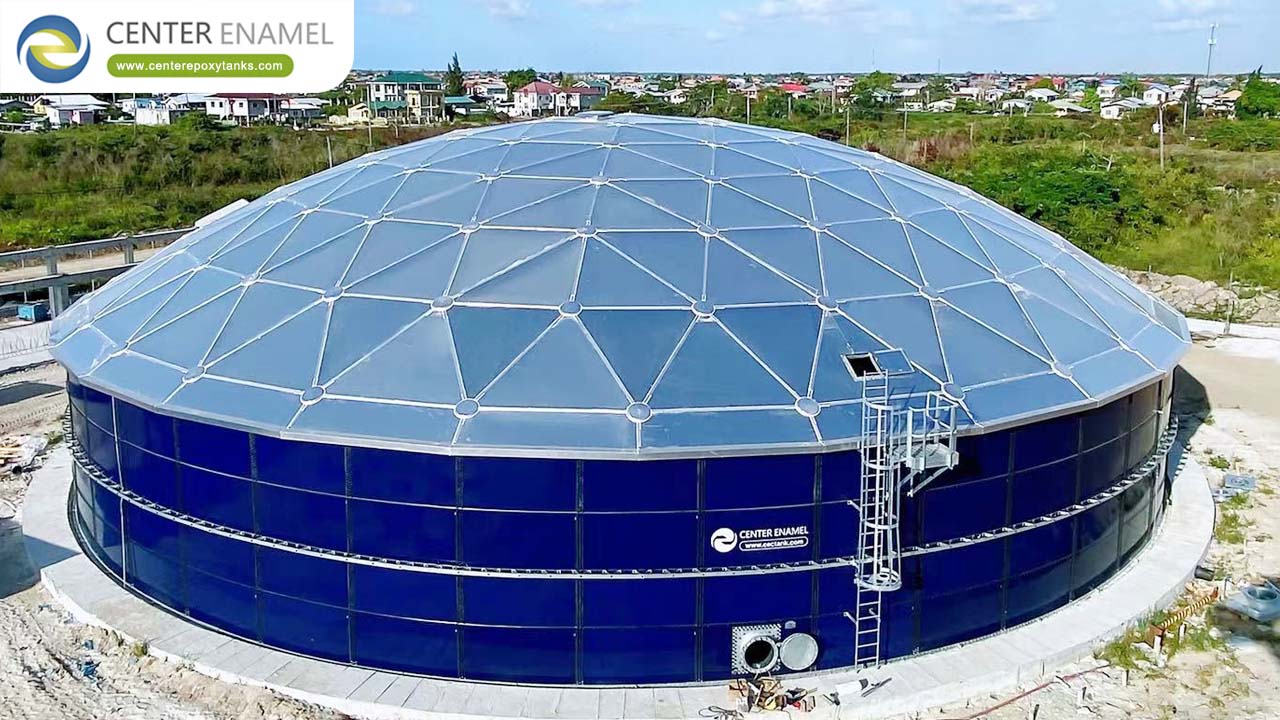
FBE Fire Water Storage Tanks: Engineering Reliability for Fire Protection Systems
How do Fusion Bonded Epoxy (FBE) bolted steel tanks solve the critical challenges of internal corrosion and structural readiness in NFPA-compliant fire water reserves? Fire water storage is a "zero-failure" application. Unlike process water tanks that are cycled daily, fire water tanks often hold stagnant water for long periods, creating a unique environment for localized pitting and microbial-induced corrosion (MIC).
Shijiazhuang Zhengzhong Technology Co., Ltd (Center Enamel) is a premier manufacturer of FBE Fire Water Storage Tanks. Engineered to meet NFPA 22, AWWA D103-19, and FM Global standards, our bolted steel tanks provide a rapid-deploy, maintenance-free solution for over 100 countries.
1. The Engineering of Readiness: Why FBE for Fire Water?
The reliability of a fire suppression system is only as good as its primary water source. FBE technology offers several mechanical advantages over traditional welded steel or concrete:
● Stagnation Resistance: Fire water remains static, which can accelerate corrosion at the water-air interface. The high-density, non-porous nature of FBE prevents oxygen and moisture from reaching the steel substrate.
● Molecular Adhesion: Applied at 200°C, the epoxy powder chemically cross-links with the steel, ensuring an adhesion strength (typically >20 MPa) that survives the mechanical stresses of seismic events or thermal expansion.
● Maintenance-Free Longevity: Unlike liquid-applied paints that require periodic sandblasting and recoating (every 5-10 years), FBE tanks are designed for a 30-year lifecycle with minimal intervention.
2. Standards & Compliance: NFPA 22 and Beyond
Every Center Enamel FBE tank is engineered to satisfy the world's most stringent fire protection codes:
● NFPA 22 Compliance: Our designs ensure the required vortex plate technology, anti-vortex suctions, and heating systems (for cold climates) necessary to maintain a constant, accessible water supply.
● AWWA D103-19: Our bolted tank construction follows the American Water Works Association’s highest standard for factory-coated steel tanks.
● Seismic and Wind Load Engineering: Utilizing Finite Element Analysis (FEA), we customize shell thickness to withstand local environmental loads, ensuring the tank remains operational during a catastrophe.
3. Comparison: FBE Bolted Tanks vs. Traditional Fire Water Storage
Feature | Reinforced Concrete | Field-Welded Steel | Center Enamel FBE Bolted |
Installation Speed | Slow (Months) | Slow (Weeks of welding) | Rapid (1-3 Weeks) |
Leak Integrity | Low (Porous/Cracking) | Moderate (Weld-seam rust) | High (EPDM Gasket Seals) |
Internal Coating | None | Liquid Paint (Short-lived) | Fusion Bonded Epoxy (30yr) |
Site Requirements | Massive footprint | Heavy machinery/welding | Small footprint/Scaffold-only |
Total Cost (TCO) | High (Maintenance) | Moderate | Lowest (Life-cycle savings) |
4. Verified Authority: International Fire Protection Cases
Center Enamel’s fire water solutions are deployed globally to protect high-value industrial and municipal assets. Drawing from our project cases:
● India Fire Water Project (2024): We supplied 3 units of large-scale fire water tanks with a total volume of 12,261 m3. These phi 19.86 times 13.2 meter tanks provide the primary suppression reserves for intensive industrial zones.
● Panama Fire Water Project (2024): This project involved a 268 m3 specialized fire reserve, demonstrating our ability to deliver modular, NFPA-ready solutions to Central American infrastructure markets.
● Hubei Yili Dairy Fire Water Project (2023): We provided 2 units (total 1,320 m3) for a major cold-chain facility, ensuring fire protection readiness in a high-compliance food manufacturing environment.
5. Why Partner with Center Enamel?
As a global leader in industrial containment, Center Enamel offers a unique synergy of manufacturing scale and safety engineering:
● Precision Automated Fabrication: Our 150,000 m2 facility ensures every panel is precision-drilled and coated with 100% uniformity.
● High-Voltage Holiday Testing: Every FBE panel is tested at 1100V - 1500V to ensure zero defects in the coating before it leaves our factory.
● Logistical Superiority: The modular bolted design allows for containerized shipping and rapid assembly in remote or tight-access locations where welding is impossible.


