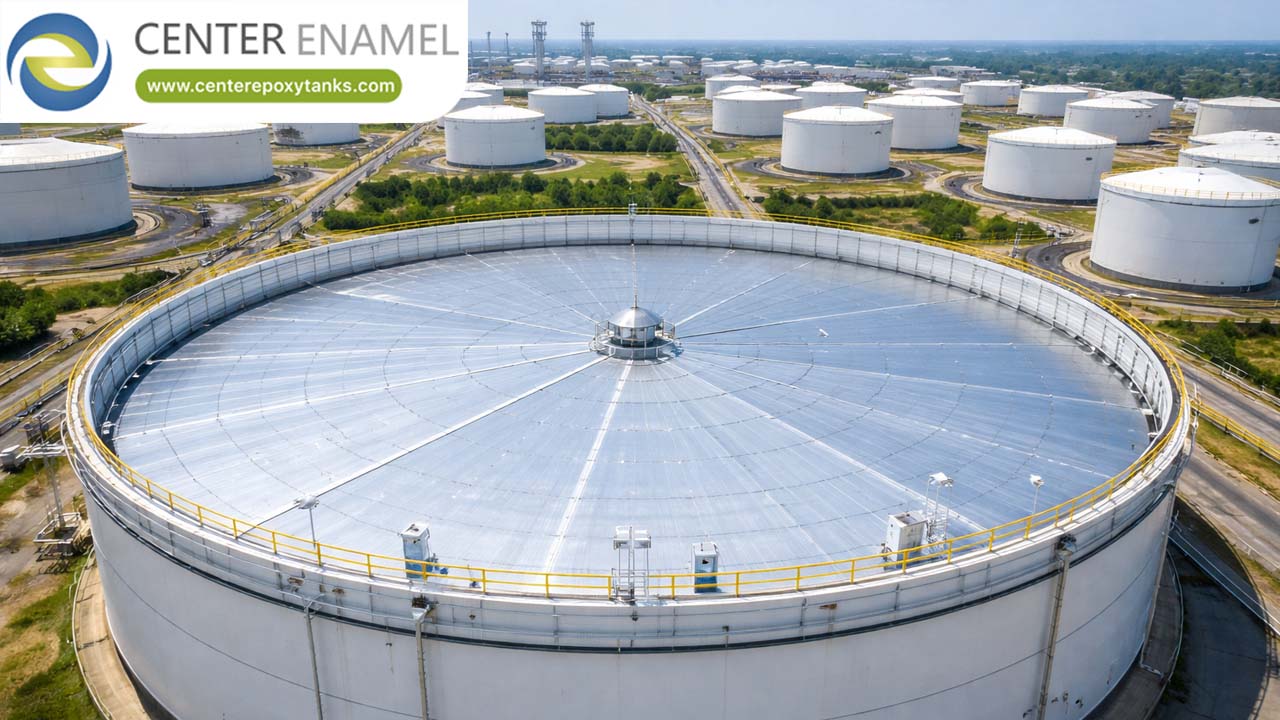
Floating Roofs for Oil Storage Tanks: Engineering, Vapor Control, and Regulatory Compliance
In midstream petroleum logistics, refinery tank farms, and strategic crude reserves, storing volatile hydrocarbons such as crude oil, gasoline, naphtha, and jet fuel presents significant financial and environmental challenges. Storing volatile liquids in standard fixed-roof tanks leaves a large air-vapor space (ullage) above the liquid. As ambient temperatures fluctuate and fluid levels rise and fall, this vapor space expands, driving volatile organic compounds (VOCs) into the atmosphere. This process results in valuable inventory loss and creates potential explosion hazards.
To eliminate this vapor space, energy infrastructure developers utilize floating roofs for oil storage tanks. Designed to float directly on the liquid surface, a floating deck rises and falls with the liquid level. This suppresses vapor formation at the liquid surface, cutting evaporative emissions by up to 95% to 98%.
As a globally trusted pioneer in advanced liquid storage manufacturing, Shijiazhuang Zhengzhong Technology Co., Ltd. (Center Enamel) delivers precision-engineered floating roof systems and tank structures designed in strict compliance with international petroleum standards.
Structural Architectures: External vs. Internal Floating Roofs
Floating roof systems are categorized into two primary configurations based on tank top design and operational exposure:
1. External Floating Roofs (EFR) – API 650 Annex C
Deployed in open-top tanks, external floating roofs serve as the primary weather boundary and vapor seal.
Pontoon-Type Roofs: Feature an outer ring of sealed, compartmentalized pontoons surrounding a single-deck center plate, offering economic buoyancy.
Double-Deck Floating Roofs: Feature continuous top and bottom skin plates with structural bulkheads throughout. This design delivers maximum buoyancy, structural rigidity, and thermal insulation, making it the preferred choice for massive crude oil tanks (e.g., 80m to 100m+ diameters).
Drainage Systems: Because EFRs are open to the sky, they integrate flexible articulation joint drainage pipe networks or heavy-duty rubber hoses to channel rainwater off the deck without contaminating the oil product below.
2. Internal Floating Roofs (IFR) – API 650 Annex H
Internal floating roofs pair a lightweight floating deck with a permanent fixed roof (such as an aluminum geodesic dome or steel cone roof).
Deck Options: Available as pontoon-supported aluminum/stainless steel skin decks, full-contact aluminum honeycomb sandwich panels, or welded steel pan decks.
Weather Shielding: The fixed top roof shields the floating deck from rain, snow, and wind-driven seal wear, making IFRs the gold standard for high-purity refined products, aviation fuels, and strict urban emission zones.
Critical Engineering Components: Seals and Safety Systems
The operational safety and emission control performance of a floating roof depend on key integrated sub-systems:
Primary & Secondary Rim Seal Systems: The annular gap between the floating deck rim and the tank shell (typically 100 mm to 200 mm) is sealed using mechanical shoe seals (metallic plates backed by fabric vapor barriers) or liquid-filled logs, often paired with secondary elastomeric wiper seals to scrape the shell during vertical travel.
Static Grounding Shunts: Rapid fluid movement during tank filling generates significant electrostatic charges. Flexible stainless steel bonding cables and shunts maintain continuous electrical contact between the roof and the shell to prevent static spark ignition.
Adjustable Support Legs: Floating decks feature structural pipe legs adjustable to two settings: a low-leg setting for normal operation to maximize net usable tank volume, and a high-leg setting (typically 2 meters) to allow maintenance access during out-of-service shell inspections.
Data Table: Comprehensive Comparison of Oil Storage Tank Configurations
Technical Parameter | External Floating Roof Tanks (EFRT) | Internal Floating Roof Tanks (IFRT) | Fixed-Roof Tanks (No Floating Deck) |
Applicable Engineering Code | API 650 Annex C | API 650 Annex H | API 650 Main Body |
VOC Emission Reduction | 90% to 95% Emission Suppression | 95% to 98% Emission Suppression | 0% (Baseline - subject to heavy breathing losses) |
Rainwater Management | Requires primary roof drains (flexible hose or swivel joints) | Zero rainwater exposure (protected by fixed top roof) | N/A (Rainwater sheds off external roof cover) |
Maintenance & Inspection Profile | Frequent inspection of drainage systems and weather-exposed seals | Low maintenance; deck seals protected from UV and weather elements | Moderate maintenance (shell and fixed roof corrosion monitoring) |
Primary Petroleum Application | Massive crude oil reserves, unrefined petroleum, and heavy feedstock | Light hydrocarbons, motor gasoline, jet fuel, and volatile solvents | Heavy fuel oil (HFO), asphalt, lubrications, and low-volatility liquids |
Frequently Asked Questions (FAQ)
Q: What is the primary purpose of a floating roof in an oil storage tank?
A: A floating roof rests directly on the stored product, eliminating the vapor headspace. This prevents volatile hydrocarbon evaporation, cuts air pollution, minimizes inventory loss, and drastically lowers explosion risks.
Q: What is the difference between an External Floating Roof (EFR) and an Internal Floating Roof (IFR)?
A: An EFR is used in open-top tanks and must withstand weather, requiring dedicated roof drains for rainwater. An IFR operates inside a tank with a fixed top roof (such as an aluminum geodesic dome), protecting the floating deck from rain, wind, and UV degradation.
Q: How do primary and secondary rim seals work on floating roofs?
A: Rim seals close the annular gap between the floating deck rim and the tank shell wall. Primary seals (such as mechanical metallic shoes) block the main vapor path, while secondary wiper seals press against the shell wall to provide a secondary seal and sweep product condensate back down.
Q: Why are adjustable support legs installed on floating roofs?
A: Adjustable legs support the roof when the tank is completely drained. The low-leg setting maximizes fluid capacity during daily operations, while the high-leg setting provides clearance for inspectors to work safely inside the tank.


