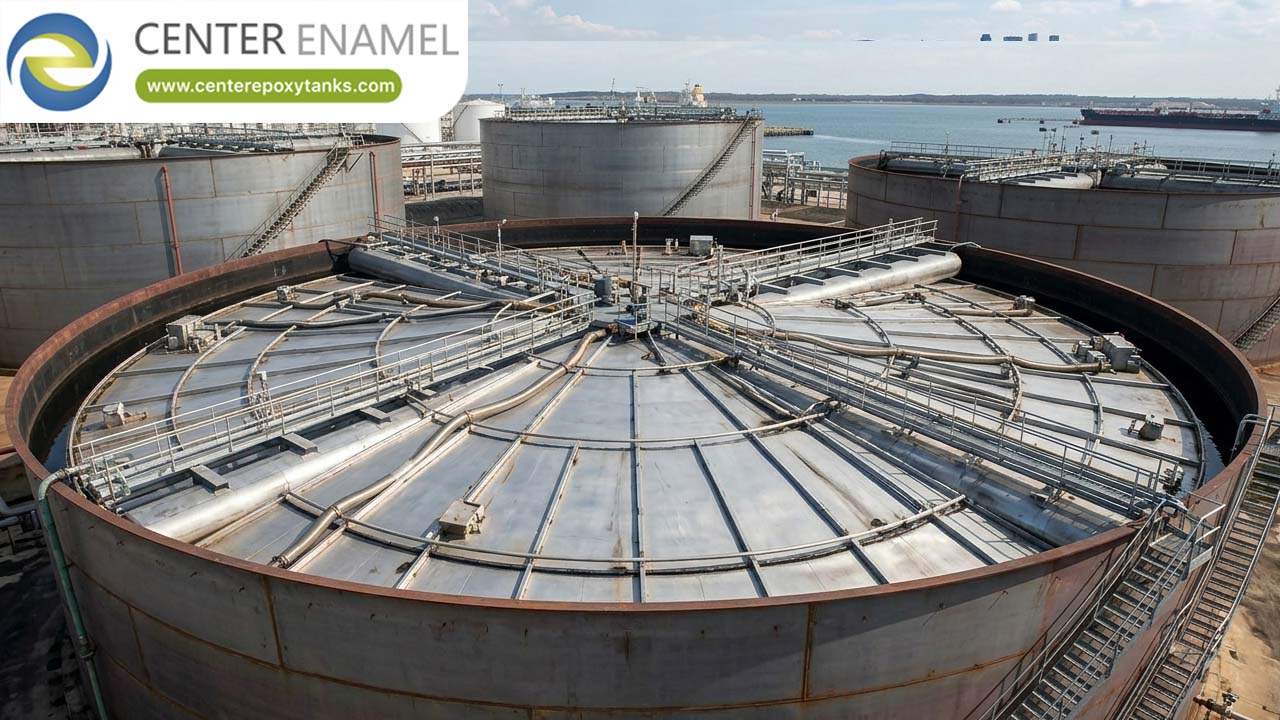
Floating Roofs for Jet A-1 Fuel Storage Tanks: Engineering & Procurement Guide
Storing Jet A-1 aviation turbine fuel requires absolute containment purity. Unlike standard diesel or crude oil, jet fuel is hyper-sensitive to particulate contamination, water ingress, and microbial degradation. For EPC contractors and airport fuel terminals, the Internal Floating Roof (IFR)—typically installed within a fixed-roof tank or beneath an aluminum geodesic dome—represents the industry gold standard. It provides a physical barrier that guarantees product integrity, prevents explosive vapor accumulation, and ensures stringent environmental compliance.
1. The Critical Demands of Aviation Fuel Storage
The storage of aviation fuel is subject to an uncompromising set of demands. A single contamination event can lead to filter blockages, engine corrosion, or catastrophic in-flight failures.
● Absolute Water Exclusion: Jet fuel must be kept impeccably dry. Free water can freeze at high altitudes, blocking fuel lines. Dissolved water creates the perfect environment for corrosion and biological contamination.
● The "Jet Fuel Bug": The interface between fuel and water in traditional tanks provides a breeding ground for microorganisms (bacteria, fungi, and yeasts). These bugs form sticky mats that rapidly degrade fuel quality and clog aircraft filtration systems.
● Oxidative Degradation: Prolonged exposure to atmospheric oxygen reduces the thermal stability and lubricity of Jet A-1 fuel over time.
2. The Superiority of Internal Floating Roofs (IFR)
While External Floating Roofs (EFRs) are common for crude oil, they are rarely used for pristine aviation fuel because rainwater can bypass the primary seals or require complex internal drainage systems that pose a leak risk.
By utilizing an Internal Floating Roof (IFR) operating within a fixed-roof tank, terminal operators eliminate the vulnerabilities of traditional storage:
1. Prevention of Roof Condensation: In a standard fixed-roof tank, temperature fluctuations cause water vapor to condense on the underside of the roof and drip into the ultra-sensitive fuel. An IFR rests directly on the liquid surface, eliminating the vapor space where condensation forms.
2. Elimination of Vapor Losses: By maintaining continuous contact with the fuel, the floating roof suppresses vaporization, virtually eliminating Volatile Organic Compound (VOC) emissions and preventing the loss of valuable product.
3. Static Electricity Mitigation: An IFR maintains a calm fuel surface, minimizing turbulence and agitation during high-capacity filling and emptying operations, which significantly reduces the generation of static electricity.
3. Engineering the Benchmark: API 650 Appendix H
A trusted manufacturer designs Jet A-1 IFR systems strictly according to API 650 Appendix H, which governs the design, materials, and construction of internal floating roofs.
● Buoyancy Requirements: The roof must be designed to remain buoyant even if the primary pontoons are punctured. Engineers calculate the specific gravity of Jet A-1 (typically around 0.804) to ensure the roof maintains the correct draft.
● Advanced Sealing Systems: API-compliant mechanical shoe seals or liquid-mounted wiper seals bridge the gap between the floating roof perimeter and the tank shell, ensuring maximum vapor suppression as the roof travels up and down.
● Anti-Rotation & Grounding: Stainless steel guide poles prevent the roof from rotating, while specialized bonding cables ground the floating roof to the tank shell, safely discharging any static buildup.
4. Material Science & Compatibility
Aviation fuel regulations (such as JIG and military specifications) strictly dictate the materials that can come into contact with Jet A-1.
Material | Compatibility | Application in Jet A-1 Tanks |
Aluminum Alloys | Excellent | The preferred material for IFRs. Lightweight, naturally corrosion-resistant, and completely non-reactive with aviation fuel. |
Stainless Steel | Excellent | Used for heavy-duty pontoons, guide poles, and grounding cables. Highly durable but heavier and more expensive than aluminum. |
Carbon Steel (Bare) | Poor | Rusts easily when exposed to trace moisture, introducing particulate contamination into the fuel. |
Galvanized Steel / Copper | Strictly Prohibited | Zinc and copper aggressively catalyze the degradation of jet fuel and are banned from internal tank components. |
Key insight: Even when using a carbon steel external tank shell, the interior of a Jet A-1 tank must be fully lined with a light-colored, 100% solid epoxy coating. This prevents rust and allows inspectors to easily spot dirt or microbial growth during maintenance.
5. Manufacturer Capabilities: Sourcing with Confidence
Delivering API 650-compliant floating roof tanks for international airport hubs requires precision at scale. Relying on our massive 150,000 square meter manufacturing base, we automate the fabrication of complex tank components to ensure perfect geometry and weld integrity.
When evaluating a manufacturer for aviation fuel infrastructure, look for:
● In-House CNC & Submerged Arc Welding: Ensures perfect plate edge preparation and zero-defect weld seams, which is critical for smooth IFR travel along the inner shell.
● Pre-Fabrication & Modularity: For export to global EPC projects, the tank shell, dome roof, and internal floating roof components must be pre-engineered, flat-packed, and shipped with 3D assembly blueprints for rapid field erection.
● Traceability: Complete documentation of Weld Procedure Specifications (WPS) and Mill Test Reports (MTRs) for every aluminum and steel component.
6. Frequently Asked Questions (FAQ)
Q: Does an IFR eliminate the need for a water draw-off line?
A: No. While an IFR prevents atmospheric condensation from dripping into the fuel, trace water can still enter during the fuel transfer process. Jet A-1 tanks must always feature a low-point sump and a non-rusting (stainless steel) water draw-off line to routinely drain settled water.
Q: Can we retrofit an existing fixed-roof tank with an aluminum IFR?
A: Yes. Aluminum internal floating roofs are designed to be lowered through existing tank manways or roof hatches in modular sections and assembled entirely inside the tank without "hot work" (welding).
Q: What type of fixed roof pairs best with an IFR for Jet fuel?
A: Aluminum Geodesic Domes are the industry preference. They require no internal support columns (which would require complex roof penetrations and additional seals on the IFR), are entirely maintenance-free, and provide exceptional weather protection.
Selecting the correct storage architecture for Jet A-1 fuel is a critical decision that impacts aviation safety and terminal profitability. By specifying an API 650 Internal Floating Roof—manufactured with precision-grade aluminum and installed within a perfectly welded, fully coated tank shell—operators can guarantee the absolute purity of their fuel reserves while protecting their infrastructure from the devastating effects of internal corrosion.
To further understand the structural engineering and finite element analysis required for these mission-critical vessels, API 650 JET A1 TANKS DESIGN provides an excellent visual overview of the 3D modeling processes used by top-tier manufacturers.


