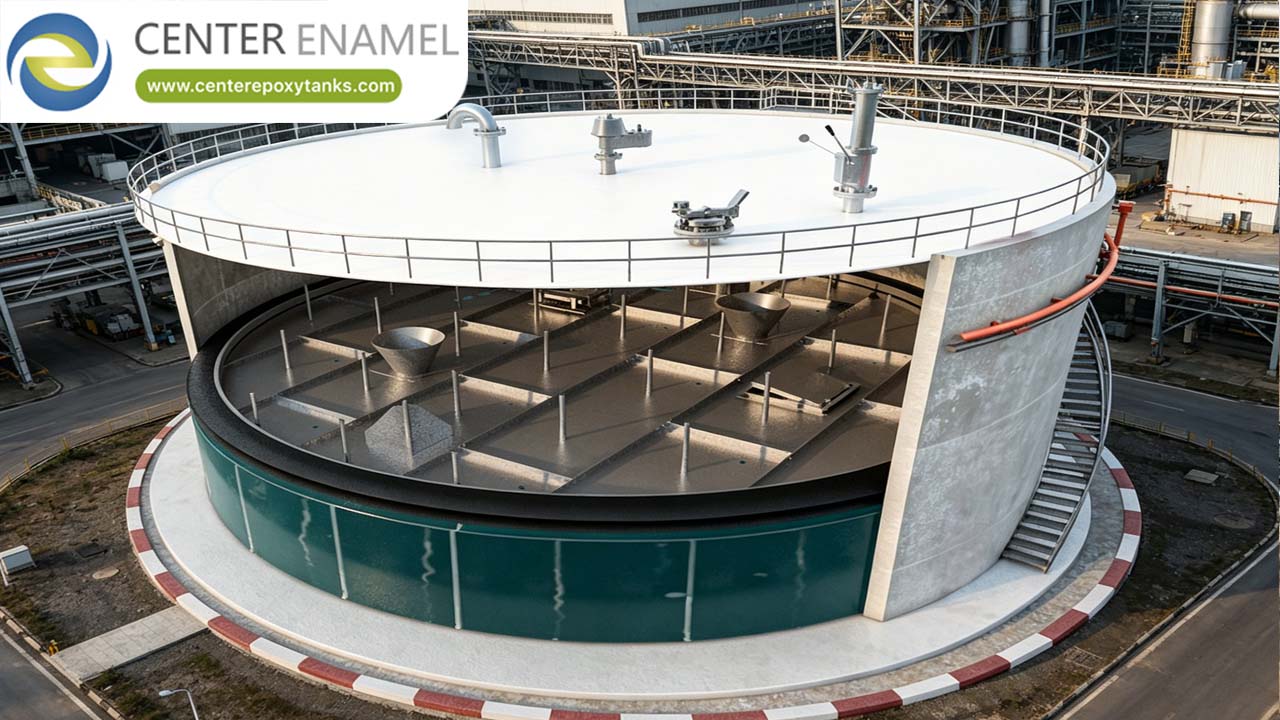
Floating Roof Tanks: Essential Infrastructure for Volatile Liquid Storage
For petrochemical terminals and refineries, managing volatile liquids like crude oil, gasoline, and naphtha presents a dual challenge: preventing hazardous product loss and ensuring strict environmental compliance. Floating Roof Tanks are the industry’s most effective solution, engineered to move dynamically with liquid levels, virtually eliminating the "vapor space" where hazardous gases accumulate [1.1.1, 1.1.2].
Understanding the Mechanics: How They Work
The fundamental goal of a floating roof tank is to eliminate the headspace above the liquid [1.1.2]. By maintaining continuous contact between the roof deck and the liquid surface, these tanks suppress evaporation at the source [1.1.1, 1.3.1]. As liquid is added or withdrawn, the roof rises and falls automatically, keeping the vapor space near zero [1.1.1].
The Two Core Configurations
1. Internal Floating Roof Tanks (IFRT)
IFRTs feature a fixed outer roof with an internal floating deck that acts as an all-weather shield [1.2.1].
Best For: Moderate tank diameters and regions with heavy precipitation (snow/rain) [1.2.1].
Why Choose IFRT: The fixed outer roof protects the floating deck from environmental debris, reducing maintenance requirements and eliminating the need for complex drainage systems [1.1.2, 1.2.1].
2. External Floating Roof Tanks (EFRT)
EFRTs feature an open-top design where the floating roof is fully exposed to the atmosphere [1.2.1].
Best For: Massive-scale storage terminals (often >60m in diameter) [1.2.1].
Why Choose EFRT: These tanks are more cost-effective for large-diameter storage because they do not require the expensive structural framework of a fixed outer roof [1.1.1, 1.2.1].
Technical Comparison Matrix
Feature | Internal Floating Roof (IFRT) | External Floating Roof (EFRT) |
API Reference | API 650, Annex H | API 650, Annex C |
Environment | Protected (Fixed Roof) | Exposed to Atmosphere |
VOC Containment | Superior | Moderate/High |
Maintenance | Low (Sheltered) | High (Requires Drain Maintenance) |
Ideal Capacity | Medium/Large | Very Large (Massive scale) |
Why Industry Leaders Prioritize Floating Roof Tanks
1. Superior VOC Emission Control
Floating roof tanks are proven to reduce evaporative losses by over 90% compared to fixed-roof designs [1.1.1, 1.1.3]. By suppressing the movement of hydrocarbon molecules into the vapor phase, they assist operators in meeting rigorous environmental mandates [1.1.2, 1.2.2].
2. Enhanced Safety and Fire Prevention
By eliminating the vapor-air mixture—which is highly combustible—these tanks significantly lower the risk of fire and explosions [1.1.1, 1.1.3]. In the event of a fire, the floating roof serves as a critical barrier, limiting the surface area of the liquid exposed to the atmosphere [1.2.2].
3. API Compliance and Structural Integrity
Modern floating roof design is governed by API 650 (Annex C & H), which mandates strict buoyancy criteria [1.3.1, 1.3.4]. The roof must remain buoyant even if multiple pontoon compartments are punctured, ensuring long-term operational resilience [1.3.1, 1.3.4].
Frequently Asked Questions (FAQ)
Q: Do floating roof tanks require a Pressure Safety Valve (PSV)?
A: Generally, no. Because the floating roof rises and falls with the liquid level, it inherently provides a pressure-relieving mechanism [1.3.3]. However, systems must be equipped with properly sized circulation vents per API 650 Appendix H to manage thermal expansion [1.3.3].
Q: What is the biggest maintenance risk for an External Floating Roof Tank?
A: "Roof sinking" is the primary operational risk [1.1.2]. This occurs if the floating roof drainage system fails or becomes clogged, allowing rainwater to pool on the deck. Modern EFRTs use multi-layered flexible hoses and redundant emergency drains to mitigate this risk [1.3.1].
Q: Which seal system is best for minimizing VOC emissions?
A: A dual-seal system—comprising a primary seal (mechanical shoe or wiper) and a secondary seal mounted above it—is the "Best Available Control Technology" (BACT) for stringent environmental compliance [1.1.2, 1.3.4].
Q: Can I retrofit an existing fixed-roof tank with an internal floating roof?
A: Yes. Retrofitting an IFR into an existing tank is a common, cost-effective way to bring aging assets into compliance with modern VOC emission regulations [1.3.4].
Are you currently engineering a new storage terminal or upgrading an existing facility to meet environmental standards? [Contact our engineering team] for a technical consultation on API-compliant floating roof configurations tailored to your site's specific storage volume and product volatility.


