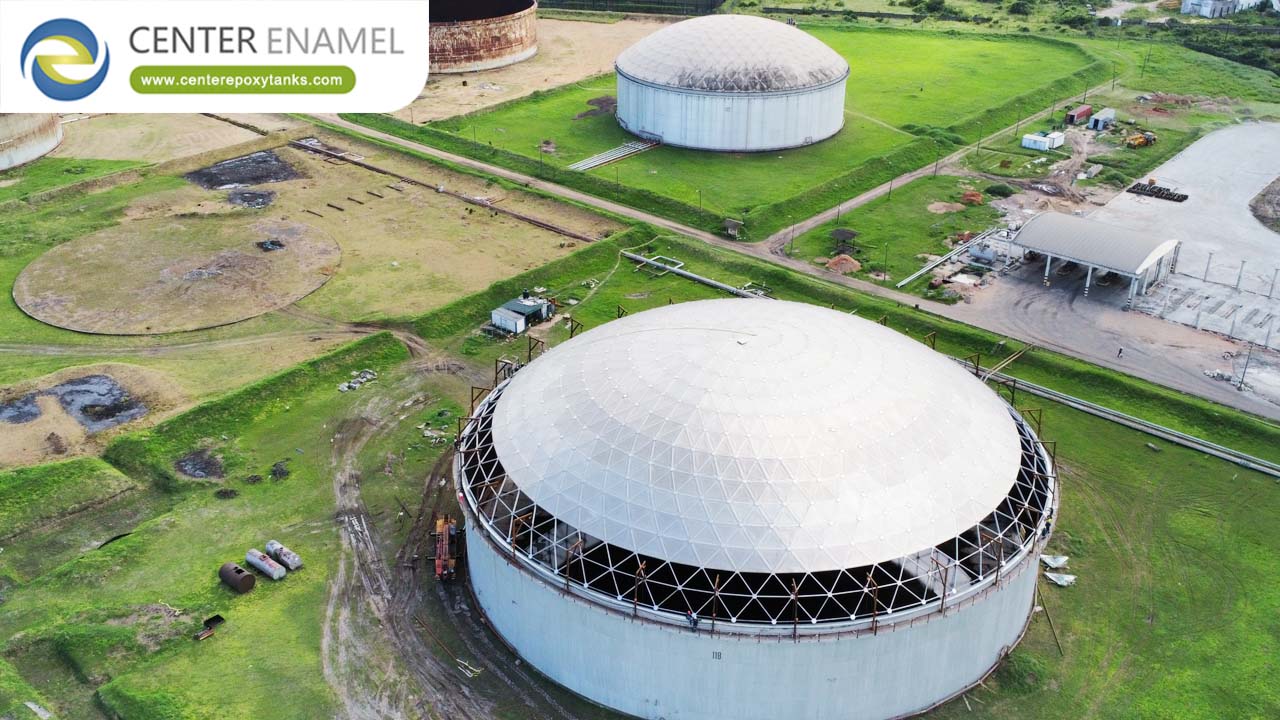
Internal Floating Roof (IFR) Systems — Advanced Vapor Control and Safety Solutions for Modern Storage Tanks
In today’s industrial landscape, environmental compliance, operational safety, and long-term asset reliability are no longer optional — they are fundamental requirements. Across the petroleum, petrochemical, chemical, and industrial sectors, storage tanks handling volatile liquids must meet increasingly stringent regulatory standards while maintaining cost efficiency and structural integrity.
One of the most effective technologies for controlling vapor emissions and enhancing tank safety is the Internal Floating Roof (IFR).
As a global storage tank solutions provider since 2008, Shijiazhuang Zhengzhong Technology Co., Ltd (Center Enamel) delivers engineered Internal Floating Roof systems designed for superior performance, environmental protection, and long-term operational value. With project experience spanning more than 100 countries, Center Enamel combines advanced engineering, international standards compliance, and high-quality manufacturing to support infrastructure projects worldwide.
1. Understanding Internal Floating Roof Systems
An Internal Floating Roof (IFR) is a secondary floating deck installed inside a fixed roof storage tank. Unlike external floating roofs, which are exposed to the environment, IFR systems operate beneath a permanent fixed roof structure.
The IFR floats directly on the surface of the stored liquid, rising and falling with changes in product level. By eliminating vapor space between the liquid and the roof deck, IFR systems significantly reduce evaporative losses and volatile organic compound (VOC) emissions.
This configuration provides:
Enhanced environmental compliance
Improved fire safety
Reduced product loss
Protection from weather exposure
Lower maintenance compared to external floating roofs
Internal floating roofs are widely used in tanks storing gasoline, jet fuel, crude oil, solvents, petrochemicals, and other volatile liquids.
2. Why Internal Floating Roofs Matter
2.1 Vapor Emission Control
Volatile organic compounds (VOCs) contribute to air pollution and regulatory non-compliance. IFR systems dramatically reduce vapor formation by minimizing vapor space above the stored liquid.
By controlling evaporation, IFR systems help facilities comply with:
API standards
EPA regulations (including NSPS Subpart Kb)
European environmental directives
Local emission control laws worldwide
This makes IFR systems essential for modern environmentally responsible storage operations.
2.2 Fire and Explosion Risk Reduction
In fixed roof tanks without internal floating roofs, vapor accumulation can create flammable atmospheres. IFR systems reduce the oxygen-vapor mixture volume, lowering ignition risks.
Key safety benefits include:
Reduced fire hazard
Lower static electricity buildup
Improved operational safety margins
Enhanced compliance with NFPA standards
2.3 Product Conservation
Evaporation loss represents direct financial loss. By reducing vaporization, IFR systems help retain valuable product, improving profitability over the tank’s operational life.
3. Structural Design and Engineering Excellence
Center Enamel’s Internal Floating Roof systems are engineered using advanced structural analysis and precise fabrication methods. Design considerations include:
Buoyancy and flotation stability
Structural load distribution
Seal integrity
Compatibility with stored liquid
Temperature and pressure variations
Our engineering team ensures that each IFR system meets or exceeds international standards such as:
API 650 — Welded Tanks for Oil Storage
API 620 — Low-pressure storage tanks
NFPA standards — Fire safety compliance
International environmental emission regulations
Every IFR is designed for optimal performance under specific project conditions, including seismic zones, high-temperature regions, and coastal environments.
4. Types of Internal Floating Roofs
Depending on tank size, stored product, and project requirements, Internal Floating Roofs may be configured as:
4.1 Pontoon-Type IFR
Pontoon-type IFRs use hollow buoyancy chambers (pontoons) arranged around the perimeter or distributed internally. These provide stable flotation and structural integrity.
Advantages include:
Proven and widely accepted design
Reliable buoyancy control
Strong load-bearing capability
Cost-effective construction
4.2 Full Contact IFR
Full-contact IFR systems rest directly on the liquid surface without large vapor spaces beneath the deck. This further minimizes emissions and enhances vapor control efficiency.
These systems are particularly suitable for high-volatility products.
4.3 Double-Deck IFR
Double-deck internal floating roofs include upper and lower deck plates with sealed buoyancy compartments. This design enhances structural rigidity and provides additional safety redundancy.
5. Seal Systems — The Critical Performance Component
The seal system is essential for IFR effectiveness. It closes the gap between the floating roof and tank shell, preventing vapor escape.
Common seal types include:
Mechanical shoe seals
Liquid-mounted primary seals
Secondary rim seals
Double seal systems for enhanced control
Center Enamel selects high-performance seal materials resistant to:
Chemical exposure
Temperature fluctuations
Abrasion
Long-term aging
Seal performance directly impacts emission reduction efficiency, and our systems are designed for long service life with minimal maintenance.
6. Materials and Corrosion Protection
IFR systems operate in aggressive environments exposed to:
Hydrocarbon vapors
Condensation
Chemical exposure
Temperature cycling
To ensure durability, Center Enamel utilizes:
High-grade structural steel
Corrosion-resistant alloys
Fusion bonded epoxy coatings
Protective surface treatments
Material selection is based on product compatibility and operational environment, ensuring structural integrity throughout the lifecycle.
7. Integration with Fixed Roof Tank Systems
Internal Floating Roofs function within fixed roof tanks, and proper integration is essential. Center Enamel designs IFR systems compatible with:
Welded steel tanks
Glass-Fused-to-Steel tanks
Fusion Bonded Epoxy tanks
Stainless steel tanks
Large industrial storage systems
Our comprehensive tank expertise ensures structural compatibility and optimized performance across the entire storage system.
8. Installation and Global Execution
With experience in more than 100 countries, Center Enamel provides comprehensive IFR project support:
Engineering design packages
Fabrication and quality control
Global logistics coordination
On-site supervision
Installation guidance and training
Our teams work closely with EPC contractors, oil & gas operators, and industrial facility owners to ensure smooth project delivery.
9. Applications Across Industries
Petroleum & Energy
Gasoline storage
Crude oil storage
Jet fuel tanks
Refined fuel terminals
IFR systems are widely used to meet strict vapor emission and safety regulations in petroleum facilities.
Petrochemical & Chemical
Solvent storage
Volatile liquid chemicals
Reactive products
Specialty chemical storage
Industrial Applications
Process liquids
Industrial waste liquids
High-volatility industrial materials
10. Environmental Sustainability
IFR systems contribute to sustainability by:
Reducing VOC emissions
Minimizing product waste
Lowering environmental pollution
Supporting regulatory compliance
These environmental benefits align with global carbon reduction initiatives and responsible industrial practices.
11. Safety Features
Center Enamel IFR systems incorporate:
Anti-rotation devices
Guide poles
Emergency drainage systems
Fire safety accessories
Inspection and access platforms
All components are engineered to enhance safety and facilitate inspection and maintenance.
12. Lifecycle Cost Advantages
When evaluating storage tank roof systems, lifecycle cost is a critical factor. IFR systems offer:
Reduced product loss
Lower emission penalties
Minimal maintenance requirements
Extended service life
Improved asset value
The economic return on investment is achieved through long-term performance and reduced operational risk.
13. Quality Assurance and Certification
Center Enamel operates under strict quality management systems, including:
ISO 9001 certification
Third-party inspections
Material traceability
Factory testing procedures
On-site quality validation
Every IFR component undergoes rigorous inspection to ensure compliance with project specifications and international standards.
14. Engineering Innovation and Continuous Improvement
As part of our commitment to innovation, Center Enamel continuously enhances:
Structural design optimization
Seal system efficiency
Corrosion-resistant technologies
Installation efficiency
Digital monitoring integration
Our R&D team works to improve safety margins and environmental performance while reducing overall lifecycle cost.
15. Global Project Experience
Center Enamel has delivered storage tank solutions globally across:
Middle East oil terminals
Southeast Asia petrochemical plants
Latin America fuel storage facilities
African industrial projects
European compliance-driven storage upgrades
Our experience ensures adaptability to diverse regulatory and climatic environments.
16. Comparing Internal vs External Floating Roofs
While both systems reduce vapor emissions, IFR systems offer distinct advantages:
Protected from weather exposure
Reduced corrosion from rain and UV
Lower maintenance requirements
Enhanced fire safety
Longer operational life
These benefits make IFR systems particularly suitable for facilities requiring maximum reliability and regulatory compliance.
17. Commitment to Partnership
Center Enamel is not merely a supplier — we are a long-term partner. Our approach includes:
Early-stage engineering consultation
Customized design solutions
Transparent communication
On-time project delivery
Ongoing technical support
Our global clients rely on us for consistent quality and dependable performance.
18. The Future of Vapor Control Technology
As environmental regulations continue to tighten worldwide, IFR systems will remain central to storage infrastructure. Advancements in:
Enhanced sealing systems
Smart monitoring technologies
Improved corrosion protection
Sustainable materials
will further strengthen the role of internal floating roofs in modern industrial operations.
Center Enamel is committed to staying at the forefront of these developments.
19. Why Choose Center Enamel Internal Floating Roof Systems?
Over 15 years of tank industry expertise
Global export to more than 100 countries
Compliance with API, NFPA, and environmental standards
Integrated tank and roof system solutions
Advanced manufacturing capability
Comprehensive technical support
Proven global performance
Internal Floating Roof systems represent a strategic investment in safety, environmental responsibility, and operational efficiency. By minimizing vapor emissions, reducing fire risk, and protecting stored products, IFR systems deliver measurable performance benefits across industries.
With advanced engineering capabilities, strict quality control, and extensive international project experience, Shijiazhuang Zhengzhong Technology Co., Ltd (Center Enamel) provides reliable Internal Floating Roof solutions tailored to global industrial needs.
For facilities seeking high-performance vapor control, regulatory compliance, and long-term value, Center Enamel’s Internal Floating Roof systems offer a trusted, future-ready solution.


