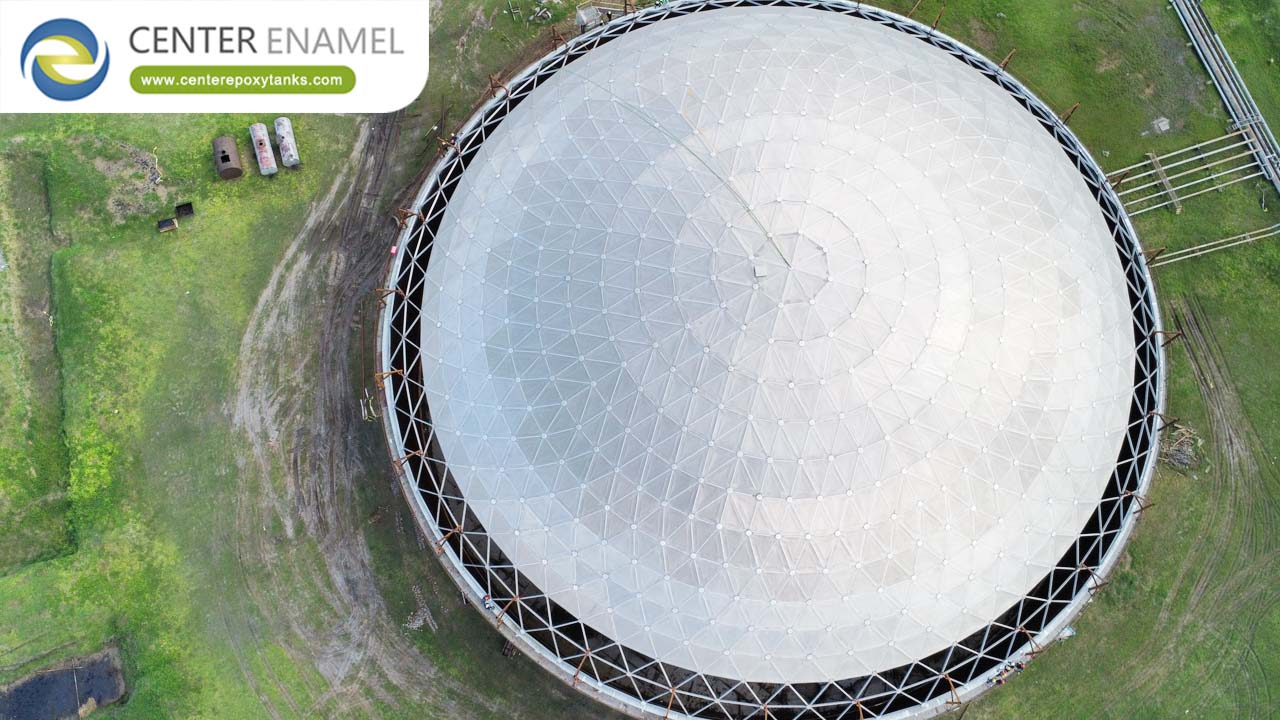
External Floating Roof (EFR) Systems — Proven Vapor Control and High-Performance Storage Solutions for Petroleum and Industrial Applications
In the global oil & gas, petrochemical, and bulk liquid storage industries, environmental protection, operational safety, and asset reliability are top priorities. As environmental regulations become increasingly stringent and storage infrastructure continues to expand, selecting the right tank roof system is critical to ensuring compliance, minimizing product loss, and enhancing long-term operational efficiency.
Among the most widely adopted vapor control technologies in atmospheric storage tanks is the External Floating Roof (EFR) system.
As a global storage tank and roof solution provider since 2008, Shijiazhuang Zhengzhong Technology Co., Ltd (Center Enamel) delivers engineered External Floating Roof systems designed to meet international standards while providing exceptional durability, safety, and environmental performance. With projects delivered to more than 100 countries, Center Enamel combines advanced engineering design, strict quality control, and comprehensive project support to serve clients worldwide.
1. What Is an External Floating Roof?
An External Floating Roof (EFR) is a roof structure that floats directly on the surface of stored liquid inside an open-top storage tank. Unlike fixed roof tanks or internal floating roof systems, the EFR is fully exposed to the external environment.
The roof rises and falls with changes in liquid level, maintaining direct contact with the stored product and minimizing the vapor space between the liquid and the roof deck. This significantly reduces evaporative losses and volatile organic compound (VOC) emissions.
EFR systems are commonly used in large-diameter atmospheric storage tanks storing:
Crude oil
Gasoline
Naphtha
Jet fuel
Diesel
Petrochemical feedstocks
Other volatile hydrocarbons
2. Why External Floating Roofs Remain a Global Industry Standard
2.1 Effective Vapor Emission Control
One of the primary functions of an EFR is to reduce vapor formation and minimize emissions. By eliminating vapor space above the stored liquid, external floating roofs:
Reduce VOC emissions
Lower hydrocarbon losses
Improve environmental compliance
Enhance product conservation
This makes EFR systems especially suitable for petroleum storage terminals and refineries.
2.2 Economic Efficiency for Large-Diameter Tanks
For very large tanks, particularly in crude oil storage farms, external floating roofs are often more cost-effective than fixed roof + internal floating roof combinations.
Benefits include:
Lower structural steel consumption
Simplified tank design
Reduced initial investment cost
Proven long-term reliability
2.3 Operational Simplicity
External floating roofs operate mechanically through buoyancy. Their straightforward design allows:
Easy inspection
Simple maintenance procedures
Long operational lifespan
Adaptability to various tank diameters
3. Structural Design of External Floating Roof Systems
Center Enamel’s External Floating Roof systems are engineered for structural integrity, buoyancy stability, and environmental resistance. Key design considerations include:
Dead load and live load distribution
Rainwater drainage capacity
Wind uplift resistance
Seismic load conditions
Corrosion protection
Long-term fatigue resistance
All EFR systems are designed in accordance with internationally recognized standards such as:
API 650 (Appendix C) — External Floating Roof Tanks
NFPA standards — Fire safety
Environmental emission regulations
Local engineering codes
4. Types of External Floating Roof Designs
External floating roofs are typically categorized into two main structural configurations:
4.1 Pontoon-Type External Floating Roof
Pontoon-type roofs feature a central deck supported by buoyancy chambers (pontoons) located around the perimeter and/or internally.
Advantages:
Proven industry design
Good buoyancy control
Lower construction cost
Reliable performance for large tanks
Pontoon roofs are widely used in crude oil storage and petroleum terminals.
4.2 Double-Deck External Floating Roof
Double-deck roofs consist of two steel plates separated by a network of bulkheads, forming sealed buoyancy compartments across the entire roof area.
Advantages:
Superior structural rigidity
Enhanced resistance to heavy rainfall
Better stability under wind loads
Increased safety redundancy
Double-deck roofs are preferred in regions with high rainfall, snow loads, or extreme weather conditions.
5. Seal Systems — Ensuring Vapor Tightness
The seal system closes the annular space between the floating roof and tank shell. It plays a critical role in emission control.
Common seal systems include:
Mechanical shoe seals
Liquid-mounted seals
Vapor-mounted seals
Dual seal systems (primary + secondary)
Center Enamel selects high-performance seal materials resistant to:
Hydrocarbon exposure
UV radiation
Temperature variation
Mechanical wear
A properly designed seal system significantly enhances emission reduction performance and operational safety.
6. Drainage Systems — Managing Rainwater
Since EFR systems are exposed to weather, rainwater accumulation must be effectively managed.
Drainage components include:
Flexible roof drains
Articulated piping systems
Sump areas
Emergency overflow systems
The drainage design ensures:
Prevention of roof overloading
Structural stability
Safe and efficient water discharge
7. Safety Features of External Floating Roofs
Safety is a primary consideration in EFR design. Center Enamel integrates:
Anti-rotation devices
Guide poles and rolling ladders
Rim vents
Emergency drain systems
Fire foam dams
Access platforms and stairways
All components are engineered to reduce fire risk, prevent mechanical failure, and ensure safe maintenance access.
8. Materials and Corrosion Protection
Because EFR systems are exposed to:
Sunlight (UV radiation)
Rainwater
Wind
Salt-laden coastal air
Hydrocarbon vapors
Robust corrosion protection is essential.
Center Enamel applies:
High-grade structural carbon steel
Corrosion-resistant steel grades
Fusion bonded epoxy coatings
Advanced anti-corrosion paint systems
Cathodic protection compatibility
Material selection is customized according to the project’s environmental conditions.
9. Wind and Seismic Design Considerations
In open-top tanks, wind loads significantly impact roof stability. Our engineering team performs detailed calculations to ensure:
Resistance to wind uplift
Stability under storm conditions
Structural integrity in seismic zones
Design optimization ensures compliance with local and international codes.
10. Environmental Compliance and Sustainability
External floating roofs contribute to:
Reduced VOC emissions
Improved air quality
Compliance with EPA and global environmental standards
Lower carbon footprint through reduced evaporation
As sustainability becomes a core industry priority, EFR systems support responsible industrial operation.
11. Lifecycle Cost Advantages
When evaluating storage tank roofing options, total lifecycle cost must be considered.
EFR systems offer:
Reduced product evaporation losses
Lower emission penalty risks
Long service life
Minimal operational complexity
High structural reliability
The choice depends on project budget, regulatory requirements, and climate conditions.
13. Global Applications
Center Enamel’s External Floating Roof systems are widely used in:
Oil & Gas Terminals
Large crude oil storage farms and export terminals.
Refineries
Gasoline, diesel, and intermediate product storage.
Petrochemical Facilities
Storage of volatile feedstocks and finished products.
Strategic Petroleum Reserves
National oil reserve storage systems.
Our global project footprint spans:
Middle East
Southeast Asia
Africa
Latin America
Europe
Central Asia
14. Manufacturing and Quality Control
At Center Enamel, quality assurance is embedded in every stage of production.
Our quality system includes:
ISO 9001 certification
Strict material inspection
Welding procedure qualification
Dimensional accuracy verification
Third-party inspection support
Complete documentation traceability
Each component undergoes factory inspection before shipment.
15. Installation and Project Support
Center Enamel provides comprehensive project services:
Engineering documentation
Fabrication and logistics coordination
On-site supervision
Installation guidance
Technical training
Commissioning support
Our experienced project teams ensure smooth execution and timely delivery.
16. Innovation and Continuous Improvement
With more than 15 years of industry experience, Center Enamel continuously invests in:
Advanced structural modeling
Seal efficiency enhancement
Improved corrosion-resistant technologies
Optimized fabrication methods
Digital inspection tools
We remain committed to providing reliable and future-ready storage solutions.
17. Why Choose Center Enamel External Floating Roof Systems?
Over 15 years of tank and roof engineering experience
Exported to more than 100 countries
Compliance with API 650 and global standards
Strong R&D capability
Integrated tank and roof system solutions
High-quality manufacturing
Global technical support
We deliver not just products, but complete engineered solutions.
18. The Future of Floating Roof Technology
As environmental standards tighten and storage volumes increase globally, floating roof technologies will continue evolving toward:
Higher emission reduction efficiency
Improved structural safety
Advanced corrosion resistance
Smarter monitoring systems
Sustainable material applications
Center Enamel remains at the forefront of this evolution.
External Floating Roof systems have proven their reliability and effectiveness for decades in petroleum and industrial storage applications. By reducing vapor emissions, conserving valuable products, and offering cost-efficient solutions for large-diameter tanks, EFR systems remain a cornerstone of global storage infrastructure.
With strong engineering expertise, strict quality control, and extensive international project experience, Shijiazhuang Zhengzhong Technology Co., Ltd (Center Enamel) provides high-performance External Floating Roof systems tailored to meet the demands of modern industry.
For clients seeking dependable vapor control solutions that combine environmental responsibility, safety, and economic value, Center Enamel’s External Floating Roof systems deliver trusted performance worldwide.


