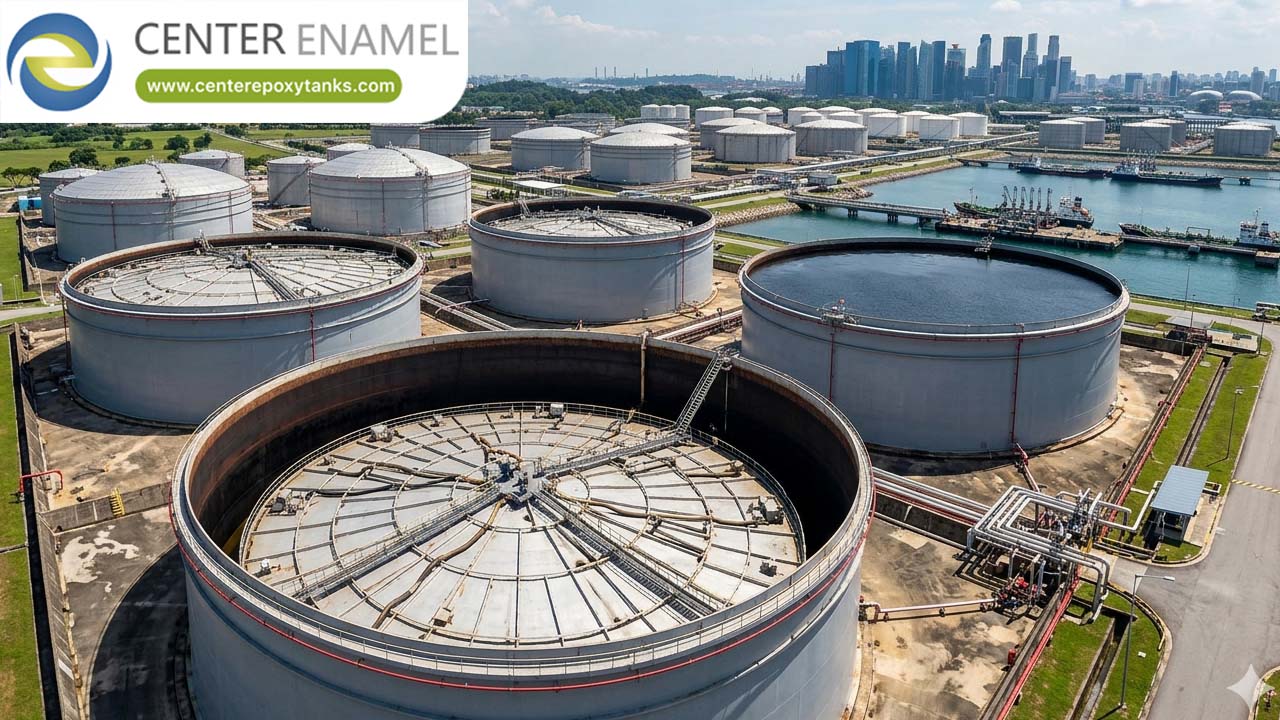
Floating Roof Tank Working Principle: Engineering Vapor Control for 2026
In the modern energy and petrochemical sectors, the floating roof tank is the definitive solution for storing volatile liquids such as crude oil and gasoline. Unlike traditional fixed-roof tanks, which maintain a permanent "vapor space" above the liquid, a floating roof tank utilizes a buoyant deck that sits directly on the product surface.
This engineering shift eliminates the air-liquid interface, reducing evaporative losses by up to 99% and virtually removing the risk of internal tank explosions.
1. The Core Principle: Buoyancy and Displacement
The fundamental working principle of a floating roof relies on Archimedes' Principle. The roof is engineered to be lighter than the liquid it contains, allowing it to rise and fall dynamically as the tank is filled or emptied.
By keeping the roof in constant contact with the liquid, the "ullage" (the space where vapors accumulate) is removed. This prevents two primary types of loss:
● Breathing Losses: Caused by daily temperature changes that expand or contract the vapor space.
● Filling Losses: Caused by air displacement when new liquid enters the tank.
2. Mechanical Execution: IFR vs. EFR
While the core principle remains the same, the execution differs between Internal Floating Roof (IFR) and External Floating Roof (EFR) systems.
Internal Floating Roof (IFR)
An IFR operates inside a fixed-roof tank. The fixed roof (often a cone or dome) protects the floating deck from the elements (rain, snow, wind), while the internal deck suppresses vapors.
● Synergy: Center Enamel often pairs IFRs with Aluminum Geodesic Dome Roofs to provide a column-free interior, allowing the roof to move unobstructed.
External Floating Roof (EFR)
An EFR tank has no fixed roof; the floating deck is the primary cover.
● Engineering Requirement: These decks must be more robust to handle environmental loads. They feature sophisticated drainage systems to prevent rainwater from accumulating and "sinking" the roof.
3. Essential Mechanical Components
To maintain "Topical Authority," we must identify the critical sub-systems that allow a floating roof to function safely:
A. Rim Seal System
The most critical component is the seal between the floating roof and the tank shell.
● Mechanical Shoe Seals: Use metallic plates held against the shell by springs.
● Resilient Seals: Use liquid or vapor-filled "logs" to provide a flexible, gas-tight barrier.
B. Pontoon Buoyancy Units
Floating roofs are supported by compartmentalized pontoons. Per API 650 standards, the roof must remain buoyant even if two adjacent pontoon compartments are punctured.
C. Guide Poles and Anti-Rotation
To prevent the roof from rotating or drifting as it moves, it is secured by guide poles (often used for sampling) and anti-rotation cables.
D. Automatic Bleeder Vents
These allow air to escape when the tank is first filled or when the roof is landed on its support legs during maintenance, preventing a vacuum or over-pressure scenario beneath the deck.
4. Why Compliance Matters: API 650 Appendix H & C
In 2026, the working principle must adhere to the American Petroleum Institute (API) standards to meet ESG (Environmental, Social, and Governance) mandates:
● Appendix C: Governing rules for External Floating Roofs.
● Appendix H: Governing rules for Internal Floating Roofs.
Compliance ensures that the materials and buoyancy calculations are sufficient to withstand local seismic events and extreme weather while maintaining zero-leakage integrity.
5. The Center Enamel Advantage
As a global manufacturer with over 30 years of experience in 100+ countries, Shijiazhuang Zhengzhong Technology Co., Ltd (Center Enamel) integrates advanced manufacturing with precision engineering.
1. Automated Fabrication: CNC production ensures perfect shell-to-seal alignment.
2. Material Innovation: We offer Aluminum, Stainless Steel, and Carbon Steel floating roofs tailored to the stored medium.
3. Digital Simulation: We use Finite Element Analysis (FEA) to model roof stability under extreme fill rates and environmental loads.
A Strategic Asset for Operational Yield
Understanding the floating roof tank working principle is essential for optimizing refinery and terminal operations. By eliminating the vapor space, these tanks protect the environment, ensure worker safety, and preserve the market value of the stored product.
Ensure your storage infrastructure is engineered for the future. Contact Center Enamel today for a technical consultation and an API-compliant floating roof quote.


