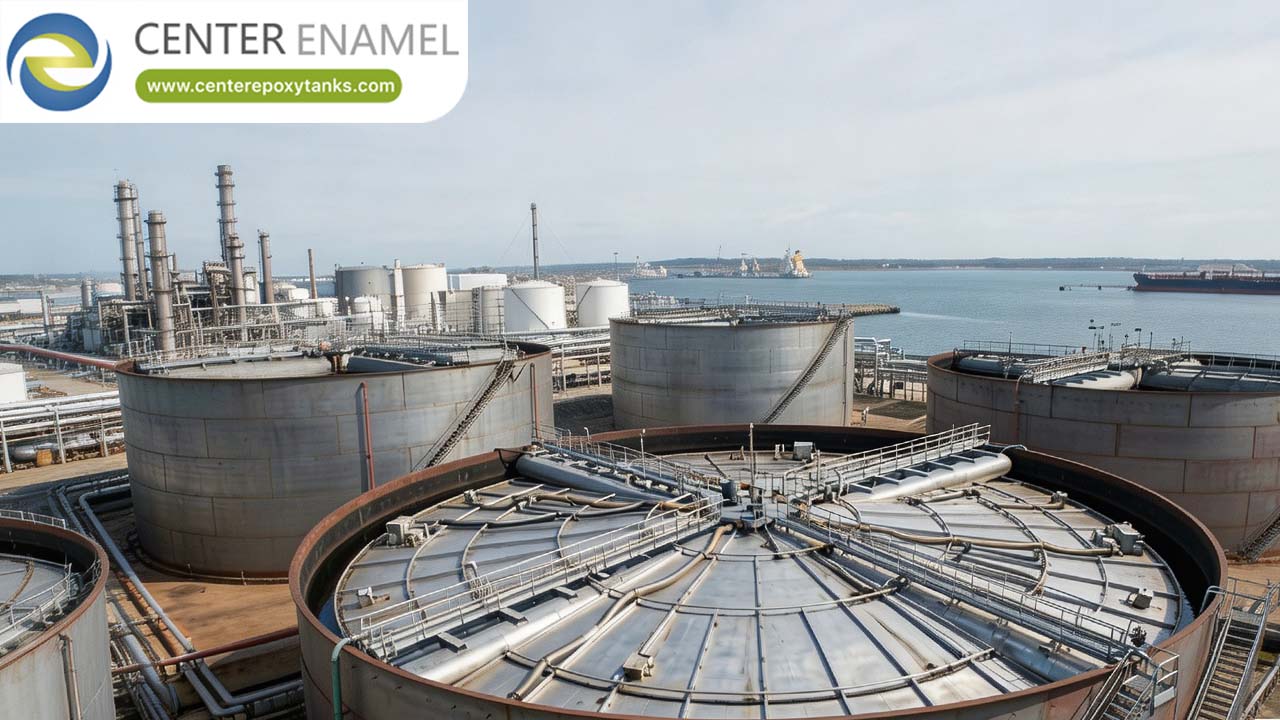
Floating Roof Tank: Components, Types, & Industrial Benefits
In large-scale liquid logistics, petroleum refining, and chemical processing, storing highly volatile hydrocarbons presents dual challenges: minimizing environmental product loss and preventing catastrophic fire hazards. The engineering answer to this challenge is the Floating Roof Tank (FRT).
By eliminating the vapor headspace (ullage) where explosive gases and Volatile Organic Compounds (VOCs) accumulate, floating roof tanks serve as a primary line of defense in modern terminal operations. Operating in compliance with stringent international standards like API 650, these dynamic storage vessels automatically rise and fall with the liquid level.
1. Core Components: The Anatomy of a Floating Roof System
To achieve effective vapor suppression and structural stability, a floating roof tank relies on a synchronized assembly of precision-engineered components:
·
The Buoyant Deck: The structural core of the roof, designed either as a single-deck pontoon system or a heavy-duty double-deck structure. It provides the necessary reserve buoyancy to keep the roof floating horizontally on the liquid product.
·
·
Rim Seal System: Positioned in the annular gap between the outer perimeter of the roof and the internal tank shell. Modern systems utilize a Primary Seal for initial containment and a Secondary Seal (Wiper) to guarantee maximum VOC emission control.
·
·
Guide Poles and Anti-Rotation Devices: Vertical members that stabilize the roof's vertical travel, preventing unwanted rotation or tilting that could compromise seal integrity during high-speed filling or drawing cycles.
·
·
Bleeder Vents and Automatic Air Vents: Valves that automatically open or close to equalize pressure during initial tank filling or complete emptying, preventing structural vacuum collapse or gas entrapment.
·
·
Drainage Systems and Rolling Ladders: For external roofs, flexible articulated pipe drains or high-strength hoses remove rainwater safely off the deck, while rolling stairways maintain constant operator access.
·
2. Primary Types of Floating Roof Tanks
Floating roof designs are categorized into two primary structural classifications based on their exposure to the external environment:
Internal Floating Roof Tanks (IFRTs)
An internal floating roof features a floating deck installed inside a conventional fixed-roof tank (such as a cone roof or aluminum geodesic dome). The outer fixed roof protects the internal structure from rain, snow, and wind, while the inner floating deck suppresses vapors. IFRTs are the industry standard for storing medium-to-high volatility products like aviation fuel, naphtha, and refined petrochemicals.
External Floating Roof Tanks (EFRTs)
An external floating roof tank features an open-top vertical cylindrical shell where the floating deck is directly exposed to the atmosphere. Engineered specifically for massive crude oil reserves and high-volatility products, EFRTs rely on heavy pontoon or double-deck structures equipped with robust weather-shielding rim seals and automated deck drainage systems.
Data Table: External vs. Internal Floating Roof Tanks Comparison Matrix
Evaluation Parameter | External Floating Roof Tank (EFRT) | Internal Floating Roof Tank (IFRT) |
Tank Superstructure | Open-top cylindrical steel shell | Fixed outer roof or aluminum dome |
Weather Exposure | High (Directly exposed to wind, rain, and snow) | Minimal (Sheltered by the outer fixed roof) |
Primary Stored Media | Crude oil, heavy petroleum terminal reserves | Gasoline, jet fuel, aviation naphtha, refined solvents |
Governing Standard | API 650, Annex C | API 650, Annex H |
Emission Control Profile | Excellent when paired with dual secondary rim seals | Superior dual-barrier containment (Fixed roof + floater) |
3. Key Industrial Benefits
Deploying floating roof storage architecture delivers extensive operational, economic, and environmental advantages:
·
Drastic Reduction of VOC Emissions: By eliminating the vapor headspace, floating roofs suppress evaporative product losses by over 90%, helping facilities comply with strict environmental regulations like EPA standards.
·
·
Enhanced Fire and Explosion Safety: Removing the oxygen-rich vapor pocket prevents the formation of flammable vapor-air mixtures, sharply lowering ignition risks from static discharge or lightning.
·
·
Prevention of Product Degradation: Maintaining continuous surface contact stops volatile fractions from escaping, preserving the chemical composition, octane rating, and quality of stored fuels.
·
·
Optimized Space and Capacity Flexibility: Floating roofs dynamically adjust to fluid volume fluctuations, maximizing storage efficiency across diverse industrial throughput schedules.
·
Frequently Asked Questions (FAQ)
Q: What is the main purpose of a floating roof tank?
A: The primary purpose of a floating roof tank is to eliminate the vapor headspace (ullage) above stored volatile liquids, thereby minimizing product evaporation, reducing Volatile Organic Compound (VOC) emissions, and preventing fire hazards.
Q: What is the difference between an internal and external floating roof?
A: An external floating roof operates in an open-top tank and is exposed directly to weather elements, whereas an internal floating roof is installed inside a tank with a permanent fixed outer roof or dome that shields it from rain and wind.
Q: How do floating roof tanks prevent product from leaking along the walls?
A: Floating roofs use specialized rim seal systems (comprising primary mechanical shoes or liquid-filled seals and secondary wiper blades) that bridge the gap between the moving deck and the tank shell, trapping vapors inside.
Q: What engineering standards govern floating roof tank design?
A: Floating roof tanks are strictly designed, fabricated, and inspected in accordance with international standards such as API 650 (specifically Annex C for external roofs and Annex H for internal roofs).


