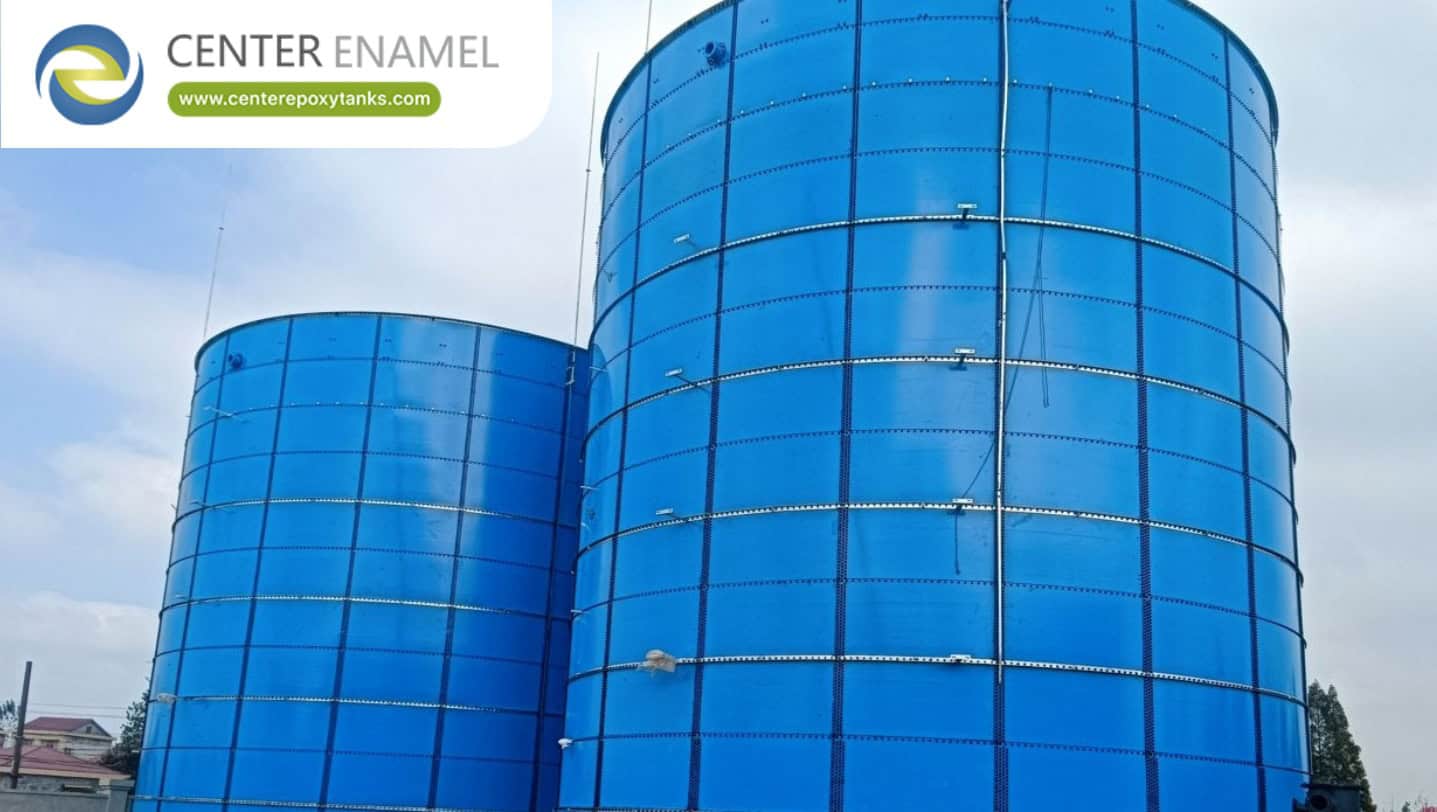
FBE vs. HDPE Tanks: Structural & Chemical Selection Guide
For engineers and facility managers, the choice between Fusion-Bonded Epoxy (FBE) Bolted Tanks and High-Density Polyethylene (HDPE) Tanks is a choice between two distinct material classes: High-Strength Structural Steel and Thermoplastic Polymer. While HDPE is an excellent solution for small-scale, highly specific chemical containment, FBE technology is the global standard for large-scale, high-capacity municipal and industrial storage where structural rigidity and long-term durability are non-negotiable.
1. Technical Mechanics: Comparing Structures
The fundamental difference lies in the material architecture. FBE tanks leverage the mechanical strength of steel, while HDPE relies on the chemical properties of a polymer.
Fusion-Bonded Epoxy (FBE) Bolted Tanks
FBE tanks utilize high-strength carbon steel panels that are grit-blasted and coated with a factory-applied, thermoset polymer.
● Structural Integrity: Steel provides the rigidity to resist wind, seismic, and hydrostatic loads.
● Scalability: Can be engineered for volumes ranging from small tanks to massive industrial reservoirs (thousands of cubic meters).
HDPE Tanks
HDPE tanks are typically rotationally molded as a single, seamless vessel.
● Structural Integrity: As a thermoplastic, HDPE is subject to "creep" (deformation) under sustained load or elevated temperatures.
● Scalability: Typically limited to smaller volumes because the plastic walls cannot support the weight of the liquid (hydrostatic pressure) in large-scale applications without significant wall-thickness increases or external support structures.
2. Comparison Matrix: At a Glance
Feature | FBE Bolted Tank | HDPE Tank |
Primary Strength | Structural Rigidity (Steel Core) | Chemical Inertness (Polymer) |
Max Capacity | Unlimited (Modular expansion) | Limited (Structural constraints) |
Chemical Range | Broad (pH 3–13) | Excellent (Specific concentrated acids/bases) |
Thermal Range | Excellent (Stable up to ~80°C) | Low (Deformation above 40–50°C) |
UV Resistance | High (Formulated for outdoors) | Moderate (Prone to oxidation) |
Structural Reliability | High (Predictable failure modes) | Variable (Subject to "creep") |
3. Critical Engineering Considerations
The "Creep" Factor
HDPE is a thermoplastic. This means that under constant stress (hydrostatic pressure) and heat, the material will slowly deform over time. In engineering terms, this is called "creep." For large storage tanks, this deformation can lead to wall thinning, stress concentrations, and eventually, sudden catastrophic failure. FBE tanks, built on a carbon steel substrate, do not suffer from creep; they maintain their geometry and structural safety factors for the duration of their 30+ year service life.
Chemical vs. Structural Needs
● Select HDPE if: You are storing small volumes of highly specific, aggressive chemicals (e.g., concentrated hydrofluoric acid) that would attack the epoxy coating of an FBE tank.
● Select FBE if: You are storing water, industrial wastewater, fire-protection reserves, or biogas. In these applications, the structural strength and scale of FBE tanks are vastly superior and more cost-effective.
4. Frequently Asked Questions (FAQ)
Q: Why can't I build a large HDPE tank?
A: Because HDPE lacks the tensile strength of steel. To support the weight of millions of gallons of liquid, an HDPE tank would require walls so thick they would become economically unfeasible, and the structure would still be susceptible to temperature-induced softening and mechanical creep.
Q: Are FBE tanks better for outdoor use?
A: Yes. HDPE is sensitive to long-term UV exposure, which can cause the polymer chains to break down, leading to brittleness and cracking. FBE coatings are specifically engineered to maintain their integrity in outdoor, high-UV industrial environments.
Q: Can FBE tanks handle aggressive industrial chemicals?
A: FBE is resistant to a wide range of industrial effluents (pH 3–13). However, if your media is a specialized solvent or ultra-concentrated acid, Center Enamel provides a "Chemical Compatibility Review" to verify if FBE is suitable or if a different material is required.
Engineering Certainty for Your Infrastructure
When comparing containment systems, do not just look at chemical compatibility—look at mechanical reliability. For large-scale projects, storage systems must be able to withstand environmental and load stresses without deforming. FBE technology provides the structural certainty that polymers simply cannot match for industrial-scale storage.
Are you currently evaluating containment options for a specific chemical process, or would you like to review our structural data sheets for your required tank volume?


