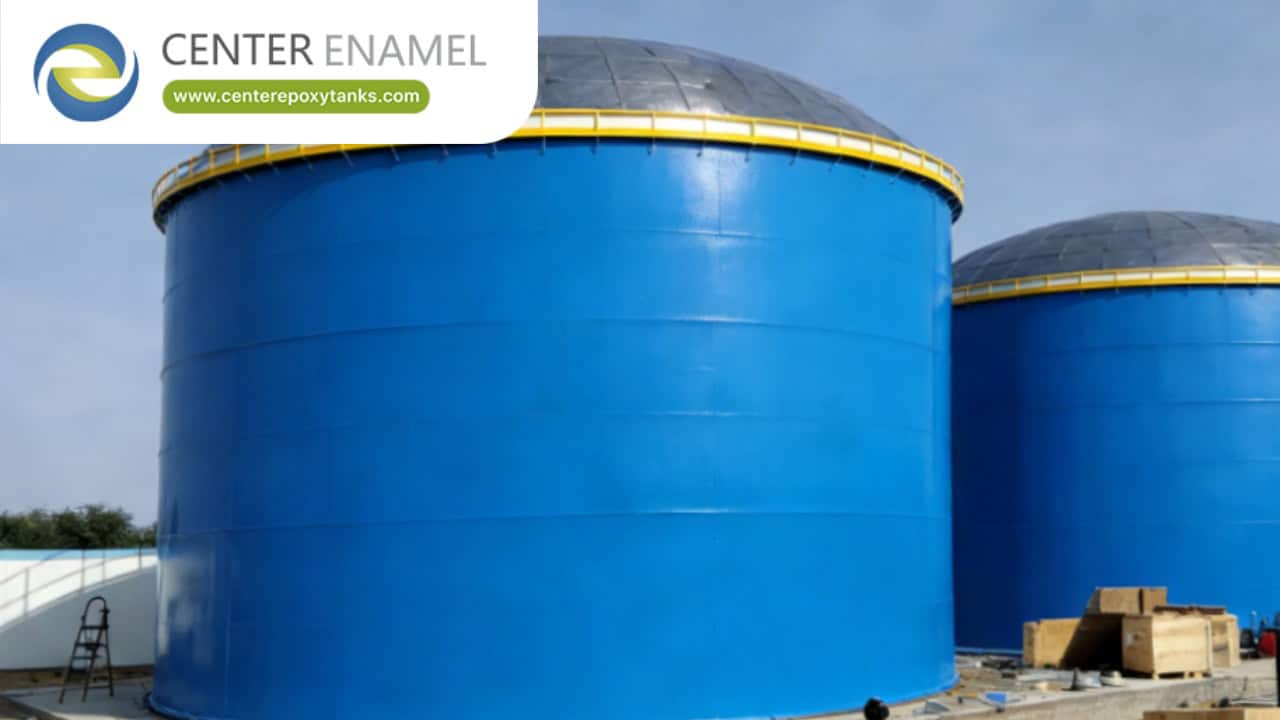
FBE Modular Tanks vs. Welded Steel Tanks: Engineering & Selection Guide
Selecting between Modular Bolted FBE Tanks and Traditional Welded Steel Tanks is a foundational decision that influences your project’s budget, construction schedule, and long-term asset value. While welded tanks offer a monolithic structure often preferred for extreme pressure or specialized petroleum applications, modular bolted tanks—engineered by Shijiazhuang Zhengzhong Technology (Center Enamel)—have become the industry standard for efficiency, quality control, and rapid deployment in water, wastewater, and biogas sectors.
1. Technical Comparison: Modular vs. Monolithic
Fusion-Bonded Epoxy (FBE) Modular Tanks
Engineered as "Manufactured, Not Built," these tanks are assembled from pre-fabricated panels that are grit-blasted and powder-coated in a climate-controlled factory.
● Construction: Panels are bolted together on-site using high-tensile fasteners and specialized sealing gaskets.
● Quality Control: Every panel undergoes high-voltage "holiday" (spark) testing before shipping, ensuring a 100% pinhole-free barrier that cannot be replicated in field-welding conditions.
Traditional Welded Steel Tanks
Engineered as a monolithic, site-built structure, these tanks are constructed by welding raw steel plates together, followed by on-site surface preparation and coating.
● Construction: Requires intensive on-site "hot work," specialized welding, and non-destructive testing (NDT) to verify joint integrity.
● Quality Control: Heavily dependent on site-specific factors, including welder skill, environmental conditions (humidity/wind), and the consistency of field-applied coatings.
2. Comparison Matrix: At a Glance
Factor | FBE Modular Bolted Tank | Traditional Welded Tank |
Coating Quality | Factory-Controlled (Superior) | Field-Applied (Variable) |
Installation Speed | Fast (Weeks) | Slow (Months) |
Labor Requirement | Low/General (Assembly) | High (Certified Welders) |
Site Risk | Zero "Hot Work" | High (Fire safety protocols) |
Relocation | Possible (Modular design) | Permanent (Monolithic) |
Maintenance | Low (Annual check) | Moderate (Periodic recoating) |
3. The "True Cost" Analysis (TCO)
Procurement teams often fixate on the "base material price," but the Total Installed Cost (TIC) reveals the true value:
● Labor Overhead: Welded tanks carry the high, ongoing costs of specialized labor, fire watches, scaffolding, and site-based surface preparation. Modular FBE tanks reduce these costs significantly by shifting the labor from the job site to the factory.
● Logistics Efficiency: FBE panels can be containerized and shipped globally at a fraction of the cost required to transport large-diameter welded sections.
● Lifecycle Maintenance: Welded tanks usually require grit-blasting and re-painting in the field every 8–12 years. FBE tanks are designed to be low-maintenance, requiring only standard inspection of gaskets and fasteners over a 30-year lifespan.
4. Engineering Decision Framework: When to Choose Which
Choose FBE Modular Tanks When:
● Speed is Critical: You need the tank commissioned in weeks, not months.
● Site Constraints: You are operating in a remote location, a dense urban site, or an area with limited access to skilled welding labor.
● Water & Wastewater Applications: FBE/GFS technology is the global benchmark for potable water (NSF/ANSI 61) and aerobic/anaerobic wastewater treatment due to its inert, non-porous surface.
● Logistical Challenges: You need to minimize shipping costs via standard containerized freight.
Choose Welded Steel Tanks When:
● Extreme Service: Your process involves high-pressure, cryogenic, or high-temperature storage (e.g., specialized petroleum refinery processes) that exceed the structural design parameters of bolted panel geometry.
● Standardized Infrastructure: You are expanding an existing tank farm that is exclusively welded and requires monolithic structural consistency.
5. Frequently Asked Questions (FAQ)
Q: Are bolted tanks as strong as welded tanks?
A: Yes, for atmospheric and low-pressure storage (like water, fire protection, and biogas), bolted tanks are engineered to international standards (e.g., AWWA D103) that provide equivalent, if not superior, structural safety factors compared to welded tanks.
Q: Can I expand a bolted tank later?
A: This is a major advantage of the modular design. You can easily add more panel rings to increase capacity in the future—an operation that is essentially impossible with a monolithic welded structure.
Q: Does the bolting process create "leak points"?
A: Modern bolted tanks use precision-engineered gaskets and sealing systems. When installed by trained crews, these joints are liquid-tight. The "leak risk" of bolted tanks is vastly overstated compared to the risk of "coating failure" on a poorly prepared field-welded surface.
Engineering Certainty for Your Infrastructure
Modular bolted FBE tanks have evolved to provide the performance of a high-end vessel with the logistical and financial efficiency of a manufactured product. By eliminating the risks of site-based welding and coating, Center Enamel ensures that your storage asset is built to a predictable, laboratory-standard quality.
Are you currently evaluating construction methods for a storage expansion project, or would you like to review our technical performance data for your specific liquid media?


