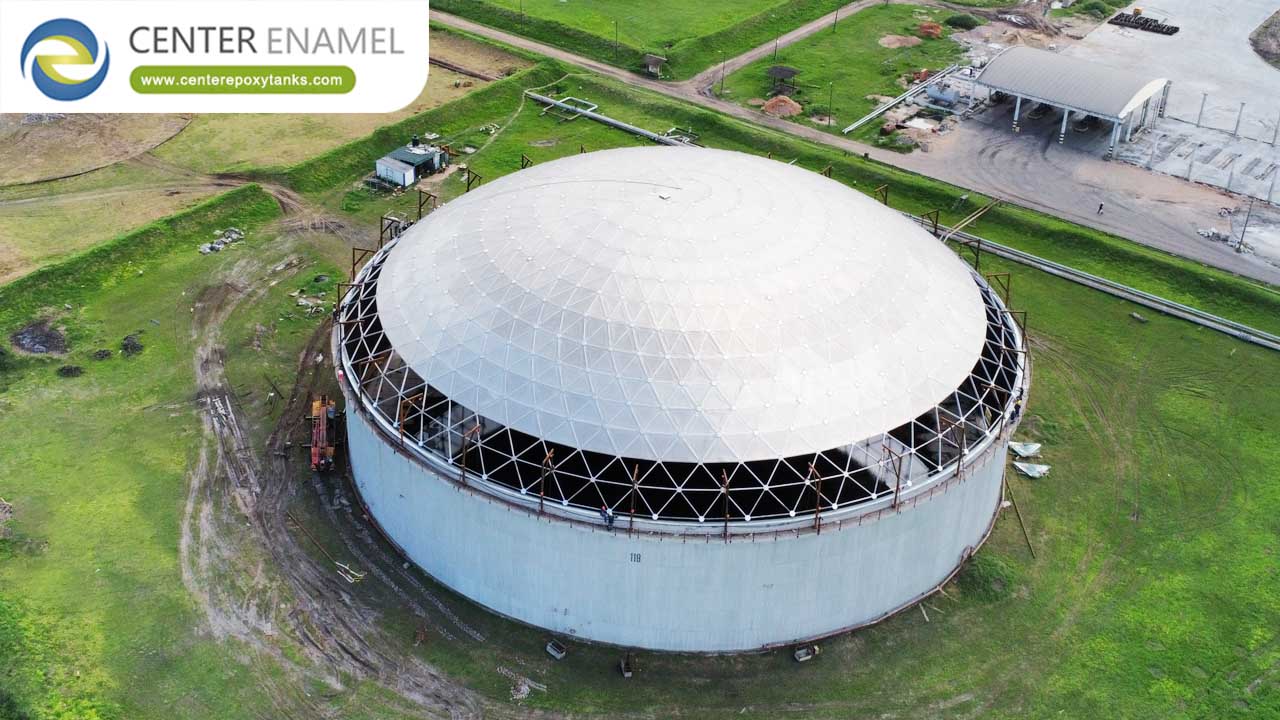
External Floating Roofs for Gas Storage Tanks: Engineering for VOC Mitigation and Safety
External Floating Roof (EFR) systems are high-performance containment solutions for large-diameter storage tanks, primarily governed by API 650 Appendix C. Unlike fixed-roof tanks, an EFR floats directly on the liquid surface, eliminating the vapor space (ullage) where volatile gases accumulate. As a global leading manufacturer, Center Enamel delivers engineered pontoon-type and double-deck floating roofs that utilize advanced primary and secondary rim seals to reduce Volatile Organic Compound (VOC) emissions by over 98%, significantly enhancing fire safety and environmental compliance.
1. Technical Specification & Buoyancy Matrix
Feature | Technical Specification (2026 Standard) | Strategic Utility Value |
Design Standard | API 650 Appendix C | Global benchmark for floating roof structural safety. |
Roof Type | Pontoon / Double-Deck | Provides high buoyancy and structural rigidity. |
Seal Type | Mechanical Shoe / Liquid-Mounted / Secondary | Minimizes rim losses and VOC leakage. |
Material | High-Strength Carbon Steel / Aluminum | Optimized weight-to-buoyancy ratio. |
Emission Control | 98%+ Reduction in VOCs | Meets stringent ESG and air quality regulations. |
Drainage System | Flexible Pipe / Articulated Joint | Prevents roof sinking during heavy precipitation. |
2. Structural Engineering: The Mechanics of Floating Containment
Buoyancy and Deck Design
The integrity of an EFR relies on its ability to remain buoyant under extreme environmental loads (rain, snow, or wind).
● Pontoon-Type Roofs: These feature a peripheral ring of compartments (pontoons) that provide the necessary buoyancy. The center deck is a single plate designed to flex with temperature changes while remaining in contact with the product.
● Double-Deck Roofs: These provide superior structural rigidity and insulation. The air space between the two decks acts as a thermal barrier, preventing product "boiling" and significantly reducing temperature-induced vapor pressure.
The Primary and Secondary Seal Interface
The "rim space" between the floating roof and the tank shell is the most critical point for gas escape.
● Rim Seal Engineering: Center Enamel utilizes advanced sealing systems, including Mechanical Shoe Seals for durability and Secondary Wipe Seals for maximum emission control. This dual-barrier approach ensures that even if the primary seal is compromised, the secondary seal maintains a gas-tight interface.
3. Strategic Applications in Volatile Fluid Management
● Petroleum Terminals: Ideal for crude oil and refined products with high vapor pressure, such as gasoline and jet fuel.
● Petrochemical Feedstock: Managing volatile chemicals where product purity and loss prevention are economically critical.
● Large-Diameter Storage: Specifically suited for tanks exceeding 20m in diameter where fixed-roof structures become structurally inefficient.
4. Why Partner with Center Enamel?
As a Global Leading Storage Solutions Provider, Shijiazhuang Zhengzhong Technology Co., Ltd offers a unique technological advantage:
● 30-Year EPC Excellence: We provide a single point of accountability—from initial Finite Element Analysis (FEA) for buoyancy stability to on-site commissioning.
● Precision Modular Fabrication: Our 150,000 m2 facility utilizes automated CNC lines, ensuring every pontoon and deck plate fits with sub-millimeter accuracy for reliable field assembly.
● Multi-Tank Integration: Whether your project utilizes Glass-Fused-to-Steel (GFS), Fusion Bonded Epoxy (FBE), or Stainless Steel tanks, our roofs are engineered for seamless mechanical integration.
● Global Compliance Mastery: Our engineering team ensures all EFR designs meet API 650 and local environmental codes, facilitating insurance approvals and regulatory compliance.
5. Technical FAQ: External Floating Roof Strategy
Q: How does the roof handle heavy rainfall?
A: Every EFR is equipped with a high-capacity drainage system, utilizing either articulated joints or flexible hoses, ensuring that rainwater is channeled off the roof without contaminating the stored product or compromising buoyancy.
Q: Can these roofs be retrofitted into existing tanks?
A: Yes. We specialize in retrofitting EFRs into existing fixed-roof tanks (converting them into Internal Floating Roof tanks) or replacing aged external roofs to meet modern emission standards.
Q: What is the expected maintenance cycle?
A: With high-grade materials and corrosion-resistant coatings, our EFRs are designed for a 30+ year lifespan. Maintenance primarily involves periodic inspection of the rim seals and drainage systems.


