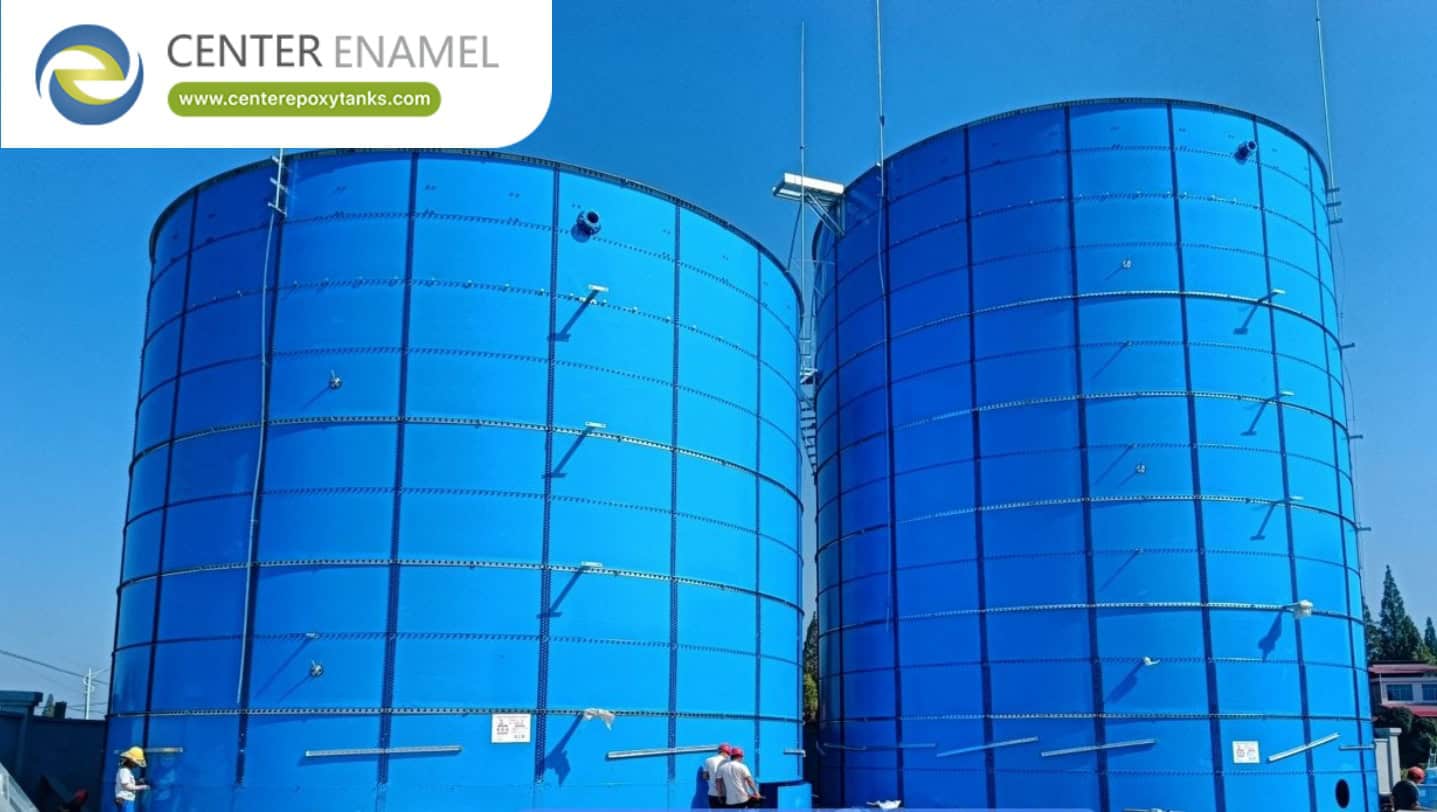
Epoxy Coated Steel Tanks for Sewage Treatment: Engineering & Procurement Guide
In the modern sewage and wastewater treatment industry, the containment infrastructure must withstand highly aggressive chemical environments, including hydrogen sulfide (H₂S) gas, sulfuric acid, and abrasive solids. Epoxy Coated Steel Bolted Tanks—utilizing advanced Fusion Bonded Epoxy (FBE) technology—have emerged as a high-performance alternative to traditional concrete or welded steel tanks. By offering a chemically inert barrier, rapid modular installation, and lower total lifecycle costs, these tanks represent the standard for efficient, sustainable sewage management.
1. The Engineering Challenge: Corrosive Environments
Sewage treatment processes generate hazardous by-products that rapidly degrade standard containment materials:
● Acidic Attack: Microorganisms in sewage convert H₂S gas into sulfuric acid, which is notorious for corroding untreated concrete and standard steel.
● Abrasive Solids: Grit, sand, and heavy sludge constantly scour the interior surfaces of aeration and settling tanks.
● Chemical Variability: Sewage often contains industrial runoff, detergents, and cleaning agents that require a tank interior with high chemical resistance.
2. The Fusion Bonded Epoxy (FBE) Advantage
Unlike liquid-applied coatings that are susceptible to peeling or bubbling, FBE is a thermosetting resin that is thermally fused to steel panels in a factory-controlled environment.
● Pinhole-Free Integrity: Using high-voltage "holiday testing" during the manufacturing process ensures a 100% defect-free surface, preventing corrosive leakage.
● Superior Adhesion: The FBE-steel bond is molecularly permanent, providing a barrier that resists mechanical impacts, thermal expansion, and osmotic blistering.
● Surface Smoothness: The ultra-smooth epoxy surface prevents the accumulation of sludge, fat, oil, and grease (FOG), ensuring that bioreactors and equalization tanks remain hygienic and efficient.
3. Comparison Matrix: Sewage Containment Solutions
Feature | Epoxy Coated Bolted Steel | Conventional Concrete | Welded Carbon Steel |
Chemical Immunity | Superior (Inert Polymer) | Low (Subject to Acid Etch) | Low (Needs frequent painting) |
Installation Speed | Fast (Modular Panels) | Slow (Weeks of curing) | Moderate |
Scalability | Easy (Add panels) | None | None |
Maintenance | Minimal | High (Crack sealing) | High (Recoating) |
Seismic Resilience | High | Variable | Moderate |
4. Key Procurement Benchmarks for Wastewater Assets
To ensure long-term reliability in sewage treatment applications, verify that your manufacturer meets the following industrial benchmarks:
1. Holiday Test Verification: Ensure every panel is tested at the factory (typically 1100V–1500V) to confirm the integrity of the epoxy barrier.
2. Structural Compliance: Tanks should be designed in accordance with AWWA D103-19 or ISO 28765 standards.
3. Chemical Resistance Documentation: Request empirical data on the coating's performance against H₂S and sulfuric acid exposure at specific operating temperatures.
4. Modular Flexibility: Prioritize manufacturers who offer bolt-together designs, which allow for future capacity expansion or even relocation of the treatment facility if urban planning needs change.
5. Frequently Asked Questions (FAQ)
Q: Why choose epoxy coated steel over glass-fused-to-steel (GFS) for sewage?
A: Both are excellent choices. GFS offers the ultimate chemical inertness for extreme environments, while epoxy coated steel often provides a more cost-effective solution for standard sewage treatment applications where balanced chemical resistance and high impact strength are prioritized.
Q: Can these tanks be used for aerobic and anaerobic treatment stages?
A: Yes. Because the epoxy surface is impermeable to gases and liquids, these tanks are equally effective for aeration basins, anaerobic digesters, and sludge thickening tanks.
Q: Is onsite finishing required?
A: No. A major benefit of bolted steel technology is that all coatings are applied in the factory. This eliminates the environmental risks and weather-related delays associated with onsite painting, ensuring a uniform, defect-free finish.
Are you currently in the design phase for a new sewage treatment plant, or are you looking to retrofit existing infrastructure to improve efficiency and reduce maintenance costs?


